Gold records best week since 2008 as Greenland crisis rattles dollar
Unlock the White House Watch newsletter for free
Your guide to what Trump’s second term means for Washington, business and the world
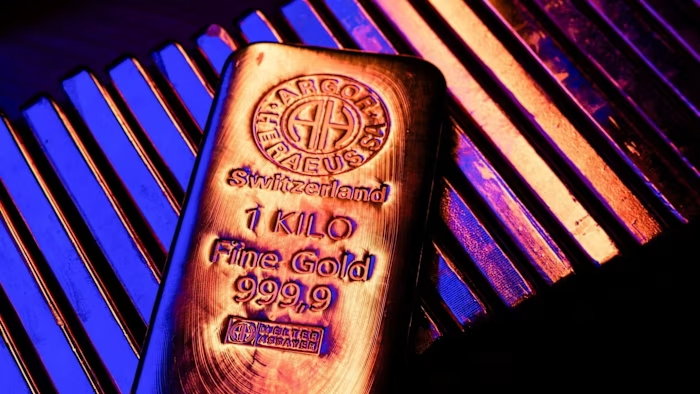
Gold recorded its best week in nearly 20 years and the dollar its worst since May, after the Greenland crisis sent investors looking for safe alternatives to the US currency amid renewed concerns over erratic White House policymaking.
The precious metal hit a record high of almost $5,000 a troy ounce on Friday, while silver rose above $100 an ounce for the first time.
“The world is hedging against continued uncertainty,” said analyst Rhona O’Connell at StoneX. “In the febrile times, gold is maintaining its role as the asset of last resort.”
US President Donald Trump’s threat to hit European allies with tariffs if they resisted his demands for control over Greenland caused a sharp Wall Street sell-off earlier this week, before his abrupt reversal on Wednesday saw stocks rebound.
But the US dollar has struggled to make up the ground lost, with an index of the currency against peers including the pound and the euro down 1.9 per cent this week, after further declines on Friday.
Gold has risen more than 8 per cent, its biggest weekly price gain since the global financial crisis in 2008. Dollar weakness itself can boost gold and silver by making the dollar-denominated metals cheaper to buy in other currencies.
The week’s gains cap a historic bullion rally over the past two years, driven by a surge of investor interest as well as buying by central banks seeking to diversify away from the dollar.
Trump’s tariff threats over Greenland came after the US’s ousting of Venezuela’s strongman leader Nicolás Maduro and the Department of Justice launching a criminal probe into Federal Reserve chair Jay Powell.
The events had caused “a bit of a change of mindset” on the dollar among investors, said Seema Shah, chief global strategist at Principal Asset Management.
“There is a little bit of damage being done on the sidelines, throughout all of the various dramas that happen,” she said. “It probably adds to that narrative around diversification [away from US assets].”
The Greenland crisis has reignited concerns about the political risks of US assets — for a long time a safe harbour for global capital — that helped drive a 9 per cent decline in the US dollar last year in its steepest drop since 2017.
Investors have described the US threats against its Nato allies as further “chipping away” at the institutional credibility of the world’s dominant asset market, mixing with concerns over White House attacks on the Fed.
Earlier this week US stocks, bonds and the dollar fell in unison in an echo of the “Sell America” trade triggered by Trump’s tariff barrage last April.

The Swiss franc, another longtime haven in FX markets, has risen 2.8 per cent against the dollar this week, its best showing since last April, according to LSEG. The euro rose nearly 2 per cent this week, to a high of $1.18.
“That policy credibility, or at least the policy reliability, has faded a little bit,” said Principal’s Shah. “I think the forecast for dollar depreciation has probably been strengthened.”
Wall Street had been expecting further dollar weakness this year as the Fed continues to cut interest rates while other big central banks are expected to be on hold, and as global investors continue to hedge their holdings of US assets against swings in the dollar.
This hedging activity itself mechanically pushes down on the dollar’s value.
But Peter Schaffrik, global macro strategist at RBC Capital Markets, said the uncertainty caused by Trump’s Greenland threats had added to the argument for investors to hedge their dollar exposure.
“What we’re seeing now is why that requirement [to hedge] is there, because these things can just out-of-the-blue happen,” Schaffrik said. “Who can guarantee that it doesn’t turn on the same dime tomorrow?”
Data visualisation by Ray Douglas