Gilts sell off after Bank of England warns of inflation risks
The Bank of England has warned that a prolonged energy shock from the Middle East war will drive up inflation, opening the door to higher interest rates and deepening a brutal sell-off in the gilt market.
In a sign of how radically the war has reshaped the challenge facing rate-setters, the Monetary Policy Committee on Thursday said that a severe energy shock could feed into wages and prices across the economy.
The MPC voted unanimously to hold interest rates at 3.75 per cent at its first meeting since the US and Israel attacked Iran last month, triggering a surge in global energy prices.
Two-year giltswhich track rate expectations, were hit particularly hard, with yields soaring 0.3 percentage points to 4.4 per cent, making it one of the worst days for short-dated UK government bonds in recent years.
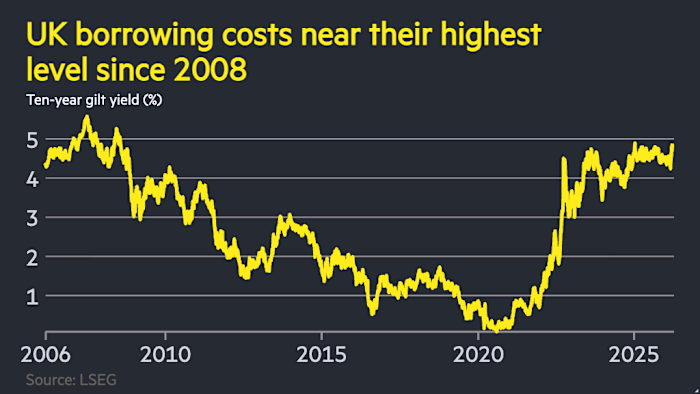
The 10-year yield was up 0.11 percentage points at 4.85 per cent, close to its highest level since 2008. Yields rise as prices fall. The pound jumped 0.9 per cent against the dollar by late afternoon in London.
The BoE’s hawkish shift has “opened the floodgates for markets to price in more rate hikes”, said James Smith, developed markets economist at ING.
Some investors questioned whether the BoE had unnerved markets by sounding too strong a warning over inflation.
“If the intention of the bank was to scare markets into raising the cost of finance for UK plc, they could hardly have done a better job,” said David Roberts, head of fixed income at Nedgroup Investments.
The decision came hours after a wave of attacks on energy facilities in Iran and across the Gulf sent oil and gas prices sharply higherwith Brent crude briefly touching $119 a barrel.
Should the surge in energy prices prove “larger or more protracted”, the MPC said, it could feed through to wages and require tighter monetary policy.
The assessment prompted traders to increase their bets on interest rate rises this year, with markets now pricing in at least two quarter-point rises and a small chance of a third.
“The market wanted to hear a lot more reassurance on looking through this as a transitory shock,” said Gordon Shannon, a fund manager at TwentyFour Asset Management. “The warnings on inflation make hikes seem much more real.”
Speaking to broadcasters after the decision was announced, BoE governor Andrew Bailey stressed that the “appropriate thing” was to hold rates at this point. “I would caution against reaching any strong conclusions about us raising interest rates,” he said. Gilt yields drifted down from their intraday highs following his statement.
Speaking later on LBC Radio, Bailey confirmed that “the message had changed” as a result of the energy price shock, but again offered a more dovish slant than that of the MPC’s minutes.
Cuts in rates were “not on the horizon” any more, he said, but added: “I’m not going to go beyond that because it’s very uncertain . . . We will do what we need to do to maintain price stability.”
He also drew attention to a recent softening of the labour market and economic conditions, saying: “That’s important because it means the context we’re seeing this happening in is a very different context from a few years ago . . . There is somewhat of a weakening in demand, interest rates are higher, so those things come into the picture.”
Before the war started, traders had expected the MPC to cut rates at its March meeting, with policymakers having forecast that inflation would return to its 2 per cent target in the second quarter.
The energy shock has raised the stakes for the MPC, which must now balance the renewed risk of inflation with lacklustre economic growth.
The MPC’s move to put the brakes on further rate cuts comes a day after Federal Reserve chair Jay Powell said the soaring energy prices would boost inflation as the US central bank kept borrowing costs unchanged.
The BoE was previously expecting UK inflation to subside to 2.1 per cent in the second quarter, but it now predicts CPI growth of 3 per cent. Inflation could accelerate to 3.5 per cent in the third quarter, well above its 2 per cent target, the BoE added.
A prime risk is that higher energy and food prices feed through into inflation expectations, triggering “second-round effects” in wages and corporate price setting.
“Households and businesses could have a heightened sensitivity to any new inflationary shock, following successive negative supply shocks in recent times,” the MPC said. “This could lead to self-perpetuating behaviour in wage and price dynamics, which could embed domestic inflationary pressures.”
In a sign of the shift in the mood on the MPC, Swati Dhingra, previously one of the most dovish members, said at the meeting that if there are “severe or long-lasting” constraints on oil and gas and broader trade disruptions, she may be forced to hold rates or even vote for an increase.
She stressed she was also willing to resume rate reductions if the inflation risk recedes, arguing in favour of “pausing” for the time being.
Sarah Breeden, a BoE deputy governor, said she was previously expecting to vote for a quarter-point rate cut but the Iran conflict had forced her to reconsider.
“Monetary policy cannot influence global energy and commodity prices, but it can and it must aim to ensure that the economic adjustment to them occurs in a way that achieves the 2 per cent target sustainably,” she said.
“How that adjustment occurs is hugely uncertain, with risks to both sides.”