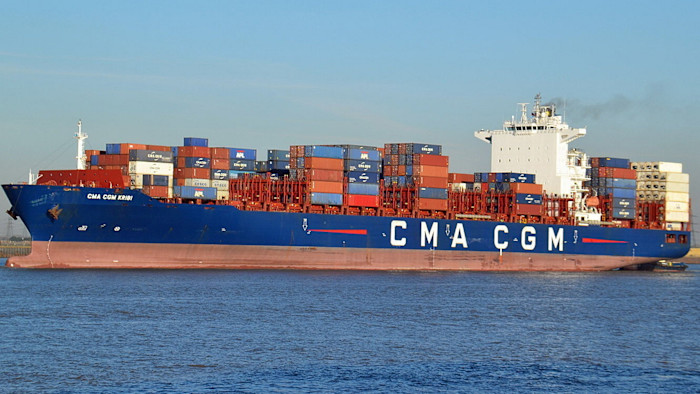
French-owned container ship and three Omani tankers pass through Strait of Hormuz
Unlock the Editor’s Digest for free
Roula Khalaf, Editor of the FT, selects her favourite stories in this weekly newsletter.
A French-owned container ship and three Oman-linked tankers have successfully left the Gulf through the Strait of Hormuz, as vessels trickle through the contested waterway.
The container ship owned by France’s CMA CGM is the first vessel owned by a major western shipping line known to have made safe passage since the US-Israeli war against Iran began five weeks ago.
The Malta-flagged CMA CGM Kribi switched on its transponder off the coast of Dubai on March 28 and on Thursday afternoon transited the strait laden with cargo, according to ship-tracking data from MarineTraffic.
The vessel passed around Larak Island close to the coast of Iran, using a route that has become common for ships making the transit and which has become part of a system used by Iran to visually verify crossings, according to maritime executives and analysts.
The three Omani ships passed through the strait without taking the northern route next to the Iranian island, the first cargo vessels in almost three weeks to do so, the analysts said.
One of the vessels, the Sohar LNG, co-owned by Japanese shipping line Mitsui OSK, became the first LNG carrier to exit the Gulf since the war began.
“What this shows is that the Strait of Hormuz is potentially open to select ships and countries that can strike a deal with Iran,” said Martin Kelly, head of advisory at maritime intelligence group EOS Risk.
“It seems Iran is officially implementing a procedure for ships to exit the strait and it’s largely around [denying] the US [transits].”
The Strait of Hormuz, a strategic waterway through which roughly a fifth of the world’s oil flowed before the outbreak of war, has become a key point of contention during attempts to negotiate an end to the war.
Tehran has retaliated against the US-Israeli assault by targeting US allies in the Gulf, including ships and ports, bringing traffic through the chokepoint to a near-halt and causing oil prices to rise sharply.
The number of ships passing through the strait has increased slightly in the past week, with 53 transits, compared with 36 transits the week before, according to Lloyd’s List Intelligence data.
Iranian state media reported earlier this week that Iranian officials were developing a “protocol” to oversee transit through the strait.
French group CMA CGM, the world’s third largest container shipping line, is owned by the Franco-Lebanese billionaire Rodolphe Saadé. He has a close relationship with French President Emmanuel Macron, and CMA CGM has an extensive presence in the Middle East, including in ports and logistics. The company has a further 13 container ships stuck at the Gulf end of the strait.
During previous crises in the Middle East, France has provided CMA CGM with naval escorts, such as in the Red Sea when Houthi rebels were attacking vessels in 2024. Saadé told the FT at the time that the French government was “helping them a lot”.
France’s Élysée Palace did not immediately respond to a request for comment, while the foreign ministry declined to say if France had played a role in facilitating the passage of the Kribi.
The country does not have naval assets at present near the strait, although Macron has sent ships, fighter jets and an aircraft carrier to the eastern Mediterranean to protect French interests and those of its Gulf allies.
Iran has signalled that it is willing to negotiate safe passage through the Strait of Hormuz for countries that it considers allies.
Pakistan last Saturday claimed to have struck a deal with Iran to allow 20 more ships sailing under its flag to pass through the strait, though analysts have cast doubt on that figure.
Last week, at least two container vessels linked to Chinese state-owned shipping group Cosco successfully transited the waterway.
Under pressure from the US, the UK hosted a conference on Thursday, bringing together dozens of countries that may be willing to contribute resources to re-establishing free navigation in the strait.
Macron said France could take part in such missions but only once the fighting ended, adding that it was “unrealistic” to think the strait could be reopened through military means alone, so negotiations would be needed with Iran.
“There are those who advocate for the liberation of the Strait of Hormuz by force through a military operation, a position sometimes expressed by the United States,” Macron said on Thursday during a visit to South Korea. “I say sometimes because it has varied, it is never the option we have chosen, and we consider it unrealistic.”
CMA CGM’s Kribi kept its transponder on throughout its journey through the strait. At the beginning of the war, many ships turned off automated tracking systems in an apparent attempt to avoid being attacked by Iran. It is unclear how many vessels continue to make so-called “dark” transits of the waterway.
CMA CGM declined to comment on how it was able to get its container ship out.
The Kribi was approaching Muscat on Friday at noon local time and was signalling “OWNER FRANCE” in its Automatic Identification System transmissions.
Additional reporting by Harry Dempsey in Tokyo