Fraud Is Only The Tip Of Retail’s $850 Billion Returns Challenge
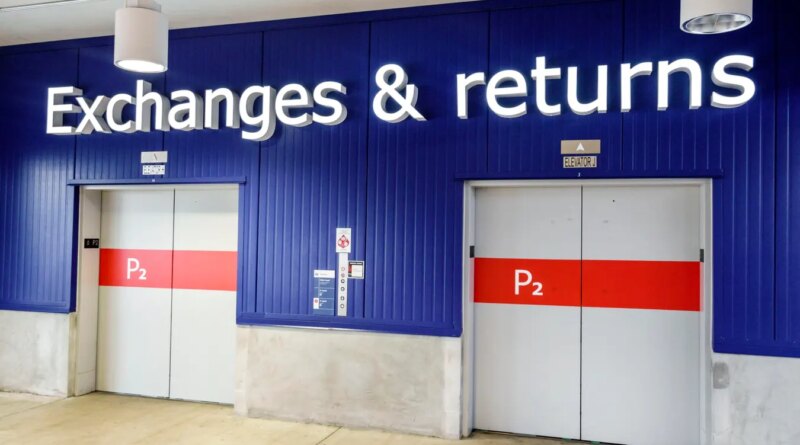
Miami, Doral, IKEA exchange and returns elevators. (Photo by: Jeffrey Greenberg/Universal Images Group via Getty Images)
Universal Images Group via Getty Images
Returns have become an intractable problem for retailers—one that exploded with the rise of e-commerce and has been compounded by a dramatic increase in fraudulent returns.
In 2020, when consumers were pushed to shop online after pandemic store closures, return volume totaled $428 billionwith an estimated 6% of those returns fraudulent. By 2025, returns value surged to $850 billion, while fraudulent returns tripled, rising from $25 million to $76.5 billion, or to about 9% of returns, according to the National Retail Federation.
And those fraud numbers are a best guess. The actual value may be much higher. After all, thieves are cunning and constantly adapt. “One of the challenges with fraud is it’s a kind of game of Whack-A-Mole,” said David Sobieco-founder and CEO of Happy Returns, which partnered with NRF in the 2025 returns report.
However, fraud may be the most visible part of the returns problem, but it’s only the tip of the $850 billion iceberg—one that cuts across every retail operation and requires cross-functional leadership to untangle the scale and complexity of customer returns.
Types Of Fraud
Fraudulent returns are defined as “when a customer purposefully exploits a retailer’s return process. At its core, the goal of return fraud is to obtain something without paying what is owed to the retailer.”
In 2025, retailers reported that the most prevalent returns they tracked in descending order were:
- Returns with an overstated quantity of items
- Decoy returns where a similar-looking item, such as a counterfeit, is substituted for the real thing
- Price switching, substituting a cheaper for a more expensive product
- Return label tampering
- Empty boxes or so called “box of rocks”
- No-proof returns.
In addition, among the 250 large e-commerce retailers ($500+ million revenues) surveyed in 2024, retailers reported increased levels of employees participating in return fraud and/or colluding with outside bad actors (59%), returns made by organized retail crime groups (59%), wardrobing where a worn item is returned (56%), merchandise returned after being purchased with stolen tender (55%), counterfeit receipt returns (55%) and returns of shoplifted/stolen merchandise (54%).
Even more surprising, otherwise honorable shoppers admitted to stretching the rules. Among 2,000 online shoppers surveyed by NRF/Happy Returns in 2024, nearly half (47%) said they’d returned items with the tags removed, 32% returned a worn item and 25% returned a different item than indicated or intended. Younger Gen Z and Millennials consumers are the most likely to break the rules.
Bracketing Blurs The Line
The common practice of bracketing—buying multiple items (styles, colors, sizes) with the intent to return some—may not be fraudulent per se, but it can obscure the line between legitimate returns and exploitation of the returns process.
Bracketing is also a practice more widespread among Gen Z consumers, with more than half saying they sometimes or always (14%) bracket. This compares to 36% of Gen X and 24% of Boomers engaged in bracketing.
While bracketing is thought to be an issue more common among fashion retailers, nearly one in four (23%) of all the 350 large e-commerce retailers surveyed in 2025 reported that purchases included a bracketed item. That figure rose to only 26% in the apparel and footwear categories.
Among the strategies retailers are using to discourage bracketing include adding more consumer reviews (42%), providing more detailed sizing information (41%), calling out items with low return rates (38%), model sizing and fit commentary (37%), recommended sizing tool, such as an AI fit tool (36%), cart or checkout reminders of return policies (36%), incentivizing exchanges over returns (36%) and charging for return shipping (33%).
Nonetheless, 45% of shoppers said it’s “fine to bend the rules when making a return,” and bracketing has become so ingrained in consumer purchasing behavior that it’s hard to see how retailers can effectively turn the tide.
Losses On Top Of Losses
It’s also difficult to grasp what $850 billion in returns—16% of total retail annual sales—means to the retail industry. And it’s more shocking to realize that nearly one out of every ten retail returns is fraudulent, resulting in a total loss. And for the 91% of legitimate returns, the costs add up along the reverse logistics chain with many of them hidden from view. Even the fraudulent returns have to be processed.
Returns expert Sender Shamiss, CEO of reverse logistics provider ReturnPro— which supports the nation’s largest retailer, Walmart, in returns processing—estimates retailers have some $200 billion annually tied up in supply-chain returns processing.
But that may underestimate the problem if every step in the returns process is accounted for, including shipping and transportation costs for inbound returns, reverse logistics moves within or outside the company, and the labor-intensive process of opening, inspecting, and sorting returns.
For resalable returns, added costs must be factored in for repackaging, cleaning, refurbishing and deciding whether to restock on the company’s shelves or ship them off to a third-party reseller.
Returns ultimately disrupt inventory management, tie up working capital and require personnel attention that would better serve corporate goals if directed to processing new orders, rather than handling returns.
Shamiss reports that retailers are lucky if they can recover about 10 to 15 cents on the dollar for returned merchandise.
“Looking at that $850 billion in total returns, if a retailer took everything they got as a return and just threw it into the garbage unopened, they’d be financially better off, considering the added $200 billion in supply chain costs,” he quipped. “But that isn’t feasible or environmentally responsible.”
Tackling The Returns Conundrum
While the 9% of returns that are clearly fraudulent is a growing challenge that retailers, along with the National Retail Federation, continue to battle, retailers have more leverage and greater opportunity in addressing the 91% of the $850 billion in returns that are legitimate.
“With the fraud problem, you don’t want to be suspicious of every customer coming in,” Shamiss warns, noting that 71% of the 1,000 consumers surveyed by ReturnPro in December said a poor returns experience makes them less likely to shop with a retailer again. The NRF/Happy Returns survey found an identical share of customers inclined to abandon a retailer after a bad returns experience.
Engage Consumers
The ReturnPro survey uncovers a meaningful way to make a difference: engage consumers before returns ever happen. Education is the key. Consumers are largely unaware of what happens to returns, assuming returned items are simply put back on the shelf to be sold again.
In reality, that is rarely the case. More than 80% of returned items can’t be restocked immediately. They must first be inspected, tested, refurbished or repaired—if they can be resold at all. Those that can’t are likely to end up in a landfill, an environmentally unsustainable choice that benefits neither retailers nor consumers.
ReturnPro recommends that retailers disclose return outcomes, including the percentage of items resold, refurbished, recycled, or responsibly discarded, so that consumers understand the post-return journey. Retailers should also make recommerce and recovery programs visible across product pages, return portals and post-purchase communications.
Notably, 85% of consumers would consider buying open-box, refurbished or previously returned items at a discount if given the opportunity. “Retailers that invest in recovery, refurbishment, resale and clear communication stand to capture incremental margin, stronger loyalty and deeper trust,” the company stated.
Appoint A Returns Czar
Returns impact virtually every aspect of retail operations, including the sales floor, customer service, marketing, merchandising and finance, yet management of the returns function typically is assigned to the supply chain or logistics department, though some large-scale retailers have a dedicated reverse logistics team.
However, returns can’t be siloed in the supply chain or even in a reverse logistics department. Returns touch too many vital parts of the business. A more unified, cross-functional approach is needed to reduce return rates, improve backend efficiency, protect margins, and strengthen customer relationships.
“Returns cross every single department within the enterprise and because of that, brands need a ‘czar of returns,’ who can become an evangelist within the organization and bring all the disparate groups together,” Shamiss said.
Results Will Show
On a positive note, retail returns dropped from $890 billion in 2024 to $850 billion in 2025—a not insignifant 4.5% decline. But Shamiss believes it was a temporary blip and that the return volumes will continue to increase. “As e-commerce grows, the number will go up, not down.”
That’s why he stresses that retailers must act proactively, not defensively to address returns. Consumers ultimately demand it.
“Consumers have moved faster than retail systems have evolved. They shop fluidly across channels. They expect flexibility without friction. They hedge when confidence is low. And perhaps most strikingly, they assume that returns are handled responsibly and given a second life, even when that isn’t always the case. That assumption shapes how confidently they buy, how loyal they remain, and how forgiving they are when something goes wrong,” he stated.
“Returns now sit at the intersection of customer experience, margin protection, sustainability credibility, and brand trust. They are no longer a back-office function or a defensive necessity. They are a visible signal of whether a retailer understands and respects how modern consumers behave.”