Carney confirms: When Washington whistles, Ottawa salutes
True leadership is measured by action, not words.
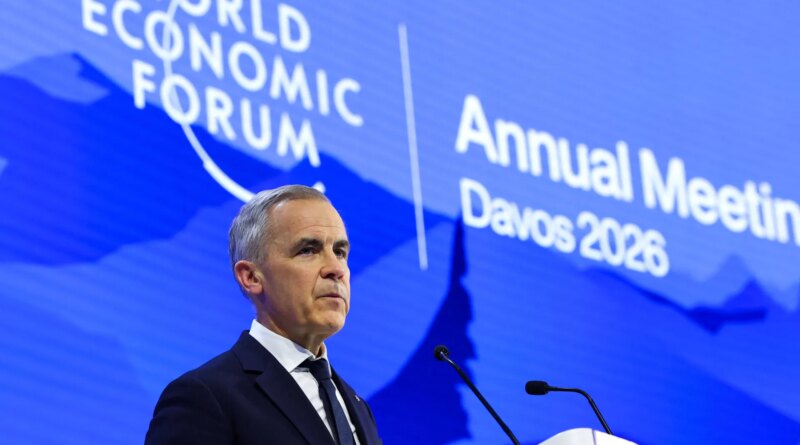
Recently, Canadian Prime Minister Mark Carney struck the tone of a thoughtful statesman at the annual gathering of the World Economic Forum in Davos, Switzerland.
His January speech was greeted with the sort of reverent approval reserved for leaders who sound serious about global responsibility.
Carney’s appearance at Davos was also meant, I suspect, to signal that Canada would be a modest, moderating force in a chaotic, tumultuous world.
He warned of the perils of geopolitical brinkmanship. He spoke about restraint. He urged the world’s most powerful governments to resist the easy seduction of reckless escalation.
Only weeks later, Carney’s address reads less like a statement of principle and conviction and more like a cynical, disposable work of bad fiction.
In a predictable volte-face, Carney has backed an illegal war that he had implied prudent powers should avoid launching.
The war on Iran — being prosecuted by an emboldened American president and an Israeli prime minister allergic to nuance, diplomacy, and restraint — bears all the blatant trademarks of the impulsive thinking Carney claimed to mistrust.
The flimsy construct that Canada’s prime minister is the nascent guardian of measured statecraft dissolved instantly after he confirmed that, like many of his compliant predecessors, when Washington whistles, Ottawa salutes.
The old, familiar instinct remains comfortably intact.
For a leader who entered politics with a reputation for sober analysis — forged during his time at the Bank of Canada and the Bank of England — this defining moment reveals an instructive lack of foresight and introspection.
Carney’s admirers portrayed him as a corrective to the ideological reflexes of his petulant Conservative opponent — a technocrat who would replace slogans with evidence and rashness with deliberation.
Yet the decision to support this abyssal war exposes how ephemeral that divide really is.
Carney has now established that he is not a serious antidote to the politics of expediency that he promised to transcend.
He is simply its more articulate custodian.
Delivering pleasing speeches is easy.
Challenging a war championed by an imperious president is, it turns out, much harder.
Wars often begin with lofty rhetoric about security and stability. Anyone with even a passing appreciation of the lethal historical record ought to know that they never unfold so neatly.
War always produces euphemisms — “collateral damage”, “unintended casualties” — but the halting reality behind those antiseptic phrases is simple. Schoolchildren die.
Schoolchildren who had no role in nuclear disputes, regional rivalries or the madness unfolding yet again in the Middle East and beyond.
The killing of 165 Iranian schoolgirls and staff, all victims, reportedly, of a US missile, should compel any government that claims a fidelity to decency and “stability” to stop and think.
Instead, Carney and dutiful company continue to endorse a war whose human consequences are emerging, day after awful day, in heartbreaking detail.
The hypocrisy deepens when one considers the essential character of a president whose war Carney has chosen to embrace.
Canada is abetting an erratic demagogue who has openly contemplated erasing the country’s sovereignty while simultaneously exacting loyalty for his war of choice.
If there is a coherent logic behind this cockeyed posture, it is difficult to discern.
Perhaps the calculation in Ottawa is that loyalty today will purchase goodwill tomorrow.
If so, it reflects a remarkable misreading of United States President Donald Trump’s brass-knuckled political instincts. This is a leader who regards concessions as weakness and obedience as entitlement. Allies who fall in line rarely earn respect; they invite further demands.
Which makes Canada’s deference to Trump not only morally bankrupt but strategically naive.
Refreshingly, not every Western government has been so eager to bow obediently before America’s surly commander-in-chief.
In Madrid, Prime Minister Pedro Sanchez has, in effect, denounced Trump’s war as dangerous folly, arguing, persuasively, that it will broaden regional instability rather than resolve it.
Sanchez understands that wars inevitably trigger profound, disfiguring consequences that extend far further than the specious rationales that allegedly justified them.
On a reliable cue, Trump responded with threats, warning that the US could cut off trade with Spain if Sanchez refused to yield.
The tactic was vintage Trump: intimidation masquerading as diplomacy.
Sanchez did not flinch.
Spain’s decision not to allow US forces to use bases on its soil to level strikes against Iran represents a rare and welcome expression of defiance within NATO.
In televised remarks, Sanchez insisted that Spain would not take part in a war that compromises its values and interests to appease a foreign president.
He framed the decision as an urgent matter of principle: Spain would not be party to more mayhem, more death, more catastrophe.
Pointing to the Iraq war’s grim legacy, he said the international community should avoid repeating those mistakes and the trauma and destruction they caused.
Carney has rejected Sanchez’s wise counsel. He has rejected, as well, the very ideas central to the speech he delivered in Davos earlier this year.
Rather than oppose violence, he has enabled it. Rather than preach reticence, he has abandoned it. Rather than defend another nation’s territorial integrity, he has sanctioned its violation. And rather than value the lives of Iranian schoolgirls, he has treated their deaths as the tragic cost of acquiescence.
In vivid contrast, Sanchez looked at the wreckage of old wars and rebuffed an invitation to join a new one. He vetoed a request to turn Spain into a springboard for grief. He ignored a bully’s threats and demands to capitulate. He said no to war when others said yes.
Carney has opted to follow rather than to lead. He has forfeited conscience in favour of complicity.
In due course, he will be judged harshly for what he did, not for what he said.
The views expressed in this article are the author’s own and do not necessarily reflect Al Jazeera’s editorial stance.