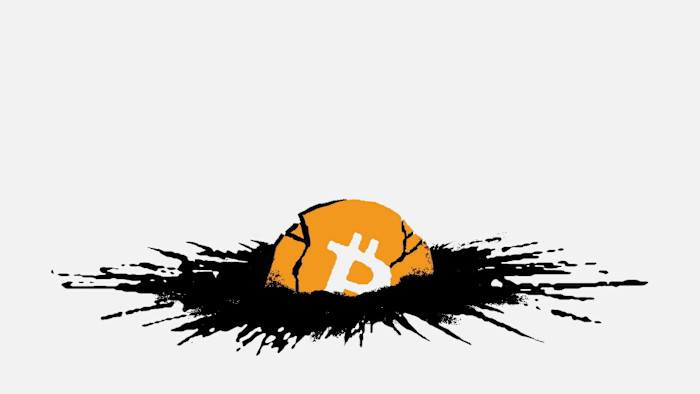
Bitcoin is still about $69,000 too high
Unlock the White House Watch newsletter for free
Your guide to what Trump’s second term means for Washington, business and the world
“It’s the story of a man who is falling from a 50-storey building. At each floor, as he falls, he comforts himself by repeating: So far, so good [so far, so good], so far so good, so far so good.”
So starts the brilliant 1995 French cult classic Hate. Those words, that image, have somehow seared themselves into my consciousness for life. They soothe me when I’m feeling anxious or having imposter worries. They suggest that, given I seem to have got away with it so far, maybe I’ll keep on getting away with it.
And so farthe shills and shamans of bitcoinland have been getting away with it too. Sure, sure, bitcoin might have had a couple of dozen substantial crashes, a few hundred crypto companies might have gone bust, untold numbers of people might have lost their life savings, but every time bitcoin falls, it has always bounced back. Those who can afford it manage to cling on (it’s the people who can’t who are wiped out), and the cognitive muscle memory they acquire on each rebound leads them to believe their hallowed crypto coin is going to live forever.
Allow me to put this sensitively: it is not. Bitcoiners’ excessive confidence — or more precisely the confidence they project, crucial in keeping the whole scheme going — has always been unwarranted, irresponsible and foolhardy. Ever since its creation, bitcoin has been on a journey that will end, splattered on the ground.
This week, that ground came into view, fast. Bitcoin had its worst crash since 2022, falling close to $60,000 at one point on Friday, wiping out all the gains it had made since Donald Trump’s 2024 re-election and marking a fall of more than half since record highs of over $127,000 last October. Some $1.25bn in bitcoin positions were liquidated in just 24 hours from Thursday to Friday, according to data from Coinglass.
The desperation and “cope”, as a bro might say — it implies someone is delusional and struggling to accept a painful truth — are palpable. “I have never been more bullish on crypto,” Balaji Srinivasan, a prominent crypto evangelist and former chief technology officer at crypto exchange Coinbase, posted on X on Thursday. “Because the rules-based order is collapsing and the code-based order is rising. So the short term price doesn’t matter.” He would say that.
Some chose self-abasement over gobbledegook. “If you want to get me a birthday gift, buy some bitcoin for yourself,” posted Michael Saylor, the man who turned his company, Strategy, into an immense all-in bet on bitcoin (it holds more than 713,000 BTC, about 3.4 per cent of the total circulation), on Wednesday. Poor little birthday billionaire.
The next day, during an earnings call for the fourth quarter of 2025 — before the worst of the crash but in which Strategy still managed to post losses of an impressive $12.4bn — Saylor was trying some different persuasion tactics. “I don’t think you can underestimate the importance of having support for the industry and digital capital at the very top of the political structure,” he insisted, pointing out that America has a “bitcoin president” intent on turning it into the “crypto capital of the world”.
But this is where it gets very awkward for cryptoland. Because Saylor is right — America does have the closest it will ever get to a “bitcoin president”, with vested family crypto interests to boot. And yet despite setting up a “strategic bitcoin reserve”, pardoning a load of convicted crypto criminals, allowing Americans to put crypto into their 401(k) pension accounts and claiming to have ended former president Joe Biden’s “war on crypto” in his first 200 days in office, Trump’s presence in the White House has not been able to hold back the tide of selling. If bitcoin can’t thrive in this environment, when can it?
We might not have quite reached bitcoin’s final “death spiral”; I don’t claim to know when that will happen. Trying to work out the end date of a speculative mania based purely on belief — or more specifically on belief in other people’s belief — is a difficult task, and bitcoin might still have a few more hurrahs to come (at the time of writing, it had rebounded to about $69,000).
But the belief is starting to ebb. This week has shown us that the supply of “greater fools” that bitcoin relies on is drying up. The fairy tales that have been keeping crypto afloat are turning out to be just that. People are beginning to wake up to the fact that there is no floor in the value of something based on nothing more than thin air. Ask yourself: is this thing still going to be going in 100 years’ time? And remember that “what really matters isn’t how you fall, it’s how you land”. So far so good, so far so good, so far. . .