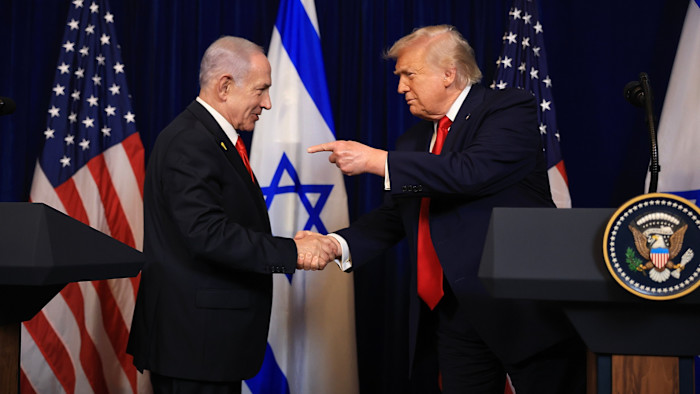
Benjamin Netanyahu’s Iran ‘fixation’ finds its moment in Donald Trump
Even before the talks with Iran began this year, and before US aircraft carriers left for the Middle East, Donald Trump and Benjamin Netanyahu had settled on a central premise: the two allies should prepare for another war with Iran.
When they talked over lunch at Mar-a-Lago in December, the pair even agreed on a tentative date: June, the anniversary of Israel’s 12-day war on Iran last year, according to people briefed on the talks.
Trump wanted to give negotiations with the Iranian regime, something Netanyahu has bitterly opposed, a chance. “He can be very difficult on occasion,” Trump quipped after greeting Netanyahu.
But the US president and Israeli premier made a fateful bargain, according to several people familiar with the discussions, one that eventually propelled the allies down a path to all-out war with Iran.
In a compromise, Trump’s envoys resumed talks with Tehran while Israel and the US military stepped up preparations for “broader combined operations against Iran”, one person familiar with the talks said.
For Netanyahuthe war that ultimately ensued was the culmination of a mission that has defined his decades-long career in politics: to anchor the US in a confrontation with Iran.
“This alliance with the US allows us to do what I have been hoping to do for 40 years: strike the regime squarely in the face,” Netanyahu said from the roof of the Israel Defense Forces headquarters in Tel Aviv at the start of the conflict in February, hours after ordering the killing of Iran’s supreme leader Ayatollah Ali Khamenei.
In retrospect, the slide towards full-scale war against Iran may look almost inevitable after Hamas’s October 7 2023 attack on Israel.
For roughly the past decade, Israel had relied on a military doctrine of the “campaign between wars”, which grew out of a practice glibly dubbed “mowing the lawn”: periodic, intense strikes to degrade enemy capabilities that stopped short of full-blown war.
After October 7, both Netanyahu and the security establishment’s mindset changed. Now, they argued, their enemies must be defeated completely.

Israel, by turns, took on Hamas, Hizbollah and the Houthis, attempting to prise itself from Iran’s “ring of fire”. But for Netanyahu, the final target was almost preordained. Tehran had been his obsession since his first moments in politics, a regional rival that even Israel’s military and intelligence services had only been able to wound.
An early record of Netanyahu advocating that the US go to war with Iran was in 1992, when the then 42-year-old, first-time member of the Israeli parliament spoke up in a debate, according to parliamentary transcripts.
“Iran is racing to develop nuclear weapons,” he said, spelling out what would become his political mantra. “This threat must be uprooted by an international front headed by the US.”
Netanyahu’s prediction — that Iran would obtain the bomb by 1999 — proved dead wrong. But almost 35 years on from the speech, US and Israeli warplanes were flying joint sorties over Iranian skies, dismantling Iran’s military.
“Netanyahu has been singing the song since at least the 1990s that they had to go after Iran,” said John Tierney, who as a Democrat congressman from 1997 to 2015 served on the House intelligence committee.

Washington’s participation was far from inevitable. The US and Iran had sparred for decades — from a 1953 CIA-orchestrated coup against Iran’s democratically elected government to Tehran’s support for militias that killed US military personnel in Lebanon in the 1980s and Iraq in the 2000s — without going to war.
Several US presidents rebuffed Netanyahu’s calls for bolder action, most pointedly Barack Obama, who pursued the 2015 nuclear deal with Iran, known as the Joint Comprehensive Plan of Action, while Netanyahu lobbied US lawmakers to oppose it.
During his first term, Trump imposed tough sanctions, left the JCPOA, which curbed enrichment in exchange for sanctions relief, and killed Qassem Soleimani, a senior Iranian military commander — but did not engage in a broader conflict.
Iran’s relatively muted responses to these actions emboldened Trump. The success of the US military’s limited strikes on Iran’s nuclear sites during last year’s 12-day war, and the US operation to capture Venezuela’s president in January, bolstered his confidence further.
“What changed was that the risks of conflict with Iran were not as high as anticipated — the fact that Israel was able to clear Iran’s air defences in June 2025 surprised the Americans,” said Eyal Hulata, a former Israeli national security adviser. “It changes the calculus for American planners on what was doable and at what cost.”
However, the Trump administration has struggled to present a coherent argument for both the timing and the decision to start a war with Iran.
Secretary of state Marco Rubio provoked a political backlash on March 2 by saying the US had joined the war because Israel had been poised to attack, but Trump has downplayed the suggestion that he was influenced by Israel.
“I was against Iran long before I even thought about Israel being against Iran,” he said this week.

Netanyahu is a veteran of managing US presidents, having bickered with Bill Clinton, insulted Obama, disappointed Joe Biden and advertised a great kinship with Trump. “He’s a master manipulator of American power,” said a US diplomat who has dealt with Netanyahu.
One overriding theme was Netanyahu’s “utter and complete fixation on Iran”, said Tom Nides, a former US ambassador to Israel, a fixation that consumed much of the political bandwidth of the US-Israel relationship.
“I’ve had hundreds of meetings in the situation room about the threat Iran poses to Israel,” he said, pointing out that all recent US presidents agreed with Netanyahu — just not on how to deal with it.
“We would bicker about the time of breakout, about the weaponisation — but no one disagreed that Iran was a threat,” said Nides.
Ehud Olmert, who was Israel’s prime minister between 2006 and 2009, said convincing a US president to take such a portentous decision takes a rare mix: charm, stubbornness and a knack for knowing when flexibility is required.
Olmert lobbied George W Bush to convince the US to join air strikes against a nuclear reactor that Syria had secretly built, saying he thought American involvement “would frighten the Iranians”.
Bush demurred, wanting to give diplomacy a chance. Olmert responded: “President, if you don’t do it, it’s all right, but I’m responsible for Israel’s security, and I’ll do it,” he recalled.
Bush never gave Olmert permission but rushed over a ship full of munitions that Israel would need to defend itself against any Syrian counter-attack, said Olmert. “The weapons all arrived two days before the target date,” he said. “So in his own way, he gave me a green light.”
Negotiations with Trump are far more transactional. After securing Trump’s approval for military preparations to begin, Netanyahu worked to keep the plans on track — or even accelerate the campaign.
Talks were held with Iran, and mediators such as Oman suggested there was progress. But after only a few rounds of discussions, Trump’s envoy Steve Witkoff expressed surprise in media interviews that Iran had not already “capitulated”. Iran came to condemn the talks as a smokescreen for war.
The White House did not dispute the FT’s reporting that the two leaders agreed on drawing up plans for military action against Iran even before negotiations started.
Anna Kelly, a White House spokesperson, said: “Israel has always been a great ally to the United States, and President Trump has a great relationship with Prime Minister Netanyahu.”
She added that the US military continued to “co-ordinate closely” with the Israeli military “as we destroy Iran’s ballistic missile capacity, navy and dreams of possessing a nuclear weapon”, rendering the regime’s outlook “bleaker by the day”.
Netanyahu had always considered US negotiations with Iran a personal betrayal.
On a Shabbat evening in November 2013, Netanyahu was informed that Obama was planning to sign an interim deal with Iran that froze some of its nuclear work in exchange for modest sanctions relief, according to Dennis Ross, a senior Middle East official in the Obama administration.
Ross, who has known the premier since 1989, said he had never seen Netanyahu “as disturbed and shaken”. Perceiving it erroneously as “a loss of will” by Obama, Ross said Netanyahu demanded a phone call, and then embarked on a political campaign to turn Republicans and Democrats in Congress against the deal.
Netanyahu deployed different tactics in 2026, as the indirect US-Iran talks in Oman and Geneva dragged on. In meetings earlier this year, Netanyahu showed Trump intelligence that Iran was preparing to move major parts of its ballistic missiles programme underground, out of reach of conventional munitions, said one person familiar with the meeting.

Then, as Trump grew openly frustrated at the lack of progress, an intelligence coup: a confirmed meeting of Khamenei with his closest aides in a building that could easily be destroyed by Israeli warplanes — providing an opening to jettison negotiations and start the war.
One Israeli diplomat told the FT that in previous encounters with Trump, Israeli officials would bring paper copies of short summaries of intelligence to hand to the US president.
Sometimes, the diplomat said, the Israelis would receive queries from their American counterparts regarding the intel, suggesting to them that it had bubbled up in the US system.
It is not clear what impact this had on Trump’s decision-making. But Michael Oren, a former Israeli ambassador to the US who has worked closely with Netanyahu, said hanging over this war was the calculus of two leaders in search of a legacy.

Netanyahu’s political hero Winston Churchill famously spent weeks over Christmas at the White House after Japan’s attack on Pearl Harbor in 1941, helping Franklin Roosevelt plan the Allied war strategy against Germany.
“Netanyahu is very Churchillian — Churchill is his god, and Churchill started warning about the Nazis in the 1930s,” said Oren, who has written several books on the US-Israeli relationship. “And Iran is Netanyahu’s raison d’être.”
Satellite image visualisation by Steven Bernard