Behind The Genius Ball’s Bid To Democratize Putting Analytics
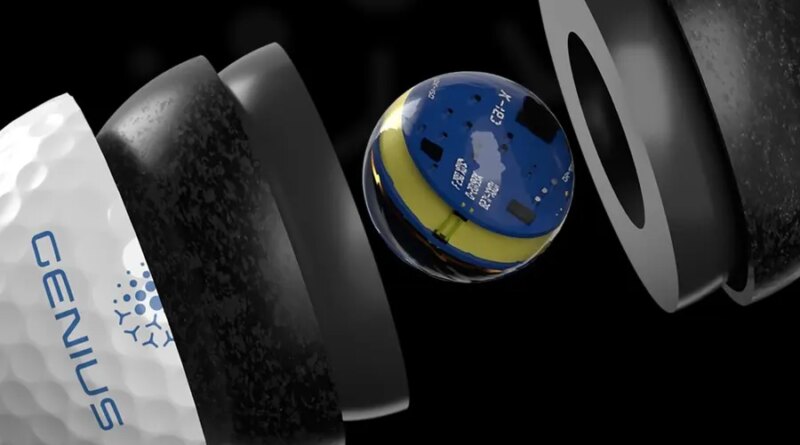
Genius is a smart golf with embedded sensor to detect a host of roll characteristics
Genius Golf
“It takes a lot of time to be a genius,” Gertrude Stein once aptly noted. In the golf industry, quixotic patience may get an idea into the tee box, but capital coupled with engineering discipline is what gives it real loft.
After five years of research and development backed by lead investor Charles Schwab and guided by a brain trust of golf ball designers formerly with Titleist, TaylorMade, Callaway and Srixon, the Genius ball is set to roll on to the market this summer. The smart sphere’s ambitious goal: solve what has long been the last mile of golf analytics by embedding intelligence inside the ball itself.
When launch monitors burst on the golf scene in the early 2000s—adapting military-grade missile-tracking technology to measure ball speed, smash factor, club path and face angle—they instantly gave golfers a trove of hard data that could be applied to game improvement.
Swing mechanics could now be instantly assessed and validated by objective measurement, and clubfitting evolved into a precise, personalized optimization science.
Genius Ball now aims to spark a similarly seismic data-driven shift in putting diagnostics. While the outcome of a putt has always been patently clear—any golfer who has watched one stop painfully short of the cup or lip out at the very last moment knows the feeling—the quality of the roll that produced that result has largely remained invisible.
By placing a series of gyroscopes, accelerometers and magnetometers inside a regulation golf ball, Genius creates a rich three-dimensional picture of what happens from the moment of impact through the final moments of roll. Launch angle, directionality, velocity and deceleration are captured directly (along with the speed of the green), bringing clarity to what remains golf’s most intuitive and feel-based skill.
Before the Genius ball was in play, if you wanted to glean informatics on your putting stroke you could go a golf academy equipped with a Quintic Ball Roll System which uses infrared lighting and a high-speed camera to measure or visit the nearest SAM PuttLab location, the privilege of which could cost a pretty penny.
“Those [systems] are also observation based. Math is universal and you can get some great data but you’re still ultimately observing what happened and then inferring what’s going on. Where we’re different is we’re actually measuring what happened and then bridging the gap to help you understand what to do next,” Mike Jordan, CEO of Genius, a 25-year golf ball engineering veteran, explained.
When that data transmits to the Genius app, users engage with it at varying degrees of complexity. The entry point is ‘Stroke Score’ which Jordan describes as a putting handicap of sorts—except higher scores reflect better performance. The score aggregates key elements of roll quality, including how quickly the ball gets into true roll and how consistently it holds its line, allowing golfers to benchmark themselves against elite-level patterns.
For instructors and more advanced users, the app also offers a launch-monitor-style mode designed to diagnose stroke issues in greater detail. That view includes visual cues such as color coding to flag inefficiencies—for example, excessive skid as a percentage of total roll—along with offering guided drills and instructional videos developed by retired PGA Tour pro Dave Stockton and his putting coach sons to help golfers improve. As changes are made and progress is tracked, those improvements are reflected back into the user’s Stroke Score, creating what Jordan describes as a “living” feedback loop.
The Genius booth drew steady interest from attendees at the 2026 PGA Show.
Genius Golf
That approach reflects a business model designed to extend impactful instruction well beyond elite academies. The product will retail for $240 for a sleeve of three balls, which includes a one-year license to the companion app, with ongoing access expected to cost $120 annually thereafter. It’s a price point that places Genius well below high-end putting studios, while signaling that this is a premium training tool for golfers committed to meaningful improvement.
That accessibility is central to the product’s broader ambition. Genius is less about turning golfers into data analysts than about providing easy-to-digest structure to a part of the game long treated as instinct-driven. Putting, Jordan argues, has remained golf’s great mystery not because it can’t be measured, but because players never knew what to practice or where to begin.
“This is a golf ball,” he said. “You can roll it on the green at your local club, your local muni, you can do it in your hallway—and it’s giving you information to become a better player.” If launch monitors once taught golfers how to swing with purpose, Genius is betting that putting analytics moment has simply been waiting for the intelligence to move inside the ball.