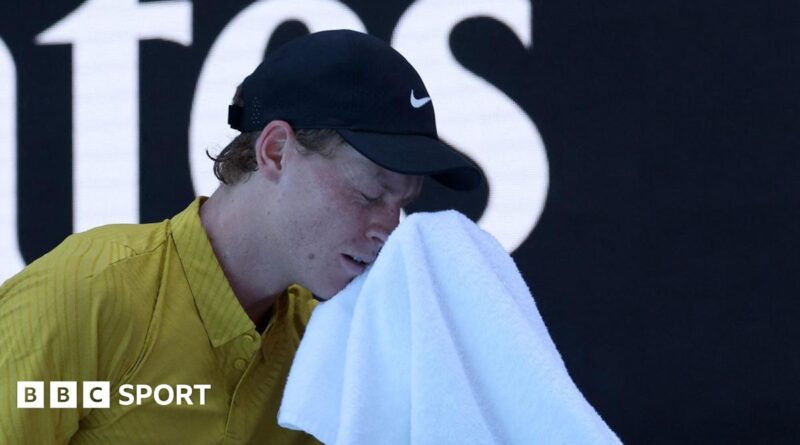
Australian Open 2026: Jannik Sinner thankful for Melbourne heat rule
Play is stopped at the Australian Open when the heat stress scale hits its maximum of five.
The tournament’s heat stress scale measures four factors: radiant heat (or the strength of the sun), air temperature in the shade, relative humidity and wind speed.
Matches on the show courts stop at the end of an even game in order for the roof to be closed and allow the air circulation system to cool the court.
When Sinner and Spizzirri took to court at about 12:30 for the second match on Laver, chair umpire Fergus Murphy reminded the players about the protocols which could be enforced.
At 13:30, the scale read 3.6. By 14:30, it had climbed to five – ticking over from 4.9 seconds after Sinner lost serve.
With the match level at one set all, Sinner could barely walk at the start of the third set and fell a break down at 3-1.
Then came a huge slice of fortune in a moment of sporting theatre.
Seconds after the fourth game, with Sinner looking finished, the Australian Open’s heat stress scale hit five – meaning the top seed was able to go off court for treatment.
It was a pivotal moment in the momentum of the match.
There is no question the heat rule benefitted the red-headed Sinner, who has a history of struggling to cope with the heat and immediately limped to the locker room.
Spizzirri looked bemused as he shook his head. But the rules were implemented correctly.
Sinner broke back immediately after an eight-minute delay while the roof on Rod Laver Arena was closed as per the ruling.
While still moving tentatively, a calmer Sinner took Spizzirri’s serve again for 5-4 and secured the third set before going on to secure a dramatic victory.
The temperature dropped to about 26C during the fourth set of Sinner’s match.
Sinner now looked much more comfortable in his movement, even though he often stayed stood at the change of ends, and his ball-striking became too much for Spizzirri to handle.
A puff of his cheeks on his way to the net indicated Sinner’s relief.