Australia news live: Bowen announces new measures to address fuel supply issues; Qantas to pay $105m to settle Covid flight credit dispute
Chris Bowen lowers minimum stock requirements for fuel
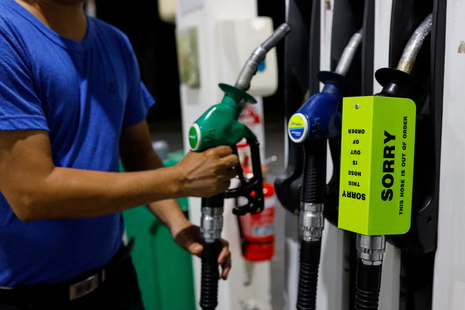
The energy minister, Chris Bowenis speaking now in Sydney. He said the country will reduce minimum stock obligations for both diesel and petrol, which will allow fuel companies “more flexibility to manage their supply chains”.
The obligations for diesel will reduce from 2.7bn litres to 2.2bn litres, and for petrol from 1bn litres to 700m litres. Bowen said:
It’s not like they can just press a button and get fuel out the door. But it will make a difference going forward and help them help regional communities, in particular.
He said it’s understandable that Australians are concerned about the fuel supply, but said the country’s minimum stock obligations are “high” and fuel continues to arrive:
Despite the fact that Australia’s fuel has been arriving and that our minimum stock obligations are in good shape, of course we have continued to see unacceptable impacts, particularly in regional Australia, as the supply chain has struggled to cope with massive spikes in demand.
Key events

Petra Stock
BoM forecasts more rain for saturated Top End
Major flood warnings remain in place across northern Australia, with further rain forecast for an already saturated Top End.
The Northern Territory’s Daly river was at 15.51m and still rising. It was expected to peak over the weekend at levels approaching the 1998 flood event (about 16.25m), according to the Bureau of Meteorology.
Senior meteorologist Dean Narramore said rainfall totals of 100 to 200mm were possible across the Top End over the weekend and into early next week, and likely to lead to rapid rises on rivers, creeks and streams.
Pretty much all of western NT is under flood watches, from Darwin to the rock [Uluru]in anticipation for widespread heavy rainfall.
Major flood warnings were in place for the Daly and Georgina rivers as well as Eyre creek.
Imams body warns against anti-Muslim hate ahead of Christchurch massacre anniversary
Australia’s peak body for imams is calling on the nation to stand up against anti-Muslim hate and religious discrimination ahead of the International Day to Combat Islamophobia on Sunday.
The day commemorates the Christchurch mosque massacre where 51 Muslims were murdered on 15 March 2019.
The president of Australian National Imams Council’s (ANIC), Imam Shadi, says a recent rise in Islamophobic incidents threatens the safety of Muslims and undermines social harmony:
Many mosques across Australia have recently received threatening letters and messages. Some have referenced a so-called “Christchurch 2.0”, while others have contained explicit threats of violence against worshippers.
Just a few nights ago, there was also a disturbing incident at a Ramadan Iftar gathering in Ballarat, VIC, where an individual reportedly stormed into a community dinner, threatened children, assaulted attendees and directed hateful anti-Islamic abuse toward those present.
Low-deposit lending records biggest jump on record

Patrick Commins
Banks in the final three months of last year lent a record $5.4bn to homebuyers with “wafer thin” deposits of 5% or less – the latest evidence that the Albanese government’s decision to uncap its home guarantee scheme supercharged demand in an already red-hot property market.
The latest figures from the banking regulator, Apra, show low-deposit lending jumped $2.1bn in the December quarter, up 63% on the previous quarter, which was the biggest increase in the history of the data, according to Canstar analysis.
Property prices continued to forge higher through last year, with values at the cheaper end of the market climbing particularly quickly over recent months as first home buyers rushed to take advantage of the scheme, which helps them take out a loan with a deposit of as little as 5%.
The cap on the number of places in the scheme was removed on 1 October, alongside increased income eligibility limits.
Sally Tindallthe director of data insights at Canstar, said the scheme had “removed a key barrier for first home buyers who have surged on to the market, wafer-thin deposits in hand”.
Tindall said saving a 20% deposit “had become an almost impossible task for many would-be buyers,” and that these super low deposit loans now accounted for 4% of new lending to owner-occupiers:
Which sounds small, but is actually the highest proportion on record.
Tehan says government does not have ‘clear plan’ for fuel security
The federal opposition’s energy spokesperson, Dan Tehan, has been speaking about the Albanese government’s announcement it will reduce minimum stock obligations for diesel and petrol.
Bowen earlier said the change would allow fuel companies “more flexibility to manage their supply chains”.
Tehan says Bowen does not have a “clear plan” to guarantee Australia’s fuel security:
The Australian people need more. They need a plan. They need to be reassured that there are no problems.
Great Western Highway closure in NSW to remain for at least three months after failure of ‘Convict Bridge’

Penry Buckley
The NSW government has announced that a section of the Great Western Highway in the Blue Mountains will remain closed for at least three months following the failure of a historic bridge this month.
Victoria Pass in the Blue Mountains, which includes the “Convict Bridge” built by chain gangs in 1832, closed last week after Transport for NSW detected cracking and movement in its substructure.
In a statement released this morning, the NSW roads minister, Jenny Aitchisonsays at least two weeks of specialist testing and 3D imaging have to be carried out with no passing traffic to understand the full extent of the damage, and “under the most optimistic scenario”, work to make the road safe would take at least a further two months.
Aitchison says:
This is not a short-term repair job. We are dealing with a major geotechnical failure on a fragile and historic section of road, and it must be assessed and repaired properly … I know this closure is causing real hardship for families, workers, school communities, freight operators and local businesses, and I am deeply sorry for that disruption. But there will be no shortcuts on safety – we will not risk lives.
Aitchison says a diversion in place for traffic is adding up to 25 minutes to cross the Blue Mountains, but has warned of heavier delays on peak periods and weekends. Extra train, coach, school and regular bus services have been laid on, but the closure has raised questions about the failure of successive state governments to replace the nearly 200-year-old bridge.
‘Of course’ there will be further threats to fuel supply if war drags on, Bowen says, but ‘we are nowhere near’ running out
Guardian Australia’s Luca Ittimani just asked Bowen if Australia could run out of fuel. The energy minister said:
I think Australians know that our fuel supply is secure, it’s arriving on schedule. Will there be further threats to fuel supply, as the international circumstances continue to worsen? Of course.
That is a realistic thing which governments should prepare for and are prepared for, the Australian people are prepared for.
I think the sort of inflammatory running-out language, we are nowhere near that.
Bowen added that panic-buying of fuel is “unAustralian”, saying there was “no need” to do so.
Bowen maintains fuel supply is secure even though regions have seen shortages
Bowen stressed that the fuel supply remains secure, although he acknowledged that there were issues in regional Australia due to heavy demand. He said:
Our fuel supply is coming in. Australians should know that. When we say the fuel supply’s secure, that’s what we say, that’s what we mean, that’s the facts.
That doesn’t mean that Australians in regional areas haven’t faced real shortages, because demand has been so high.
Two things can be true, and these two things are true.
Chris Bowen lowers minimum stock requirements for fuel
The energy minister, Chris Bowenis speaking now in Sydney. He said the country will reduce minimum stock obligations for both diesel and petrol, which will allow fuel companies “more flexibility to manage their supply chains”.
The obligations for diesel will reduce from 2.7bn litres to 2.2bn litres, and for petrol from 1bn litres to 700m litres. Bowen said:
It’s not like they can just press a button and get fuel out the door. But it will make a difference going forward and help them help regional communities, in particular.
He said it’s understandable that Australians are concerned about the fuel supply, but said the country’s minimum stock obligations are “high” and fuel continues to arrive:
Despite the fact that Australia’s fuel has been arriving and that our minimum stock obligations are in good shape, of course we have continued to see unacceptable impacts, particularly in regional Australia, as the supply chain has struggled to cope with massive spikes in demand.
Angus Taylor criticses government over soaring petrol prices, but doesn’t offer alternative solutions
The opposition minister, Angus Taylor, is speaking in Sydney about ongoing cost of living struggles amid surging petrol prices.
He said:
If you have an economy that’s not working any more, where inflation is crashing households and businesses, where your standard of living is going backwards, then frankly you can’t get ahead.
Taylor claimed energy minster Chris Bowen is “asleep at the wheel”. When asked what the Coalition would do differently, Taylor didn’t provide a concrete answer besides saying you needed to “admit there’s a problem”.
First of all, recognise that there’s a problem. I don’t know how many questions we asked where we laid out issues where people were trying to get fuel. …
The first thing you’ve gotta do if you’re going to fix a problem, is admit there’s a problem. Sadly the real problem here is Chris Bowen.
Bowen said yesterday Australia would relax petrol standards for 60 days in hopes of injecting an extra 100m litres a month into the system.
Qantas to pay $105m to settle Covid flight credit dispute

Jonathan Barrett
Qantas will pay $105m to settle a class action lawsuit over its Covid credit scheme, ending a long-running dispute with some of its affected customers.
Qantas said in a statement there was no admission of liability and that the settlement was subject to federal court approval.
The legal action, run by Echo Lawalleged that Qantas had breached its contracts with customers by failing to provide timely cash refunds for cancelled flights during the pandemic. It provided travel credits instead, with expiration dates.
The airline’s policy generated significant debate, with consumer groups raising concerns over the credit redemption rules.
Qantas later removed the expiry dates on the credits.
The affected flights caught by the class action were scheduled to depart between 1 January 2020 and 1 November 2022, but were cancelled.