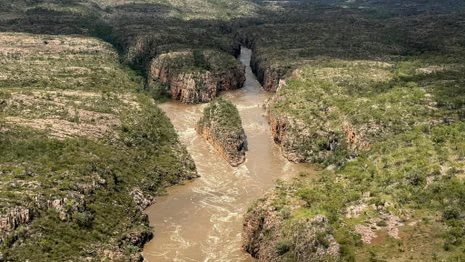
‘A saltwater crocodile on the AFL oval’: worst flooding in decades inundates NT as residents urged to avoid water
Katherine’s mayor has warned locals to be wary of flood waters inundating the town after a crocodile was spotted on the town’s AFL oval, as residents are warned to boil their water amid the record-breaking deluge.
As rain and storms continued to soak the Top End on Monday, the Bureau of Meteorology issued major flood warnings for thousands of Territorians near the Katherine, Daly and Georgina rivers and Eyre Creek, with a flood watch covering nearly a dozen river catchments. The bureau also warned of severe thunderstorms and heavy rain in Darwin.
The Daly River – which flows 354km all the way to the mouth of the Timor Sea – was still rising, having passed its major flood level, after “extremely heavy rain”, senior meteorologist Angus Hines said.
Sign up: AU Breaking News email
The river was expected to peak at about 15.3 metres or higher – the highest since 1998 – by around Wednesday, rising from 10 metres last Monday, with flooding likely to persist for more than a week.
The Katherine River was slowly subsiding on Monday morning, having peaked at 19.2 metres before midnight on Saturday – its highest level since 1998 – with streets and low-lying parts of the community inundated.
Mayor Joanna Holden, of Katherine town council, said she had never seen so many fresh and saltwater crocodiles in local flood waters before.
“There was actually a saltwater crocodile on the AFL oval last night,” she said. “It just adds another element of danger to the whole cleanup.”
On Sunday, NT residents were warned to stay out of flood waters due to the risk of wastewater overflows and crocodiles.
“There are crocs absolutely everywhere … please don’t go in the water,” NT incident control acting commander, Shaun Gill said Sunday morning.
Hundreds of people across flood-affected communities of Palumpa, Jilkminggan and Nauiyu (Daly River) have been fully evacuated to Darwin, according to SecureNT, with at least seven schools closed in Katherine and five shut across the Big Rivers region as of Monday.
The NT health department also issued “boil water” alerts to communities including Katherine, Wugularr (Beswick), Tindal, Palumpa and Nauiyu (Daly River) advising people to use boiled or bottled water for drinking, preparing food or baby formula or brushing teeth.
Major transport routes, including the Stuart, Victoria, Roper and Buchanan highways and Central Arnhem Road, remained closed in parts due to flooding.
Dheran Young, the local member for Daly in the NT represents people across large swathes of remote and rugged country – an area roughly the size of Tasmania.
While many residents were used to heavy rains cutting off roads and isolating communities for months during the wet season, he said many were worried and frustrated by the official response to the disaster, which included evacuating two communities Daly River and Palumpa, over the weekend.
“It has been a challenging time for residents. Many people have been calling me about the anxiety they’re feeling about having to leave their community and come into Darwin, but also now the relief that they are out,” Young said.
With many residents vulnerable, he feared that access to essential goods such as food and medicine would be at risk.
“They are cut off and isolated and are in very remote locations,” Young said.
The ABC has reported that rail and road routes had re-opened to supply food across the Top End.
Fleur Parry, the arts manager for Djilpin Arts, had been attempting to return to Katherine from Darwin when heavy rains, flooding and road closures turned a usually straightforward drive into a more than five-hour ordeal.
“There was going to be a chopper, but then a storm came in, so the chopper couldn’t leave. So then I got a lift as close as I could to town, but that was a police block,” she said. Police gave Parry a lift home.
In the past five days, 571.5mm has fallen at Daly River police station, Hines said, with weather stations across the central and western parts of the Top End observing widespread totals of 100 to 200mm. About 241mm of rain fell in five days at the Katherine Bridge weather station.
Hines said a couple of tropical low pressure systems had moved into the Top End and over much of Queensland, bringing a “whole whack of tropical moisture”, with heavy rain and flooding.
It was an “unusually wet week, even for the wet season in the Territory,” Hines said. Some five-day rainfall totals looked likely to be March records, he said, with the potential for further rain to cause renewed river rises, or prolonged flooding.
“Unfortunately, at this time of year, there’s no dry forecast in the foreseeable future,” Hines said, with the wet season continuing until the end of April.
A flood watch also remained in place across most of Queensland – affecting more than 20 river catchments – with moderate to heavy rain falling in saturated catchments across the central coast, and parts of Capricornia and Wide Bay.
Major flood warnings were in place for the Stuart, Boyne, Mary, Flinders, Thomson, Barcoo and Georgina rivers and the Charleys, Barker, Barambah, Cooper and Eyre creeks.
“Queenslanders are reminded not to put their lives at risk by driving through flood waters. The message is simple – if it is flooded forget it,” a Queensland Police Service spokesperson said.
The State Emergency Service undertook 54 rescues between 6pm Sunday and 8am Monday.
The state’s highest rainfall (in the 24 hours to 9am) was 260mm at Brovinia, in the Wide Bay Burnett region in the state’s south-east.
More intense rainfall was possible in the south-east on Monday, with six-hourly rainfall totals between 60 and 90mm likely, but would ease from Tuesday.
Australia experienced its fourth-warmest year on record in 2025, with annual temperature about 1.23C higher than average, according to the Bureau of Meteorology. Global heating, driven mainly by the burning of fossil fuels, has increased the frequency and severity of extreme weather events.