A Ford worker heckled Trump. His suspension is a reminder that free speech can get you in trouble at work.
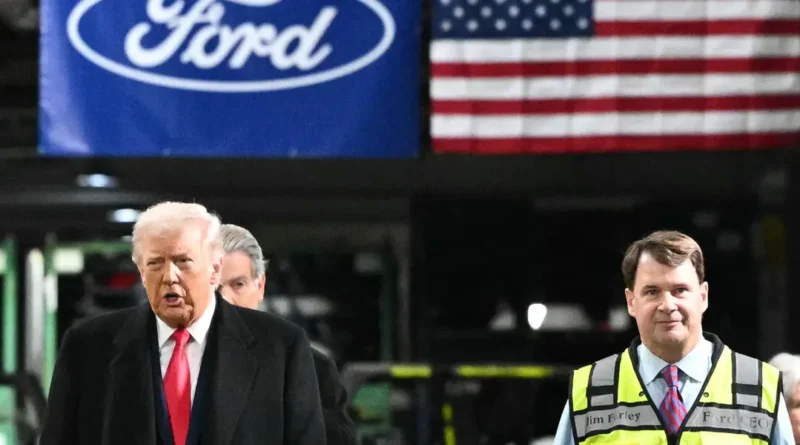
Hours after President Donald Trump toured a Ford pickup truck assembly plant, the big news story wasn’t about manufacturing jobs or the economy. It was about a Ford worker who heckled him and was later suspended.
The incident raised questions about the limits of free speech in the workplace — and when companies can discipline workers for political protest.
Business Insider spoke to five experts, including four employment lawyers and an HR executive, to find out.
Their conclusion was blunt: an employee’s words can quickly become fireable offenses.
‘An employer has the ability to discipline an employee for speech’
All four lawyers said workers retain legal free speech rights under the Constitution, but those rights rarely protect speech in their workplace.
“With very few exceptions, employees in the private sector don’t have free speech rights at work,” Mark Kluger, a co-founding partner at New Jersey-based law firm Kluger Healey, told Business Insider.
Jessica Childress, a managing attorney at Washington, DC-based The Childress Firm, said workers often confuse who the First Amendment actually applies to. The best way to think about it, she said, is to divide government action from a private company’s authority.
“The First Amendment’s right to freedom of speech only applies to government actors, not private employers, such as Ford,” she said. “A private company can — with certain exceptions — limit what their employees say.”
That distinction has played out in real-world cases before.
Juli Briskman, a former government contract worker, was fired from her job after a photograph lensed her flipping off Trump’s motorcade. BRENDAN SMIALOWSKI/AFP via Getty Images
In 2017, Juli Briskman, a former marketing analyst for a government contractor, was fired from her job after professional photographers caught her giving Trump’s motorcade the middle finger.
Even though her action happened outside of the office, her lawsuit against her employer was tossed.
“Employers are legally allowed to regulate behavior that disrupts the workplace,” said Jared Pope, an employment law attorney and CEO at Work Shield. “That is why most organizations apply their codes of conduct consistently, even when speech happens off the clock or references public figures.”
Still, lawyers said workers generally have more protection if they express their political belief off-the-clock.
“If you are so inclined to protest, do it off-duty, off-premises, and off-company networks,” Eric Kingsley, a partner at Kingsley Szamet Employment Lawyers, told Business Insider. “An employer has the ability to discipline an employee for speech in matters of politics when it becomes misconduct.”
Ford decided to suspend the worker initially, not fire them. The UAW said it’s looking into the situation, while Ford said it doesn’t comment on personnel matters. JEFF KOWALSKY/AFP via Getty Images
Why Ford likely suspended — not fired — the worker initially
Each lawyer we talked to said that Ford was well within its rights to suspend the employee, T.J. Sabula.
In fact, some said the automaker may have displayed restraint by not outright firing the factory employee after the decision.
“It implies Ford is buying time,” Kingsley added. “Suspending the employee gives them a chance to investigate and make a decision that may not be as rash as laying off an employee.”
On Wednesday, the United Auto Workers, the union representing the workers in Sabula’s plant, confirmed his suspension. Sabula, who has said he doesn’t regret heckling Trump and is set to receive over $800,000 in crowdfunded support, has not responded to requests for comment from Business Insider.
Laura Dickerson, a vice president for the UAW, said the union was reviewing Ford’s actions and said workers “should never be subjected to vulgar language or behavior by anyone — including the President of the United States.”
The union also said Sabula “believes in freedom of speech, a principle we wholeheartedly embrace, and we stand with our membership in protecting their voice on the job.”
Ford declined to comment on the suspension, saying it was “a personnel matter.”
“Ford is navigating a high-profile, politically charged moment,” Lauren Winans, CEO of the HR consulting firm Next Level Benefits, said. “The union’s involvement likely influenced Ford’s decision to suspend (not fire), because unilateral termination could lead to grievances and arbitration.”
For workers wondering if they can get fired for speaking their mind at work, Kluger made it clear the answer is yes.
“Try telling your boss what you really think of them and see how long you remain employed,” he said.
Do you think Ford should fire the employee? Let us know by taking our survey: