Process over Outcome
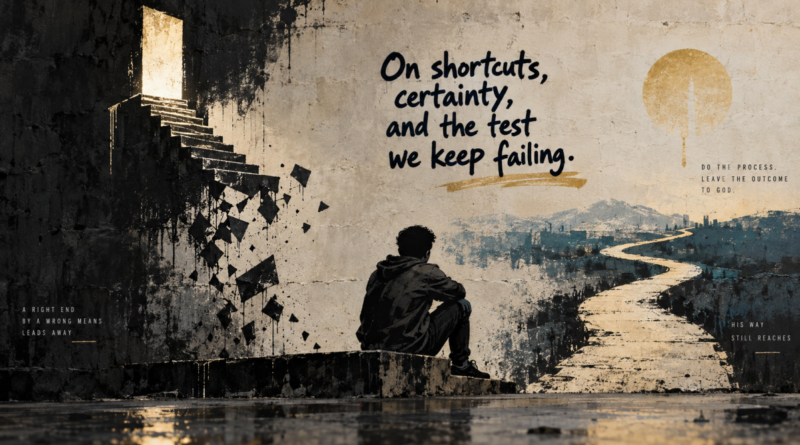
On shortcuts, certainty, and the test we keep failing.
There is a particular anxiety that grips religious people, and it is worth naming precisely: the anxiety of getting the answer right. Is this permitted or forbidden? Is my prayer valid or void? Did I fulfill the obligation or fall short? The questions are sincere, and the stakes feel infinite, so the search for certainty becomes urgent. And it is exactly in that urgency that something quietly goes wrong.
Under pressure for the correct answer, people become willing to reach for whatever will deliver it—sources God never sanctioned, methods He never authorized, shortcuts that promise to close the gap between not-knowing and knowing. The reasoning feels airtight: if the goal is a righteous one, surely the means can be forgiven. But this is a trade that never pays. The person has silently swapped the thing God actually asked of them—faithfulness to His process—for the thing they wanted for themselves: a guaranteed outcome.
This is the inversion at the heart of so much religious error. God assigns us a process and reserves the outcome for Himself. Our task is sincere adherence to what He actually revealed; the result—whether we are judged right, whether we are guided, whether we are saved—belongs to Him. When we seize the outcome and try to manufacture it by our own means, we have not become more devout. We have quietly appointed ourselves in God’s place.
The First Shortcut
The pattern is old. It is, in fact, the first pattern.
When Satan set out to ruin Adam, he did not pitch him on evil. He pitched him on a good outcome reached by a forbidden road:
“But the devil whispered to him, saying, ‘O Adam, let me show you the tree of eternity and unending kingship.’” (20:120)
Note what is being offered. Not rebellion for its own sake—eternity, kingship, permanence, nearness to the everlasting. These are not ignoble desires. They are close to the highest things a soul can want. Satan’s genius was never to make sin look like sin. It was to make disobedience look like a shortcut to something Adam already, rightly, longed for.
He even presented it as sincere counsel:
“The devil whispered to them … He said, ‘Your Lord did not forbid you from this tree, except to prevent you from becoming angels, and from attaining eternal existence.’ And he swore to them, ‘I am giving you good advice.’” (7:20-21)
The whole seduction runs on a single, seductive premise: the outcome you want is being withheld from you, and the way to secure it is right here, one step off the path God drew. The command not to approach the tree was a process—an instruction whose full reasoning Adam could not see. The test was never really about the fruit. It was about whether he would keep to God’s process while trusting God with the outcome.
He did not. And here is the irony that should haunt anyone tempted by a shortcut: the method destroyed the very outcome it promised.
“He thus duped them with lies …” (7:22)
“… Adam thus disobeyed his Lord, and fell.” (20:121)
Adam reached for permanence in the garden by the one act that would cost him the garden. The shortcut to eternity was the road out of paradise. This is not incidental—it is the structure of the thing. When you pursue a right end by a wrong means, the means contaminates the end. You do not arrive at what you were chasing. You arrive at its opposite.
As for those who disbelieve, their works are like a mirage in the desert. A thirsty person thinks that it is water. But when he reaches it, he finds that it is nothing, and he finds GOD there instead, to requite him fully for his works. GOD is the most efficient reckoner. (24:39)
Satan Tempts with Unsanctioned Means
“The ends justify the means” is not a neutral piece of worldly pragmatism that religion can quietly borrow. In the Quranic account, it is Satan’s native logic—the exact argument he used in the opening scene of human history. Whenever a believer catches himself reasoning that a good goal licenses an unsanctioned method, he should recognize the voice. It is a very old voice, and it has made this offer before.
Which brings us to the modern version of the same mistake.
A believer wants to know a ruling—what is lawful, what is required, how exactly a thing must be done. The desire for a precise, certain answer is understandable. But the Quran presents itself as sufficient for exactly this purpose:
“Shall I seek other than GOD as a source of law, when He has revealed to you this book fully detailed? … The word of your Lord is complete, in truth and justice. Nothing shall abrogate His words.” (6:114-115)
Fully detailed. Complete. And yet, driven by the hunger for a more granular certainty than they believe the book provides, many reach past it—into vast collections of unverified reports, narrations attributed to the Prophet across centuries through chains of transmission no one can actually confirm—and elevate these into a second source of binding law. The motive is often sincere: they want to get the ruling right. But the move is precisely Adam’s move. It secures the felt certainty of an answer by stepping off the source God authorized.
The Quran anticipates the objection and names it with startling directness:
“These are GOD’s revelations that we recite to you truthfully. In which Hadith, other than GOD and His revelations, do they believe?” (45:6)
“Which Hadith, other than this, do they uphold?” (77:50)
The question is not decorative. It is a challenge: having been given God’s own recited revelation, complete and sufficient, what other hadith—what other narration—will you now bind yourself to? To answer that question by producing an unproven report is to answer it exactly wrong, no matter how correct the resulting ruling might happen to look.
Why the Shortcut Fails Even When It “Works”
And this is the subtle point the anxious seeker misses. Suppose the shortcut actually lands on a correct answer. Suppose the unsanctioned method delivers a ruling that is, by some measure, right. It does not matter. The answer is poisoned at the root, because the test was never the answer.
The test was the process. It was whether you would confine yourself to what God authorized and trust Him with the rest. A right answer reached by an unauthorized road is not a success that happens to have a flaw in its paperwork. It is a failure of the actual thing being examined—your willingness to submit to God’s process rather than your own. You cannot pass a test of obedience by disobeying efficiently.
The reverse is the great, understated promise of the believer’s life:
“As for those who strive in our cause, we will surely guide them in our paths. Most assuredly, GOD is with the pious.” (29:69)
The order is critical. First the striving—the sincere effort along the path God actually laid down. Then the guidance, which is God’s to give. He does not promise to guide those who have already secured the answer by their own means. He promises to guide those who strive in His cause, by His way, and leave the outcome to Him.
This is what it means to do the right process and hand the outcome to God. It is not passivity. You are working, seeking, striving—but within the bounds He set, and without the arrogance of demanding the result on your own terms. And to that posture God attaches a guarantee He attaches to nothing else: He will make it succeed. Not necessarily by handing you the exact answer you were anxious about, but by making the outcome the right one—the one He, who owns all outcomes, defines as success.
The Garden and the Stream
The Quran does not leave this as an abstraction. It dramatizes both halves of the principle in narrative—once as a warning, once as a promise—and the two stories turn out to be mirror images of each other.
Sura 68 tells of a group who owned a garden. Here are men doing everything a worldly reckoning would call wise. They own a productive garden, they rise early, they make a shrewd plan to harvest at first light. There is nothing lazy or careless about them. Their failure is invisible from the outside, because it is entirely a matter of posture. They had made the harvest theirs—a yield owed to their own effort and cunning, to be secured by their own hands and kept for themselves alone.
“We have tested them like we tested the owners of the garden who swore that they will harvest it in the morning. They were so absolutely sure.” (68:17-18)
So absolutely sure. That is the whole of the error. They swore they would harvest in the morning and left no room for the possibility that the morning was not theirs to command.
“On their way, they confided to each other. That from then on, none of them would be poor. They were so absolutely sure of their harvest.” (68:23-25)
The plan was efficient. It was also a quiet declaration that the harvest was a product of their labor rather than a provision from their Lord, theirs to allocate or withhold as they pleased. And so the outcome they were so sure of was taken from them before they could lay a hand on it:
“A passing (storm) from your Lord passed by it while they were asleep. By morning, it was barren.” (68:19-20)
Notice the timing. It was destroyed while they slept, in the gap between the plan and its execution, at the one moment when neither their effort nor their cunning could reach it—precisely to demonstrate that the yield had never been in their hands to begin with. When they arrived and found ruin, the diagnosis came from the most righteous among them, and it was not “you should have worked harder” or “you should have planned better.” It was:
“If only you had glorified (God)!” (68:28)
The problem was never the effort. It was that they had mistaken the effort for the source. They performed the worldly-right actions with a heart that had written God out of the outcome, and the outcome collapsed in their hands.
Now the mirror image, the promise: Saul and the stream. Where the garden shows a worldly-wise method failing, this shows a worldly-foolish one succeeding—for the same underlying reason.
Saul (Talut) leads an army toward a stronger enemy, and God tests the troops in a way that makes no military sense at all:
“GOD is putting you to the test by means of a stream. Anyone who drinks from it does not belong with me—only those who do not taste it belong with me—unless it is just a single sip.” (2:249)
By every worldly calculation this is backwards. An army marching to face Goliath should drink; soldiers denied water are weaker soldiers. Forbidding the stream is exactly the sort of counterintuitive instruction a commander optimizing for victory would never give. But the test was never about hydration or tactics, any more than the forbidden tree was ever about fruit. It was about who would keep to God’s process when the process looked like a handicap. Most drank. A few obeyed.
And here the worldly logic makes one last appeal, this time from the mouths of the faithful few themselves. Having obeyed, they look at the enemy and feel exactly the weakness the worldly reckoning had predicted—”Now we lack the strength to face Goliath and his troops.” The answer they receive is the entire thesis of this essay compressed into a sentence:
“Many a small army defeated a large army by GOD’s leave. GOD is with those who steadfastly persevere.” (2:249)
The outcome does not belong to the size of the army or the strength of its soldiers. It belongs to God. Do the process—obey, persevere—and the arriving is His to grant. And He granted it:
“They defeated them by GOD’s leave, and David killed Goliath. GOD gave him kingship and wisdom.” (2:251)
By GOD’s leave. The phrase brackets the victory on both sides, insisting on the point the whole episode exists to make. The ones who followed the process that looked like weakness were carried to a triumph their own strength could never have secured. Had they optimized for the outcome—drunk their fill, kept their strength, done the militarily sensible thing—they would have disqualified themselves from the very victory they were trying to win. The garden’s owners lost the harvest by grasping for it. Saul’s soldiers won the battle by letting it go.
The Reframe
So the fixation on the “right answer” turns out to be a misreading of the entire situation. God was never primarily testing whether we could locate the correct ruling. He was testing whether we would trust Him enough to stay on His road when it did not hand us the guaranteed outcome we craved—and whether we would refuse the shortcut even when the shortcut promised us something good.
Adam wanted eternity and lost the garden by grasping for it. The one who reaches past God’s complete revelation for a more certain answer loses the very thing he was after—a ruling he can actually stand on before God—by grasping for it. The pattern does not change.
Do the process. Leave the outcome to God. This is not a consolation prize for those who could not secure the result themselves. It is the result. It was always the result.