With reconstruction stalled, Gazans shelter in buildings at risk of collapse
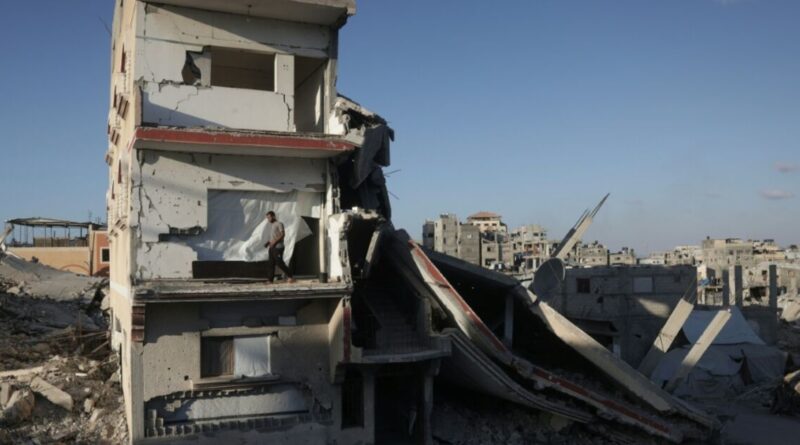
In her Gaza City apartment, Heba Arafat walks uphill across a living room slanted at a steep angle after Israeli airstrikes caused the building’s foundations to collapse, leaving the entire structure tilted.
Like thousands of people in Gaza, Arafat chose to risk living in an apartment building damaged during nearly three years of war between Israel and Hamas, with countless Israeli airstrikes on the Palestinian territory.
“We were forced to live here because we had nowhere else to go. All of our homes were destroyed, our land was razed and we have nothing left,” said Arafat, 47.
According to the UN, 84 percent of all structures in Gaza had been damaged or destroyed by October 2025, and Gaza’s civil defence says 2,000 buildings across the territory are at risk of collapse.
Last week, 21 people including 12 children died in Gaza City after a six-storey building that local authorities said had been hit repeatedly by Israeli airstrikes collapsed. Israel denied having struck the building.
Arafat lives with her six daughters and husband in their old apartment building in Gaza City’s Al-Shati Refugee Camp, which they left at the height of the war that began in October 2023 with Hamas’s massive attack on Israel.
The family returned after an October 2025 ceasefire, which has reduced but not ended Israeli strikes. They found that their four-storey building, in which 30 people now live, had collapsed inward at the ground floor, the result, she said, of an Israeli ground operation in the area.
Like most buildings in Gaza City, the windows were blown away by blasts, with makeshift bedsheets spread across the frames providing little privacy.
As she spoke, Arafat illustrated her building’s slant by leaving a water bottle sideways on the floor, only for it to quickly roll away to the other end of the room.
While no territory-wide estimate exists, Ramiz Alakbarov, the UN humanitarian coordinator for the Palestinian territories, said last week that people across Gaza were living in “hundreds of damaged and unsafe shelters”.
– ‘Where can we go?’ –
“Where can we go? Even though this house is dangerous,” Arafat said. “We have been terrified ever since we heard about houses collapsing. The danger has become even greater” than we thought.
Gaza City municipal staff patrol the streets to identify buildings at risk of collapse and mark them with stencils.
“These homes pose a genuine threat to the lives of the displaced persons sheltering inside them, as well as to residents in the vicinity and those in nearby displacement camps,” said Hosni Muhanna, a Gaza City spokesman.
But Muhanna knows that people are likely to remain in these buildings for lack of better options.
“Thousands of displaced people are forced to seek shelter in these dilapidated buildings which are on the verge of collapse to escape the hardships of displacement camps that offer no protection against the summer heat or winter cold.”
Most residents of Gaza were displaced at least once during the war, and many of them remain in enormous camps for the displaced, in tents provided by humanitarian organisations or in improvised shelters.
– Stalled reconstruction-
With diseases such as the skin infection impetigo rampaging through certain camps due to the lack of waste disposal and general overcrowding, many Gaza residents have found it safer to take the risks of moving into the damaged buildings.
And with Gaza’s economy in tatters, many remain dependent on aid, which Israel has allowed into Gaza with restrictions since the declaration of the US-brokered ceasefire in October 2025.
But Israel has kept carrying out airstrikes, and has restricted the entry of a range of equipment that it says could also have military use, but which Gazans and international NGOs say are needed for the territory’s vast reconstruction needs.
These can include large machinery needed to clear rubble from the site of destroyed buildings, or spare parts and lubricants needed to keep other tools running, UN spokesman Stephane Dujarric said in August.
With the ceasefire process stalled for months, reconstruction efforts planned under the ceasefire have yet to begin.
According to a joint assessment published by the United Nations, World Bank and European Union in April, Gaza will require $71.4 billion in recovery and reconstruction spending over the next decade.
“We’re afraid a wall or the roof might fall on us, so we huddle together, afraid that one of us might get hurt,” Arafat said.
vid-lba/sct/ris/hol