
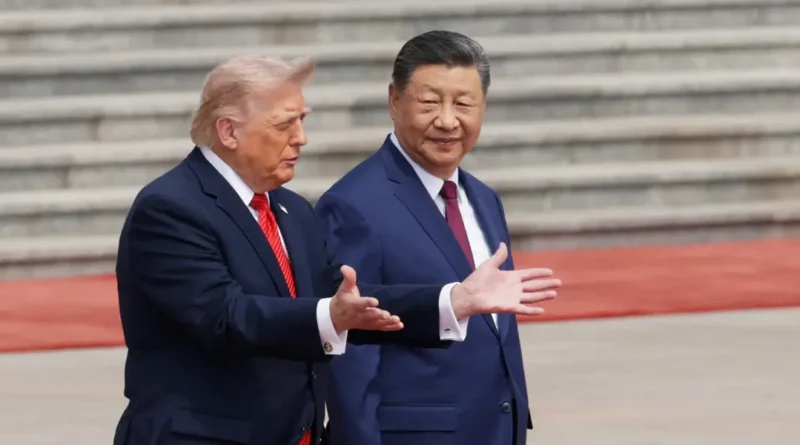
All eyes are on what Trump and Xi will do next amid grim warnings of AI doom
In the face of a grim debate about an AI-fueled apocalypse, both President Donald Trump and Chinese leader Xi Jinping are locked in on keeping up the pace of AI progress, not slowing it down.
Trump downplayed concerns about AI researchers’ warnings that AI could threaten humanity’s existence during his visit to Ireland to watch the Irish Open.
“Whoever wins AI, wins,” Trump said from his Doonbeg golf resort.
“And we can put guard rails, we can do this and that, but I think you have a lot of negative forces that are bringing it up that shouldn’t be bringing it up, and they’re bringing up things that won’t happen,” he added.
Meanwhile, Xi has not directly commented on the AI doom-and-gloom yet. Instead, he said during a BRICS Summit in New Delhi on Sunday that “Global South” countries — developing countries in Asia, Africa, and South America — should work faster to create a global AI governance framework.
He also said China would pioneer a BRICS open-source AI community that would support LLM development, host AI seminars, and build an open AI ecosystem.
“We should build incubators for innovation, upgrade traditional industries, develop emerging industries, and deploy future industries,” Xi said of his proposed BRICS initiatives.
Trump and Xi are scheduled to meet on September 24 at the White House.
Pacing the frontier
The leaders’ comments come as both OpenAI CEO Sam Altman and Anthropic CEO Dario Amodei have called for cooperation between the US and Chinese governments to pace and regulate the development of frontier AI models.
Altman said in a Sunday interview with Fortune that Trump and Xi should get the Nobel Peace Prize if they can agree on shared rules on the safe development of AI.
“Even if just the US and China could agree on some shared standards and testing for development of this technology, I think that’d be a wonderful accomplishment that the two of them can deliver,” Altman said.
He didn’t specify what those standards would look like, but said it wouldn’t be hard to create, calling it akin to a “one-page document.”
Amodei, in an interview with CBS released on Sunday, said the US should talk with the Chinese and work together to “put a speed limit on the rate of this technology.”
The debate about whether AI has the capacity to bring about the apocalypse has reached a fever pitch.
Last week, Anthropic researcher Jacob Coxon quit the company, saying neither OpenAI nor Anthropic was acting responsibly and they were “gambling with our lives.”
He said the people building this technology “earnestly believe that it could kill us all by the end of the decade.” Several OpenAI and Anthropic staff have since followed his lead, posting about what they say is AI’s potential to wipe out humanity if it’s allowed to develop unchecked.