The Guardians: Chastity & Salat
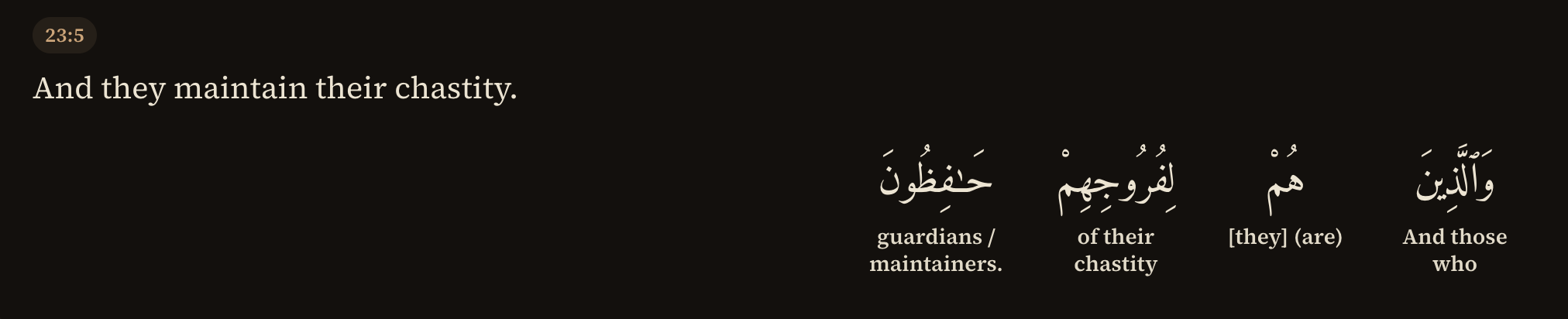
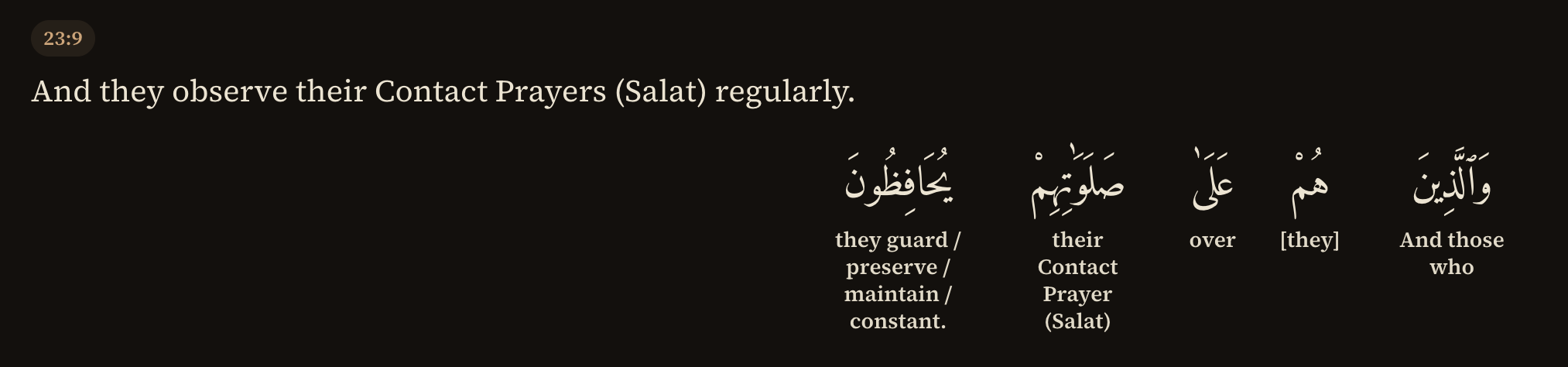
The opening portrait of the believers in Surah al-Mu’minun (23:1–11) is held together by a single Arabic root: h-f-z, to guard, to keep, to preserve. It surfaces at two decisive points. The believers are those “who guard their chastity” (li-furujihim hafizun, 23:5), and they are those “who diligently maintain their prayers” (‘ala salawatihim yuhafizun, 23:9). The most private conduct of the body and the most sacred discipline of worship are described with the same verb. To be a believer, in this framing, is to be a hafiz—a guardian.
The vocabulary is not incidental. Hafiz is among the names of God: al-Hafiz, the Guardian (cf. 11:57, “my Lord is Guardian over all things”; 12:64, “God is the best of guardians”). When a human being guards chastity and guards their Salat, they are mimicking a divine attribute.
But what, exactly, is being guarded? Here the passage asks to be read more carefully. Guarding the salat is not only guarding the act. A prayer can be performed with perfect outward regularity and still be breached from within, because the thing that must be kept whole is its exclusivity—its absolute devotion to God alone.
Say, “My Contact Prayers (Salat), my worship practices, my life and my death, are all devoted absolutely to GOD alone, the Lord of the universe. He has no partner. This is what I am commanded to believe, and I am the first to submit.” (6:162–163).
The believers are those who devote the religion exclusively to God alone.
All that was asked of them was to worship GOD, devoting the religion absolutely to Him alone, observe the contact prayers (Salat), and give the obligatory charity (Zakat). Such is the perfect religion. (98:5)
To guard prayer is to guard it against dilution, against the quiet entry of any rival to whom the heart also turns in hope or fear. A prayer whose devotion is divided is already a compromised prayer, whatever the body performs.
Guarding chastity works by the same logic. It is not merely the avoidance of an act; it is the keeping of an exclusive bond—intimacy confined to one’s spouse (23:6). And the Quran dignifies that bond with striking language: marriage is a “solemn covenant” (mithaqan ghaliza, 4:21), the very phrase used for the covenant God takes from the prophets themselves (33:7). Fidelity to a spouse and fidelity to God are cast in the same vocabulary. The two guardings are, at bottom, one act performed on two planes: the refusal to divide what is meant to remain undivided.
The Bible makes this identity explicit. Across the prophets, idolatry is symbolized through adultery. Israel is the bride who “plays the harlot” by turning to other gods (Hosea; Ezekiel 16 and 23; Jeremiah 3); God is the husband betrayed (Jeremiah 31:32). The New Testament keeps the equation: “You adulterers, do you not know that friendship with the world is enmity with God?” (James 4:4). Read alongside 23:5 and 23:9, the pattern completes itself. Shirk—associating partners with God—is unfaithfulness committed against the Creator; adultery is shirk committed against the marriage covenant. To guard the one is, in principle, to guard the other, because believers maintain their promises and their covenants.
And the believers keep their word; they are trustworthy. (70:32)
This is why the prayer that is truly guarded also guards the one who prays.
You shall recite what is revealed to you of the scripture, and observe the Contact Prayers (Salat), for the Contact Prayers prohibit evil and vice (al-fahsha’ wa’l-munkar). But the remembrance of GOD (through Salat) is the most important objective. GOD knows everything you do. (29:45)
A prayer that is kept pure also protects the person who keeps it. By restraining the believer from indecency and wrongdoing, Salat becomes a barrier against the very corruption that eats away at a community from within. In that sense, to guard the prayer is also to be guarded by it.
Nor will the Quran let prayer remain a private transaction. In the example of Shuaib, whose people cheated in their weights and measures, his opponents sneer:
They said, “O Shu’aib, does your religion (Salat) dictate upon you that we must abandon our parents’ religion, or running our businesses in any manner we choose? Surely, you are known for being clement, wise.” (11:87)
The mockery is revealing. Shuaib’s adversaries understood, better than many pious readers since, that his prayer was the root of his economic reform; they felt its pressure on their fraudulent trade. A prayer that leaves the marketplace untouched is not the prayer the Quran describes.
The two acts of guarding thus converge on a single social function. Chastity guards the integrity of lineage and family—the horizontal bonds between people. Prayer guards the bond with God—the vertical axis that keeps the horizontal ones honest. Societies rarely rot all at once; they rot where these two hinges loosen, in the collapse of exclusive fidelity to a spouse and the collapse of exclusive devotion to God. The believer who holds both is holding the load-bearing structure in place.
The Gospel gives this preserving vocation its sharpest image. “You are the salt of the earth,” Jesus tells his followers, “but if the salt loses its savor, how shall it be made salty again? It is then good for nothing” (Matthew 5:13). Salt, in the ancient world, was a preservative before it was a seasoning: rubbed into meat, it held back rot, and a little of it kept a great deal from spoiling. That is precisely the logic of the hafiz. The guardians of chastity and prayer are not only saving themselves—they are salting the society around them, holding back a decay that would otherwise spread unchecked.
The Quran names the opposite type with equal precision: the mufsidun, those who “spread corruption in the land” (fasad fi’l-ard). Every community contains both. The corrupters work to dissolve; the guardians work to preserve. And the striking thing about salt—and about the believer—is how little is required to make the difference. A faithful minority can preserve a majority who are not. This is not a call to withdraw into private purity, but its reverse: to remain within society as its preservative, its restraint, its resistance to rot.
So the two verses that bracket the believers’ portrait, 23:5 and 23:9, are finally about one thing seen twice. To guard one’s chastity and to guard one’s prayer is to refuse betrayal on both the human and the divine plane—and, in doing so, to become a hafiz worked into the social body the way salt is worked into what would otherwise spoil. The measure of such a life is not only what it keeps out, but what it keeps whole.