
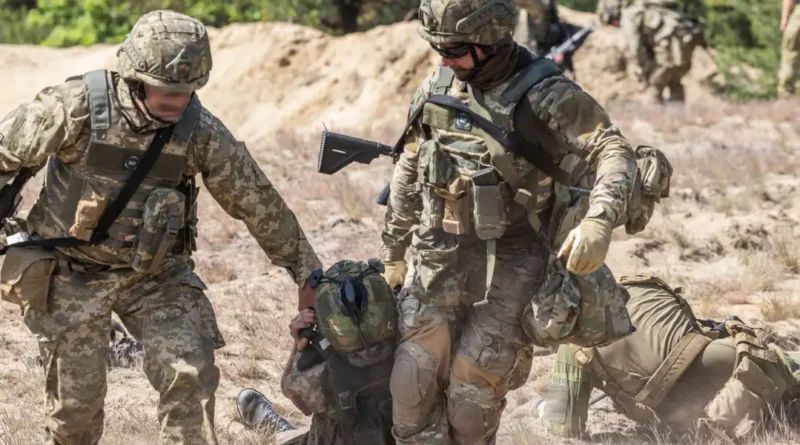
At this NATO training camp, the aim is to train the Ukrainians who can then turn around and train everyone else
New Western training for Ukrainian troops on NATO soil isn’t taking in large numbers of soldiers, but is instead focusing on leaders and specialists who can spread what they learn throughout Ukraine’s military.
The Norway-led Operation Legio trains Ukrainian soldiers with help from allies at a purpose-built camp in eastern Poland, called Camp Jomsborg. Rather than basic recruits, the training is primarily focused on preparing specialists, instructors, and leaders, including section leaders and platoon and company commanders. Many already have combat experience.
“The capacity in Jomsborg is limited,” Brigadier Atle Molde, the commander of Task Force Legio, told Business Insider. He said that using that capacity to train leaders on different levels helps to maximize the impact.
A “well-trained instructor can go back and teach 10, 20 soldiers of his own for maybe four or five times a year,” he added. “So the overall effect will be better if we focus on training the specialists in Jomsborg and not necessarily basic recruit training.”
Synne Nilsson / Forsvaret
Speaking on the condition that only his rank and first name be used, Maj. John, the S3 Operations Officer in charge of synchronizing the training operation, told Business Insider that Ukraine can train far more of its own troops, and in some areas, such as drone warfare, it is better prepared to train its own soldiers. Western militaries, however, can offer expertise in other areas.
Operation Legio cannot make a major quantitative difference for a military of Ukraine’s size, John said, “but we have a qualitative difference because we produce what we call force multipliers. That is platoon leaders, squad leaders, combat medics, instructors.”
With an instructor, “the secondhand value is quite big. He will train maybe 400, 500 Ukrainians a year within these training programs. And when you produce a lot of instructors, that secondhand value is quite big,” he said.
He said effects are also felt through non-instructors, too: Squad leaders who return and lead their squads, platoon leaders who return and lead their platoons, and combat medics who return and save lives on the battlefield. “So that is what we focus on here.”
Training battlefield leaders
Battlefield leadership is one of the main areas where Operation Legio officials believe Western militaries can add value.
Molde said “we try to give them competencies with regard to the conventional methods, planning methods, military decision-making processes, and so on.”
One Ukrainian sergeant taking part in the training told Business Insider that his unit tries to structure its leadership as NATO militaries do and said that being at Camp Jomsborg was helping him develop those leadership skills. The sergeant, who uses the call sign Yankee, said the training “will help me a lot in understanding the situation better, in evaluating the situation” when he returns to the battlefield.
Molde said the Ukrainians want to know how to move, how to lead, and how to do mission command.
“They want to, in a more long-term cultural change of their old legacy from the Soviet time, moving in a more Western direction,” he said.
It was Ukraine that asked for this specialist-focused training, John said, explaining that the curriculum is built around Ukraine’s requests, rather than partners deciding on their own what Ukrainian troops need.
Molde said the training “has to be based on the priorities and the demand signals, as we call them, from Ukraine.” It’s ultimately “their war; it’s our job to help them. And that’s not by imposing our own opinions on something they don’t see as beneficial.”
The Operation Legio officials said there are areas where Ukrainian soldiers are stronger than their Western counterparts, particularly in technologies and tactics developed during the war, while Western forces bring strengths in fundamentals.
John said that the Ukrainians “have the combat experience. They have the highest understanding of the new technologies. At the same time, it’s not like the Western instructors here don’t have any expertise.” Both sides challenge each other to be better.
“We’re learning from each other,” Molde said.