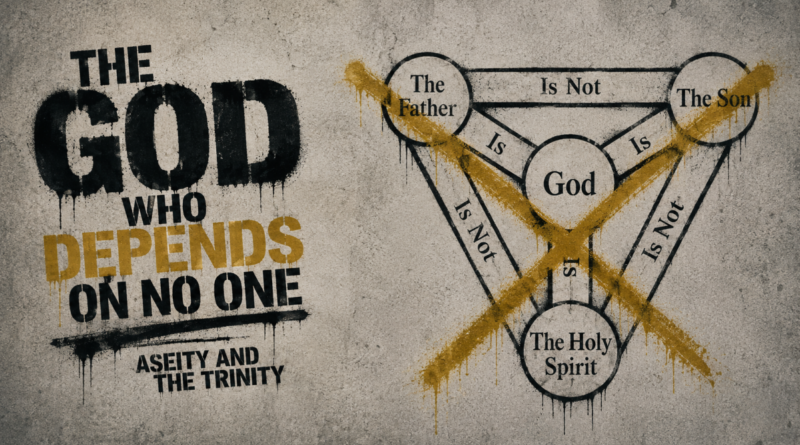
The God Who Depends on No One: Aseity and the Trinity
One of the oldest and least negotiable ideas about God is that He depends on nothing. Everything else in existence leans on something. A tree needs soil, a child needs parents, a flame needs fuel, a building needs a foundation. God, by definition, leans on nothing at all. He is the one reality that exists entirely from and through Himself.
Proclaim, “He is the One and only GOD. The Absolute GOD. Never did He beget. Nor was He begotten. None equals Him.” (Quran 112:1-4)
Theologians have a name for this quality: aseity, from the Latin a se, meaning “from Himself.” A being with aseity is self-existent, uncaused, and completely independent. Strip away everything else in the universe, and He would remain, unchanged, needing no one and nothing to prop Him up.
This is not a minor or optional attribute. It is close to the whole point of the word “God.” If God depended on something outside Himself, then that something would be more fundamental than God, and it—not God—would have the better claim to being the ultimate reality. So aseity is a kind of dividing line. Whatever is truly God must have it; whatever lacks it is, by that very fact, not God but a creature.
Here is where a serious problem appears for the Christian doctrine of the Trinity.
What the Trinity Claims
The doctrine of the Trinity says that the one God exists as three distinct persons: the Father, the Son (Jesus), and the Holy Spirit. These are not three gods and not three names for one person. They are said to be three genuinely distinct persons who share one divine being.
Crucially, classical Christian theology does not treat these three as interchangeable or as simply standing side by side. It describes them through what are called relations of origin:
- The Father is the source. He is “unbegotten”—He comes from no one.
- The Son is “eternally begotten” of the Father. The historic Nicene Creed calls Him “God from God, Light from Light, begotten, not made.”
- The Holy Spirit “proceeds” from the Father (and, in Western Christianity, from the Son as well).
In plain terms: the Father is the fountain, and the Son and the Spirit flow from Him. This ordering is not a temporal sequence—Christians are emphatic that the Son and Spirit never “began.” But it is a real ordering of origin. The Son gets His being from the Father. The Spirit gets His being from the Father. The Father gets His being from no one.
Now hold that picture next to aseity, and the tension becomes hard to miss.
No Single Person Can Stand Alone
Aseity means existing entirely from oneself, dependent on no one. Ask it of each person in turn.
The Son cannot have aseity. He is “begotten.” His very existence as the Son is described as coming from the Father. A being whose existence is from another is, by definition, not self-existent. To say the Son is begotten is to say His being is received, not underived. That is precisely what aseity rules out.
The Holy Spirit cannot have aseity for the same reason. He “proceeds.” His existence is derived from the Father. Whatever “procession” means in detail, it means the Spirit does not exist from Himself alone.
The Father, surprisingly, also cannot have aseity as a person. This is the point people miss. “Father” is a relational word. You cannot be a father without a child. The identity of the Father as Father is constituted by His relationship to the Son. In fact, one of the most influential Christian accounts of the Trinity (from Thomas Aquinas) says the persons simply are their relationships to one another—the Father just is “fatherhood,” the Son just is “sonship.” But if that is true, then the Father cannot be the Father on His own. Remove the Son, and there is no Father left. Each person is what it is only in relation to the others.
That is a beautiful description of interdependence. It is also the exact opposite of aseity. Aseity says: this being needs no one. The Trinity’s own internal logic says: each person is defined by needing the others. The Father needs the Son to be Father. The Son needs the Father to be Son. The Spirit needs the Father to proceed from. Taken as persons, none of the three can be said to exist “on His own.”
So the problem is not just about Jesus, or just about the Spirit. It reaches all the way to the Father. No individual person of the Trinity possesses aseity in Himself.
[35:15] O people, you are the ones who need GOD, while GOD is in no need for anyone, the Most Praiseworthy.
Every Escape Route Ends in Heresy
Christians have known about this tension for seventeen centuries, and the striking thing is that each attempt to resolve it collapses into a position the Church itself condemned as heresy. There are four main exits, and all four are walled off.
Exit 1: Say only the Father has aseity. This is the most natural reading—the Father is the source, so let Him alone be self-existent, with the Son and Spirit deriving from Him. But this makes the Son and Spirit dependent, derived, and therefore lesser—not fully God. That is subordinationism, and in its sharpest form, Arianism: the view (condemned in 325 CE) that the Son is a lower, derived being rather than truly God. The moment you protect the Father’s aseity by admitting the others lack it, you have demoted them out of the Godhead.
Exit 2: Give each person full, independent aseity. Let the Father, Son, and Spirit each be completely self-existent, dependent on no one, including on each other. This does preserve aseity—but now you have three beings, each of whom depends on nothing and stands entirely alone. That is not one God. That is three gods. This is tritheism, and it destroys monotheism outright.
Exit 3: Collapse the three into one. Say there is really only one self-existent God who merely appears in three modes—sometimes as Father, sometimes as Son, sometimes as Spirit, like one actor wearing three masks. This preserves both aseity and oneness. But it denies that the three are genuinely distinct persons at all. This is modalism (also called Sabellianism), and it too was condemned. It saves God’s independence by throwing out the Trinity.
Exit 4: Locate aseity in the shared essence, not the persons. This is the most sophisticated move and the one most theologians actually reach for. Say that aseity belongs to the one divine essence that all three persons share, rather than to the persons individually. The essence is self-existent; the persons share in it.
But look closely at what this concedes. It grants exactly the point at issue: the persons, as persons, are not each self-existent. The Father, Son, and Spirit derive their personal existence from one another, and only the abstract essence they share is a se. Yet Christianity does not tell people to worship an abstract essence. It tells them to worship God, the Father. If the persons are not individually self-existent, then the God actually addressed in prayer and worship is not, as a person, self-existent. And if you try to make the essence a self-standing thing in its own right, behind or beneath the three, you have quietly added a fourth item to the Godhead—a “quaternity”—which is no solution at all.
“But It’s Eternal”
The most common reply is that all of this misfires because the begetting and procession are eternal. The Son never began to exist; He was “begotten before all ages.” So, the reply goes, there is no dependence here, just eternal relationship.
But this answers a different objection than the one aseity raises. Aseity is not about when something exists. It is about whether its existence is derived. A being can be eternal and still be dependent. If the Son’s existence is, and always has been, from the Father, then it is eternally derived—and eternally derived is still derived. Saying “the Son never began” answers the worry did He come into being? It does not touch the worry does His being depend on another? Those are two separate questions, and aseity concerns only the second. Insisting the Son was never created is true to the doctrine, but it is simply not a claim about self-existence.
[25:2] The One to whom belongs all sovereignty of the heavens and the earth. He never had a son, nor does He have any partners in sovereignty. He created everything in exact measure; He precisely designed everything.
Where This Leaves Things
The argument can be stated in three lines. Aseity—existing from oneself, dependent on nothing—is a necessary mark of God. In the Trinity, no single person possesses aseity in Himself: the Son is begotten, the Spirit proceeds, and even the Father is defined by His relation to the others. Every attempt to repair this either strips two persons of full divinity (Arianism), multiplies God into three (tritheism), dissolves the three into one (modalism), or quietly relocates true self-existence away from the persons into a shared essence that no one actually worships.
Trinitarian theologians, of course, do not accept this as checkmate. Their deepest reply is that the whole argument misdescribes the doctrine—that aseity belongs to the one God who is the three, and that treating each person as a candidate for independent self-existence smuggles in a unit (“a person that must stand alone”) the doctrine never accepted in the first place. That is a real response, and it is where the honest disagreement actually lives.
But notice what it costs. To make that reply work, one has to say that the God who is self-existent is not any of the persons taken individually, but the tri-personal whole—and then explain how a “whole” made of mutually dependent parts can be the very thing that depends on nothing. That is a hard circle to square, and the difficulty of squaring it is exactly why the simpler intuition has such staying power: the God worthy of the name is the one who stands utterly alone, needing no Son to be Father, no Father to be Himself, and no third to complete Him. A God like that has no parts to hold together—because there is nothing, and no one, He depends on.
[4:171] O people of the scripture, do not transgress the limits of your religion, and do not say about GOD except the truth. The Messiah, Jesus, the son of Mary, was a messenger of GOD, and His word that He had sent to Mary, and a revelation from Him. Therefore, you shall believe in GOD and His messengers. You shall not say, “Trinity.” You shall refrain from this for your own good. GOD is only one god. Be He glorified; He is much too glorious to have a son. To Him belongs everything in the heavens and everything on earth. GOD suffices as Lord and Master.