
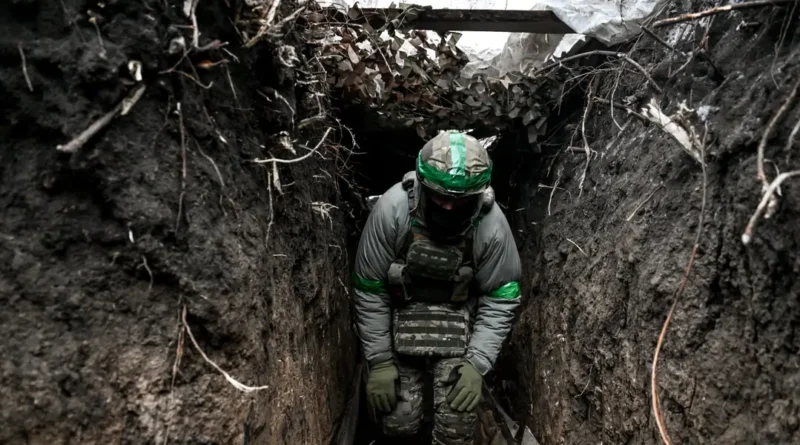
The big lesson one NATO military is taking away from its work with Ukrainian troops is: Don't get stuck in this kind of war
One of the big lessons that NATO member Norway has learned from training Ukraine to fight Russia’s invasion is that it cannot afford to get bogged down in this sort of war, its officers say.
NATO is worried about Russian aggression and the possibility of further armed conflict, and the alliance has been significantly increasing its defense investments while trying to learn from Ukraine.
The big lesson for Norway’s armed forces is that they need to prepare to prevent any conflict from turning into the kind of slog playing out in Ukraine, military officials heading up Operation Legio, the multinational, Norway-led training effort for Ukrainian soldiers, told Business Insider.
Maj. John, the S3 Operations Officer in charge of synchronizing the overall training operation, said, “I think the most important thing for Norway as a small nation is to avoid getting into that situation where we are now, with static, attritional warfare.”
“So we are looking for solutions for how to maintain maneuverability,” he told Business Insider at Camp Jomsborg, the purpose-built training site in NATO ally Poland, where the training takes place. The goal, John explained, is that “we can move, be dynamic.”
ROMAN PILIPEY/AFP via Getty Images
Russia likely cannot sustain another deeply attritional fight, “losing 35,000 people a month,” John said, that figure aligning with estimated losses in Ukraine. But Norway, as a much smaller country with five million people, “won’t exist as a nation for a very long period if that was to happen to us. So I think maybe to avoid getting into that situation is the key thing for us.”
Brigadier Atle Molde, the commander overseeing Task Force Legio, told Business Insider that “the most important lesson learned is: Don’t end up in a situation where Ukraine has to fight for their survival for years and years and years, taking thousands and thousands of casualties. Be prepared.”
That means being prepared on a whole-society level. Right now, he said, “we are not prepared. No Western country’s prepared.”
Part of that essential preparation means having the right technology and tactics, which means taking only the applicable lessons from the war in Ukraine and passing on those that aren’t or that Ukraine is employing out of a lack of better options.
It’s about being prepared from the society level down to preparing a single soldier to take down a drone with a shotgun, “and everything in between,” Molde said.
Norway is a NATO ally, meaning it has the protection provided by collective defense obligations, but it needs to focus on how it can maintain dynamic warfare, John said, using “air defense technologies that Ukraine is world-class on,” as well as counter-drone systems and electronic warfare measures to make sure that its mechanized units can still move. “We are still a mechanized army.”
Ukraine has developed cutting-edge battlefield technology and equipment that allies are studying closely, but many of those capabilities emerged only after the war had already settled into a grinding, static fight.
Both sides have built deep defenses, swarms of drones are constantly watching the battlefield, and it has become difficult to mass equipment and infantry for large-scale maneuvers. The area that now surrounds the front line is regularly described as a “kill zone.”
NATO’s Future Force Study in June said that forces need to prepare to maintain the ability to maneuver even under heavy observation. Many officials still warn that heavy attrition could be inevitable and that militaries must also be capable of surviving a prolonged, Ukraine-style conflict.
Ivan SAMOILOV / AFP via Getty Images
Ukraine pulled off the unexpected, surviving Russia’s attempt to seize the capital and pushing the war back into the east. With limited options early on in terms of higher-end equipment from allies, it held out against the Russian invasion with its arsenal of older Soviet-designed systems. Ukraine has since received greater Western support — including artillery, missiles, tanks, and fighter jets — but it is also investing heavily in its own defense.
Ukraine’s defense industry has boomed, but the country is still facing a difficult fight where breakthroughs are hard to come by and battlefield gains are often measured in hundreds of meters.
NATO militaries expect to avoid many of the challenges Ukraine has faced, and they have significant advantages in combat power over Ukraine, such as larger air forces that could seize control of the skies and potentially enable more successful progress on land.
The alliance, however, has acknowledged the need for masses of low-cost weaponry for both offensive and defensive actions. That has been another key lesson from the war, where both sides are building millions of drones each year.
“We are learning every day from the Ukrainians,” Molde said, sharing that lessons are being relayed back to the Norwegian military.
Norway is “integrating Ukrainian experiences on the front line into the development of our own defense,” Norwegian Prime Minister Jonas Gahr Støre said in April.
“Technology is evolving rapidly in Ukraine, and the Ukrainians are teaching us a lot about modern warfare,” he said.