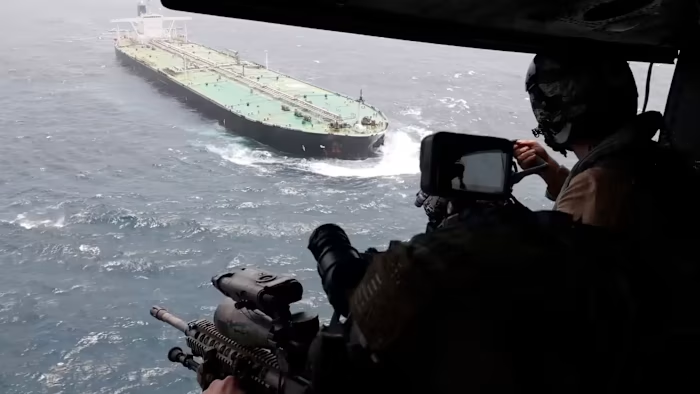
Iranian tankers gather off Sri Lankan coast
Unlock the Editor’s Digest for free
Roula Khalaf, Editor of the FT, selects her favourite stories in this weekly newsletter.
More than a dozen Iran-flagged tankers have gathered off the coast of Sri Lanka, as the US blockade all but halts access to Iranian ports six months into the war.
Ship tracking data shows that about 13 Iranian tankers are anchored on the edge of Sri Lanka’s territorial waters, alongside several others linked to Iran’s “shadow fleet”. They are prevented from returning to Iran by a US blockade on ships using Iranian ports, first imposed in April and reintroduced in July after the collapse of a month-long ceasefire.
“A flotilla of approximately 20 state-owned Iranian tankers, all empty of cargo, decided to seek shelter in the exclusive economic zone of Sri Lanka,” said Samir Madani, co-founder of the maritime intelligence firm TankerTrackers.com.
The ships’ draught levels indicated that they were empty, he explained — and therefore more likely to re-enter Iranian waters to pick up cargo. That made them “susceptible to attacks”, in “a pattern we’ve noticed when examining past air strikes on Iranian tankers by US Central Command”, added Madani.
The US blockade has proven to be one of the most successful tools in the US arsenal against Iran, preventing the country from importing fuel and earning revenue from oil exports.
Still, it has failed so far to reopen the Strait of Hormuz fully and end the war that began with the US-Israeli bombing campaign in February.
US Treasury secretary Scott Bessent said on Monday that the US would pile further pressure on Iran, expanding secondary sanctions to target entities doing business with Iran. Writing in the FT, Bessent described it as “economic D-Day”.
As of August 24, US forces said they had redirected 71 merchant vessels away from Iran, disabled three and boarded another two “to ensure compliance” with its blockade.
Since mid-July, no tankers bound for destinations beyond the Gulf have loaded at Iran’s main oil-exporting facility on Kharg Island, according to commodities platform Kpler.
Instead, empty tankers have been building up off the south-west coast of Sri Lanka and off Pakistan. A further 48, listed by the US-based campaign group United Against Nuclear Iran as trading Iranian crude oil, are loitering off Malaysia in an anchorage traditionally used by Iranian ships to transfer cargoes to Chinese vessels bound for independent “teapot” refineries in China, UANI said.
The tankers off Sri Lanka were skirting its territorial waters in case of an approach from the US Indo-Pacific Command, analysts said. Under international law, the US cannot hit ships within another country’s territorial waters, which extend 12 nautical miles off the coastline.
In March, a US submarine sank an Iranian frigate, the IRIS Dena, some 19 nautical miles from the Sri Lankan coast.
Sri Lanka’s ports ministry and navy said they were unaware of Iranian tankers gathering off the country’s coast. The foreign ministry and the harbourmaster at Sri Lanka’s port authority in Colombo did not respond to requests for comment.
Although successful in halting the passage of Iranian ships, the US blockade was unlikely to achieve its aim of reopening the contested strait, said Brett Erickson, managing principal of Obsidian Risk Advisors.
He added that Bessent’s “economic D-Day” risked “an Iranian retaliation that devastates the global economy”.