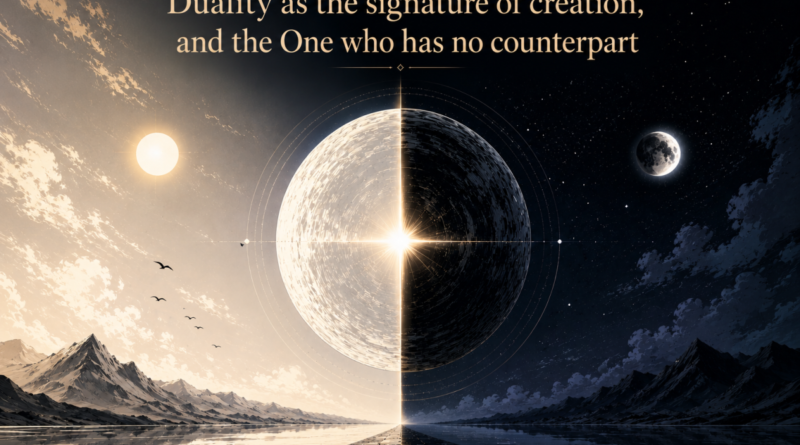
Duality as the signature of creation, and the One who has no counterpart
[51:49] We created a pair (male and female) of everything, that you may take heed.
وَمِن كُلِّ شَىْءٍ خَلَقْنَا زَوْجَيْنِ لَعَلَّكُمْ تَذَكَّرُونَ
One short sentence advances a claim of staggering scope. Not some things, not most things, but min kulli shayʾ—of every thing—come in twos. And this universal doubling is not offered as a curiosity of natural history. It is offered as an occasion for tadhakkur: remembrance, recollection, the mind being brought back to something it half-knew already. Duality is presented as a sign, and the thing it signifies is conspicuously not dual. To read the verse closely is to watch creation’s most pervasive feature turn, under the pressure of reason, into a pointer toward the One who shares that feature with nothing.
The word that carries the argument
The verse does not say ithnayn, “two,” as a bare number. It says zawjayn—two mates, the dual of zawj. This choice does the real work. A zawj is not simply one item in a count; it is a member of a relation. A zawj is a partner, a spouse, a complement—the very word the Quran uses for a marriage-mate (30:21) and for the paired kinds of created things (36:36, 43:12, 53:45). To be a zawj is to be essentially oriented toward another: incomplete on its own, defined by what it lacks, drawing its meaning from a counterpart.
So the claim of 51:49 is stronger than “things come in twos.” It is that every created thing is a half—a term in a pairing, constituted by relation. Male stands to female, night to day, heaven to earth, sea to land, the two easts to the two wests of Sūrat ar-Raḥmān, positive to negative, one to the other. Nothing made stands utterly alone. Relationality is stamped into the grammar of the created word itself.
The logic of the half
Why should this be so? Reason can supply the connective tissue the verse leaves implicit.
To be created is to be contingent—to have received one’s existence rather than to possess it in one’s own right. A contingent thing does not contain the sufficient reason for its own being; it points beyond itself. And this “pointing beyond” shows up, at every level, as pairing. A thing that needed nothing outside itself would be a thing without a complement, without an opposite, without a mate. It would be self-enclosed, self-sufficient, whole. But nothing in creation is like that. Everything leans. The electron requires its charge-opposite to be intelligible as a charge at all; the male means nothing biologically without the female; “up” is empty without “down.” To be a creature is to be one side of a relation.
Pairing, then, is not an accident of how the furniture of the world happens to be arranged. It is the visible form of contingency. The mark of the made is that it is never whole by itself. Each thing wears its dependency openly, in the shape of the counterpart it cannot do without.
There is even an epistemic corollary. We know things by contrast—light against dark, motion against rest, figure against ground. To define is already to divide: to say what a thing is is to draw the line where it stops and its negation begins. The created intellect operates by duality because the created world is built of it. This is precisely why the pairs can teach—why the verse ends in tadhakkur rather than mere observation. A dual mind, reading a dual world, is being led somewhere.
The One who has no counterpart
Follow the logic one step further and it forces a conclusion the Quran states directly. If everything created is paired—half, relational, dependent—then whatever is not created can have no pair. The One who makes the mates cannot Himself be a mate, on pain of being just another creature inside the series.
The Quran draws exactly this line, and it draws it with the same word that appears in our verse. 51:49 says “of every thing (shayʾ)” pairs were made. And 42:11 says: laysa ka-mithlihi shayʾ—”there is nothing (shayʾ) like unto Him.” Every shayʾ is paired; but He is not a shayʾ among things, not an item in the inventory of the made, and therefore not paired. The verbal echo is not decoration. It marks the exact seam between the created order, where duality reigns, and its Source, over which duality has no grip.
Sūrat al-Ikhlāṣ completes the thought with surgical economy. “He is God, aḥad” (112:1)—and the Arabic distinguishes aḥad from wāḥid. Wāḥid is “one” as the first term in a series that continues into two and three; it is one-that-could-be-followed. Aḥad is oneness that admits no second at all, a unity so total it cannot be counted because counting already presupposes more to come. The sura then spells out what such Oneness excludes: lam yalid wa lam yūlad—He neither begets nor is begotten (no lineage, no derivation, no reproduction, which is the paradigm case of pairing). And it closes: wa lam yakun lahu kufuwan aḥad—”there is none equal to Him.” Kufuw is a matching partner, a peer of the sort that makes a marriage or a rivalry. The final word of the sura denies God a kufuw—denies Him, precisely, a mate.
Read together, 51:49 and 112 form a single argument. Creation is mated; the Creator is unmated. And aṣ-Ṣamad (112:2), often rendered “the Self-Sufficient” or “the Absolute,” seals it: to be Ṣamad is to be the one on whom all depend while depending on none—which is only another way of saying the one who needs no complement, who is not half of anything. Contingency wears the face of the pair; necessity wears the face of the One.
Why the two remind us of the One
Now the closing phrase, laʿallakum tadhakkarūn, becomes legible. Why should pairs prompt remembrance rather than, say, calculation?
Because the creature’s own incompleteness is the reminder. Every time a thing reaches for its complement—every hunger, every attraction, every dependency—it enacts a small confession: I am not enough by myself. And that confession, generalized, is the intimation of a Being who is enough by Himself. My duality reminds me of His unity; my need reminds me of His sufficiency; the fact that I am a half reminds me that He is not. The pairs are a mnemonic for the One, working not by resemblance but by contrast: they teach the unpaired precisely by being paired.
This also dissolves an old puzzle. If the mind knows only by dividing and contrasting, how can it grasp a One that has no opposite to be contrasted with? The verse’s answer is that we do not grasp Him as one more object set against its background. We are reminded of Him—led back to Him through the failure of every created thing to be self-standing. The pairs do not picture God; they point past themselves to what has no picture, in the same breath in which 42:11 forbids any likeness. The knowledge at the end of the road is apophatic: we approach the One by removing from Him everything that makes a thing a thing—above all, its pairing.
That the verse says tadhakkur—re-membering, being reminded—rather than taʿallum, learning afresh, is itself suggestive. It frames the recognition of the One not as the acquisition of new data but as the recovery of something the self already carried and had covered over. (The Quran elsewhere locates such a prior knowing in the primordial acknowledgment of 7:172, “Am I not your Lord?”) The dual world does not install the knowledge of Oneness; it jogs it.
Reason’s ascent: why the two presupposes the One
Here the argument can be pressed on purely rational grounds, and it is worth marking where it leans on a framework external to the text.
Every pair is two ones. There is no “two” that is not composed of unities; the dyad is parasitic on the monad. You cannot have a couple without first having each of the two, and you cannot have “each” without the notion of one. Plurality, in other words, always presupposes unity—multiplicity is unity counted more than once. So the pervasive twoness of creation cannot be self-grounding. It points upstream to a Oneness that is not itself one-of-a-count but the very condition under which counting, pairing, and multiplying become possible.
This move—that the many depend on a One that is beyond the series of numbered things—is the spine of the Neoplatonic ascent to “the One beyond being,” and I flag it as an import rather than a Quranic doctrine. But it converges on the text with unusual precision. It explains why the regress does not run forever. If every thing is paired, one might worry that the pair is itself a thing needing its own pair, and so on without end. The regress halts only because its terminus is not a thing—laysa ka-mithlihi shayʾ. The One stops the infinite ladder of pairs by refusing to be a rung on it. Reason reaches for a non-thing to ground the things; the Quran names it.
The pair as the engine of becoming
Duality is the engine of change. Where there are two poles, there is tension, and tension is motion: day gives way to night and back again, the seasons turn on their opposites, life and death chase each other through every generation. A world of mates is inescapably a world of becoming, pulled perpetually between its poles, never at rest. Time itself may be read as the working-out of this polarity—the oscillation that duality makes inevitable.
If so, then the One who has no pole is, by the same logic, not subject to becoming. Nothing pulls Him between contraries; He is not stretched between a “not yet” and a “no longer.” The Quran gives this its own image: kullu man ʿalayhā fānin, wa yabqā wajhu rabbika—”Everyone on earth perishes. Only the presence of your Lord lasts. Possessor of Majesty and Honor” (55:26–27). What perishes is the paired, the dual, the thing caught in the tension of becoming and passing—which is itself a pair. What remains is the One, whose unity places Him outside the churn that duality drives. Permanence, on this reading, is not a property the One happens to have; it is what it means to have no counterpart to be pulled toward.
Shirk as the counterfeit pair
The verse also reframes the Quran’s central prohibition. If duality is the mark of the created and Oneness the mark of the Creator, then the archetypal error—shirk—is exactly the smuggling of the created structure back into the divine. To “associate partners” with God is, structurally, to give Him a zawj: a mate, a rival, a second.
The Quran’s own words for idolatry make this literal. “Do not set up rivals (andād) to God” (2:22)—a nidd is a peer, a counterpart, an equal-and-opposite. Every dualist theology that pairs a god of light with a god of darkness, and every theology that folds relation and generation into the Godhead, does the same thing from the tawhīd vantage: it projects onto the One the very pairing that belongs only to the made. To insist that God has no kufuw (112:4) is to refuse that projection at the root. Radical monotheism, on this reading, is not one metaphysical option among several. It is simply the refusal to mistake the signature of creatures for the nature of their Source.
“And of what you do not know”
One more clause deserves weight. A parallel verse widens the scope explicitly: “Glory to Him who created all the pairs—of what the earth grows, and of themselves, and of what they do not know” (36:36). The pairing extends past the catalog of observed opposites into mā lā yaʿlamūn—the unknown. The claim is not merely that the pairs we happen to have noticed come in twos; it is that pairing is a law reaching into regions not yet surveyed.
It is tempting to cash this out in the currency of modern physics—matter and antimatter, particle and wave, spin up and spin down, the charge-conjugate partners of the standard model—and the resonance is real and striking. But honesty about method requires restraint. The verse is not a physics paper, and reading later discoveries back into it as proof risks turning a metaphysical sign into a concordist parlor trick, hostage to the next revision of the theories. The disciplined reading is more modest and more durable: the text asserts that duality is a deep and general feature of the made, extending beyond the observed—and the repeated confirmation of that pattern, wherever inquiry has reached, is at least consonant with the claim. The sign was never that “the Quran predicted antimatter.” The sign is that incompleteness goes all the way down, and that it points somewhere.
The completeness that incompleteness remembers
Return, finally, to where the verse ends: that you may take heed.
The whole movement is compressed there. Look at anything closely enough, and you find it leaning on a counterpart—half of a pair, a zawj to some other zawj, unable to stand or to mean alone. That universal leaning is the fingerprint of createdness: to be made is to be incomplete. And an incomplete thing, felt as incomplete, is a standing reminder of the one Being who is not—the aḥad with no second, the Ṣamad who needs nothing, the one “like whom there is no thing,” who neither begets nor is begotten and has no equal to pair with.
So the verse turns the entire furniture of the world into a single sustained gesture pointing away from itself. Every pair is a sentence whose subject is elsewhere. The twos are not the message; they are the finger. And what they point to, by being exactly what it is not, is the One—remembered, at the far end of every duality, as the only thing that was ever whole.
[35:15] O people, you are the ones who need GOD, while GOD is in no need for anyone, the Most Praiseworthy.
يَٰٓأَيُّهَا ٱلنَّاسُ أَنتُمُ ٱلْفُقَرَآءُ إِلَى ٱللَّهِ وَٱللَّهُ هُوَ ٱلْغَنِىُّ ٱلْحَمِيدُ