Bosnia and Palestine share more than many realise
In the middle of the Yugoslav-(Serbian) aggression against Bosnia, specifically in 1993, some Bosnia-based Western war correspondents used an interesting term in their descriptions of the situation, albeit mainly off the record.
Reporters were saying something like,
We are witnessing the ‘Palestinisation’ of Bosnia.”
Soon after that, even some local journalists, politicians too (anonymously), started labelling Bosnian Muslims/Bosniaks “Palestinians of Europe”.
Readers should be reminded that this was going on during the systematic ethnic cleansing of Bosniak civilians from many parts of the country. This resulted in genocide as we now know. Such a comparison was a bit ironic and to some extent realistic at the same time. This phrase survived a war and genocide, it has stayed in occasional public usage even today.
Besides a destiny of suffering and tragedy that Bosnia as a country and Bosniaks as an indigenous population went through, there are current political as well as historical reasons for such a comparison, related to some events in this country which happened a long time before the aggression and war from the 1990s.
For those who may find this surprising, here is a reminder of the political, cultural, and historical things that Palestinians and Bosniaks have in common.
Different genocides, same results
Let’s see what could be compared in connection between Bosniaks and Palestinians, both in the past and today.
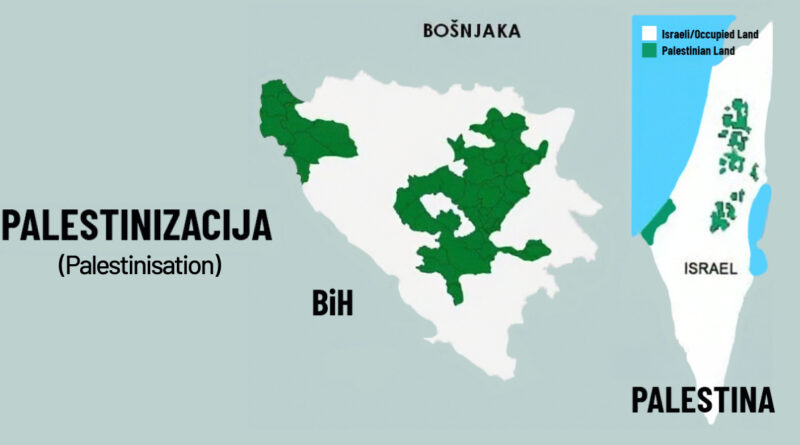
Firstly, as we can see in the main article image, there is a map of Bosnia and Herzegovina (BiH) next to the map of Palestine, with large parts marked showing lost areas where Palestinians and Bosniaks were once the majority. (In this case, majority means they had political, demographic, and economic control of the country, it is not just about the percentage majority in the number of inhabitants.)
The Bosnian map shows how, in less than one century, the majority of the population have been compressed into approximately 23-25 per cent of their own state. Unsurprisingly, in this shrunken territory, they have a limited political influence, a watered down ability to go about their life. The Palestinian map shows something similar: how the Palestinians were once the majority in their own country, yet for decades thereafter have been restricted and forced into ghettoised regional points, disconnected from each other.
And here are lots more points for a deeper comparison:
| Theme | Palestinians | Bosniaks |
|---|---|---|
| Massacres and genocide | The Palestinians have Sabra and Shatila, places where Lebanese Christian militias in coalition with Israeli Zionists committed a major war crime in 1982.
The mass shootings of Palestinian civilians in those refugee camps had a genocidal character, but the event was still not recognised as genocide by the international bureaucracy. |
The Bosniaks from the Aggression period (1992–95) have towns such as Srebrenica and Žepa for comparison.
However, most of the east and north area of the country, together with the town of Prijedor, would fit here. |
| Historical suffering | The Palestinians were living under the British Mandate during the Second World War, just a few years before the official founding of Israel after WWII. | Like the Palestinians, Bosniaks experienced genocidal campaigns across different periods of history, including during the Second World War and the 1992–95 aggression. |
| Denial of identity, history, and land | The Palestinian national identity is still denied today by Zionists and some evangelical circles in the US, just as their past is denied, as is their ownership of the land. | Bosniaks are denied their identity, history, and culture among influential political circles in Montenegro, Croatia, and Serbia, and also within Bosnia sometimes. |
| Propaganda and dehumanisation | Palestinians are, among other things, victims of the mythomania that accompanies Zionism, the falsification of Jewish religion, ethnicity, and racist propaganda.
Palestinians have been dehumanised for decades in American and Israeli media. |
Bosniaks are victims of Yugoslav, Greater Serbian and partly Greater Croatian manipulative mythology enriched with chauvinism and ideological indoctrination.
Bosniaks have also been dehumanised for decades through communist education, propaganda, and some contemporary narratives. |
| Justifications for dispossession and violence | In seizing land from Palestinians, the Zionists are abusing the old racist premise of the Hebrews as a “chosen people” to whom everything is permitted as such. | In the genocidal campaign against Bosnia, Greater Serbian slogans referred to the Serbs as a “heavenly people” who, as such, were “guaranteed” justification for their crimes in advance. |
The above are all points that go back to the respective genocides in Bosnia and Palestine, but there are also some heartwarming links.
- Throughout Palestine, there are many Bosniak awqāf (endowments) from the Ottoman past. Some of them were usurped under the Israeli occupation, and some were destroyed.
- In Bosnia, there are descendants of children from Bosniak-Palestinian marriages, officiated during the Ottoman Caliphate.
- Some Palestinians still use the term “bushnaq”, an old Arabic term for a handsome person, and also a name for Muslims from Bosnia who once served in the Ottoman Army or worked in various Palestinian areas.
Living under constant threat and pressure
On a daily basis, radical Jewish settlers are violently seizing or destroying the property of Palestinian natives, physically attacking them along the way. Simultaneously, Serbian chauvinists are occasionally attacking Bosniak returnees in the Bosnian Serbs’ political territory, “Republika Srpska”, leaving threatening or insulting messages. Sometimes, Croatian extremists in parts of Bosnia (where their political party controls the local government) are conducting similar incidents.
Such a pattern can also be seen in how almost every Palestinian reaction or defence is labelled in advance by the Western media as terrorism, whether it is the PLO, Fatah, or Hamas. Likewise, every reaction of Bosniak individuals to previous mass oppression is labelled in the plural form by media, i.e. as an indictment of the entire population. For years, the Army of the Republic of Bosnia and Herzegovina has been belittled, and attempts have been made to present it in the media as criminal on the same level as the former Yugoslav–Serb army or radical Croatian units.
There are also religious parallels. Palestinians are a majority Muslim population living with a Palestinian Christian minority. Bosniaks are a majority Muslim population living with a Christian minority where Bosniaks have local government. During the 1990s war, a certain percentage of non-chauvinist Bosnian Serbs (Orthodox Christians) and Bosnian Croats (Catholics) joined the Bosnian Army or simply had no problem surviving the war together with Bosnian Muslims, in the area under the Bosnian Army’s control. Palestinian Muslims also live together with Palestinian Christian minority compatriots, jointly surviving and resisting the Zionist oppression.
There are also similarities in the role of external political influence. Israel has a strong political lobby in the US. Serbia and Croatia also have strong political lobbies in the US, plus Europe and Russia.
At the same time, both societies have histories of coexistence that predate modern conflicts. Before the establishment of the State of Israel, Palestinians and Jews lived peacefully together for centuries, and some still do today, depending on the strength of Zionist pressure for apartheid. Before and after the attack on Bosnia and Herzegovina, Bosniaks lived in peace with local Croats and Serbs, except in places where an artificial division prevailed by force.
Zionists advocate apartheid in Palestine, Serb and Croat political authorities advocate apartheid in Bosnia. A couple of years ago, Benjamin Netanyahu was invited for a friendly visit to the Bosnian city of Mostar, by the leader of the Bosnian Croat political party. It never happened but it showed nationalist, political, and perhaps an ideological connection between those who are destroying Bosnia and Palestine, albeit in different ways. And on this same point, the most influential Bosnian Serb politician of today, Milorad Dodik, has a close friendship and diplomatic relationship with the controversial Israeli businessman and politician Avigdor Lieberman.
Parallels in occupation and resistance
The military siege of the Gaza Strip is one of the longest in the world, and is still ongoing. Infrastructure was been totally destroyed and countless Palestinian civilians have been killed by bombing, including many children.
As Muslim-majority enclaves, Bosnian cities like Sarajevo, Mostar, and Goražde faced prolonged artillery sieges, during which thousands of civilians were killed, wounded, and crippled, including a lot of children. All of that happened even before the most notorious massacre in Srebrenica took place. The events of July 1995 in Srebrenica were the first genocide on European soil since the WWII until today.
Sarajevo is sometimes symbolically referred to in tourist presentations as the “Balkan Jerusalem” or “European Jerusalem”. Radical Serbs want to divide Sarajevo along ethnic and confessional lines. The Zionists have already divided al-Quds.
During Ramadan, Israeli police and settlers invade Islamic holy sites such as al-Aqsa, beating up pilgrims. In the Serb political entity of Bosnia, during Ramadan, there is always someone writing chauvinistic graffiti on mosques and the homes of Bosniaks.
For Palestinians, Hebrew settlers or even the Israeli army sometimes destroy olive groves, knowing that they are only or main source of income, thus inducing the owners to move elsewhere. In the Serb-controlled part of Bosnia, some Bosniak returnees have their cattle or other livestock poisoned, effectively telling the owners that they would be better off moving away.
Manipulative propaganda is out there for a very long time
In 1988, the Serbian-Jewish Association was founded in the Serbian capital, Belgrade. The association later had a branch open in Tel Aviv. One of its presidents, a certain Klara Mandić, lobbied for stronger ties between Israel and Serbia before the collapse of communist Yugoslavia, and then during the era of Serbian dictator Slobodan Milošević.
In 1993, a passionate Zionist named Arnold Sherman from New York, who lived and fought in Israel, published the book Perfidi in the Balkans; the Rape of Yugoslavia. The book relies heavily on outdated, but also refreshed Serbian propaganda about the so-called “Islamic threat” in Europe, referring mainly to Bosnian and Albanian Muslims.
Sherman states that Israel and Serbia have a common enemy among the Muslims in Bosnia, suggesting that he himself fought against the same kind of “enemy” in Israel. All of this, and more, contributed to partial military co-operation between Milošević’s Yugoslavia and Israel during the aggression against Bosnia.
Years later, two prominent Israelis, genocide scholar Yair Auron and lawyer Itay Mack, proved Israel’s involvement in the war in Bosnia, among other things, in a Tel Aviv court. This included the Zionists sending weapons to the Serbian war criminal, then Army General Ratko Mladić. Countless Israeli-made Uzis were used by the notorious Serbian paramilitary known as the Red Berets. According to Auron and Mack, Israeli special forces allegedly trained Serbian special forces in Greece during the 1990s. [1]
One important difference
Of course, in addition to the listed similarities in the situations with Palestine in relation to Bosnia, there are also many differences. We will not deal with them here, except to point out one significant difference, probably temporary. Palestine is still fighting for its recognition, not only as a people but also as a state. Perhaps it will succeed one day, although it is under tremendous pressure from Israeli lobbies around the world that are blocking everything in this regard.
Alhamdulillāh, Bosnia is an internationally recognised country with its own state borders and passport. But it is still surrounded by not-so-friendly neighbours, politically, economically, culturally, and ideologically. Right now as you are reading this, many municipalities in Bosnia have Serbian national flags flying in public, from the street to governmental institutions. There are still comments about exclusive Serb land in the parts of the country where Bosnian Muslims were the majority for centuries, but today they are minorities because many of them were either systematically executed back in the 1990s or expelled from their homes. So in that sense, denial of Bosnia as a country and anti-Muslim sentiment are still out there, both inside Bosnia as well as around.
On a lesser scale, similar political signals are coming from Croatia, from time to time. There are parts of Bosnia where Croatian flags are flying in public and government institutions. Both Serbian and Croatian-controlled media are watching the reaction of the Bosniaks to the ongoing genocide in Gaza. Every time there is a street demonstration in the Bosnian capital of Sarajevo — supporting Palestinians in Gaza or in general — the Serb and Croat nationalist media immediately label Bosniaks as Hamas supporters or collaborators. This has become a common occurrence.
The bottom line is this problem started with manipulation, i.e. using a popular terminology imported from the Western media — “terrorists”. Genocidal attackers and invaders are calling their respective targets the same thing. Therefore, we can recognise one final common detail between Bosniaks and Palestinians.
Source: Islam21c
Notes
[1] https://mondoweiss.net/2016/12/holocaust-professor-complicity/