What Is Iran’s Pickaxe Mountain Trump Is Threatening?
Topline
President Donald Trump renewed his threats on Iran’s Pickaxe Mountain on Tuesday, admitting he doesn’t know if Iran has moved centrifuges there—hours after a report said Israeli intelligence suggests it has.
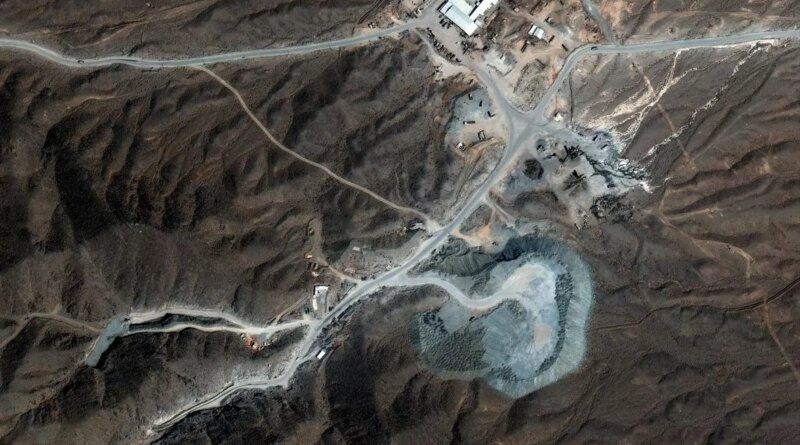
Vantor satellite image shows tunnel construction activity and road infrastructure near the Natanz nuclear facility in the mountainous area around Pickaxe Mountain. Please use: Satellite image (c) 2026 Vantor.
DigitalGlobe/Getty Images
Key Facts
Trump told reporters Tuesday while meeting with the president of Lebanon, “we’ll be hitting that area very probably pretty soon . . . and very heavily,” he said when asked about Pickaxe Mountain, located near Iran’s Natanz uranium enrichment facility.
Trump said Iran “may have” stored centrifuges used to enrich uranium there, but that the U.S. doesn’t “have it on record.”
Trump made the comments after the Wall Street Journal reported that Israel provided the U.S. with intelligence suggesting Iran has moved centrifuges to the site.
Even if they had moved centrifuges there, Trump said, “it doesn’t mean anything unless they have the [nuclear] material,” insisting, “they don’t have it.”
Trump has repeatedly threatened Pickaxe Mountain, telling conservative radio host Hugh Hewitt last week it is “a possible target for a nice, big, fat shot right in the front door,” but said, “we don’t see any activity there.”
What Is Pickaxe Mountain?
The site is located 140 miles south of Tehran and less than two miles from the Natanz nuclear complex, one of three the U.S. bombed in June last year. The mountain acts as a shield for an underground tunnel complex, with two pairs of entrances visible in satellite imagery, the Institute for Science and International Security said in a report last week. Iran began fortifying the entrances and building a secure perimeter surrounding the entire mountain and Natanz in 2025, according to the Institute for Science and International Security. Iran publicly announced its intention to have nuclear activity at Pickaxe Mountain as “part of their quite systematic intention to put their most sensitive facilities underground,” International Atomic Energy Agency Director-General Rafael Grossi told PBS in March. “This was not a secret.” Since Pickaxe’s facilities are protected by the mountain, the U.S. could more easily attack it with ground forces, according to the Institute for Science and International Security, which noted “deep earth penetrating weapons via aerial attacks” could effectively penetrate the mountaintop. The U.S. could also target above-ground power supply lines, ventilation shafts or the tunnel entrances.
Crucial Quote
Trump said Tuesday the U.S. is “not finished at all” with the war, adding that Iran hasn’t “seen anything yet. We have been nice,” he said.
Key Background
Iran and the U.S. have been fighting every day for over a week after a cease-fire the two sides agreed to last month collapsed, though both sides have said they’re open to reconvening negotiations. Iran has concentrated its attacks in Kuwait, Bahrain and Jordan, which all host U.S. military bases. Meanwhile, Iran-backed Houthi militants in Yemen complicated the war this week by announcing a blockade of Saudi ships and threatening to fire on vessels passing in and out of the southern end of the Red Sea. Trump said Tuesday the U.S. would attack the Houthis if they followed through on their threats. Trump dismissed assertions Iran appears uninterested in a peace agreement, telling a reporter Tuesday who made the observation, “you don’t know what the dialogue is behind the scenes,” claiming, “they want to desperately meet. And until they’re ready to meet in a meaningful way, we have no interest.”
further reading
Pentagon Denies Hiding Injury Stats—After Report Dozens Were Hurt In Undisclosed Iran Strikes (Forbes)
U.S. Service Member Killed In Iraq—After 2 Deaths In Jordan (Forbes)
Two U.S. Service Members Killed In Iranian Strikes Against Jordan (Forbes)