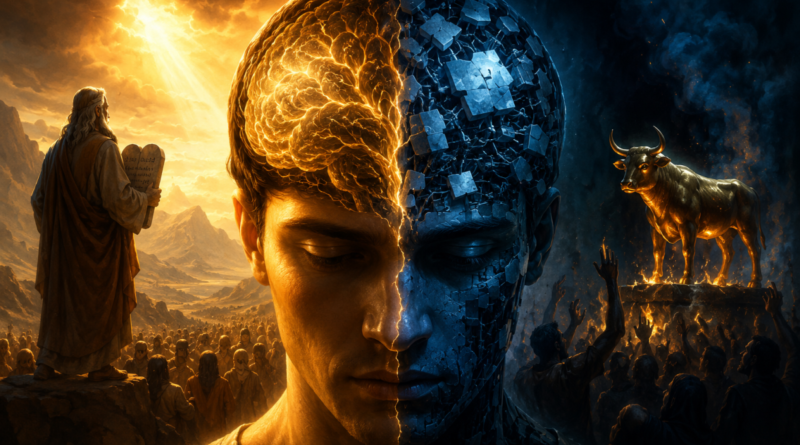
Moses & Aaron and the Allegory of the Mind
The Divided Brain
In 2009, the British psychiatrist, neuroscientist, and philosopher Iain McGilchrist published a book called The Master and His Emissary: The Divided Brain and the Making of the Western World. It is not a light read. It runs nearly six hundred pages, draws on neuroscience, philosophy, literature, and the history of Western civilization, and it makes one of the most consequential arguments about the human mind that has been put forward in decades. The core claim is this: your brain is divided into two hemispheres—a left and a right—and they do not simply divide up tasks between them. They represent two fundamentally different ways of encountering reality. And the relationship between them is not one of equals.
Before we go further, let’s clear something up. You’ve probably heard the pop psychology version of this: left brain equals logical and analytical, right brain equals creative and artistic. That version, McGilchrist argues, is largely wrong—or at least so oversimplified as to be misleading. Both hemispheres are involved in almost everything you do. Both can reason. Both process language. The difference is not what they do but how they do it—what they pay attention to, what kind of reality they bring into view.
Here is the distinction that matters.
The right hemisphere attends to the world in a broad, open, holistic way. It sees things in context. It perceives wholes before parts. It is attuned to living things, to relationships, to the unique and the embodied—to the face of a person you love, to the tone of voice behind the words, to the sense that something matters before you can articulate why. The right hemisphere is where new experience first lands. It is where we encounter what is genuinely other, genuinely surprising, genuinely alive. McGilchrist calls it the Master—not because it controls more functions, but because it has the broader grasp of reality. It sees the world as it actually is: complex, contextual, full of meaning that cannot be fully captured in a formula.
The left hemisphere attends to the world differently. It focuses narrowly. It breaks things into parts. It categorizes, abstracts, and systematizes. It is the hemisphere of language in the sense that it processes the formal rules of grammar and syntax—the mechanics of saying things. It is comfortable with what is already known, already mapped, already reduced to manageable units. It is brilliant at manipulating representations of the world—models, symbols, categories—but it tends to forget that these representations are not the world itself. McGilchrist calls it the Emissary: a brilliant servant that was appointed by the Master to do a specific kind of work, but one that has, over time, begun to believe it is the Master.
To understand this dynamic, consider what happens when you hear a symphony. Something arrives in you that is immediate and total. The emotion comes before you can name it. The sense that the piece is building toward something—that this particular passage is heartbreaking, or triumphant, or restless—registers as a whole experience. You feel it as one thing. That is your right hemisphere at work. It hears the symphony. Now imagine a music theory student sitting in the same concert hall, following along with the score. They can identify every note, mark every rest, name every chord change and key modulation. They know, with technical precision, exactly what is happening at every moment. That is the left hemisphere at work. It hears the notes. Both people are listening to the same piece of music, but they are having, in an important sense, two different experiences—one richer and more whole, one more precise and more analyzable. McGilchrist’s argument is not that the note-by-note analysis is wrong or useless. It is that the analysis was always supposed to serve the symphony—to deepen your encounter with it, not replace it. When the left hemisphere forgets this, you end up with someone who can tell you everything about a piece of music and has stopped actually hearing it.
Or consider a joke. A good joke lands in an instant—the punchline arrives and something clicks, a kind of recognition that is faster than thought, and you laugh before you have consciously processed why. That click is the right hemisphere perceiving the incongruity, the surprise, the gap between what was expected and what was delivered—all at once, as a whole. Now try to explain why the joke is funny. The moment you begin to dissect it—this word sets up that expectation, which is then subverted by this substitution—the joke dies on the table. The left hemisphere can perform the autopsy with complete accuracy. It can identify every mechanism. It simply cannot tell you why any of it was funny, because funny is not a mechanism. It is an experience that arrives whole or not at all. This is not a flaw in the left hemisphere. It is a feature. The left hemisphere was never designed to catch the joke. It was designed to analyze it afterward—to help you understand the structure so that the right hemisphere’s encounter with the next joke might be richer. When the Emissary forgets that, it becomes the person in the room who responds to every punchline by saying: “I see what you did there”—and wondering why no one is laughing.
The proper relationship between the two hemispheres, McGilchrist argues, flows in a specific direction. The right hemisphere first encounters the world in its full complexity. It then passes what it has perceived to the left hemisphere, which analyzes, unpacks, and renders it into usable form—language, categories, tools. And then—crucially—the left hemisphere is supposed to hand that processed understanding back to the right hemisphere, which reintegrates it into a richer, more embodied whole. The cycle is: right to left to right. Perception to articulation to wisdom.
When that cycle is intact, the two hemispheres work in creative tension. When it breaks down—when the left hemisphere stops reporting back to the right, when the Emissary starts to believe it knows everything—something goes wrong. The map gets mistaken for the territory. The category gets mistaken for the living thing. The word gets mistaken for the reality the word was pointing at. And the Master—the right hemisphere, with its broader, more honest grasp of the world—gets ignored, overruled, or simply forgotten.
The Structure
Now. Hold that framework in mind, and notice how the story of Moses and Aaron can serve as an allegory for precisely how the brain operates under this model—and what happens when it doesn’t.
Moses is the prophet who spoke directly with God and experienced the divine firsthand. But Moses has a problem. When God first commissions him, Moses objects:
“I may lose my temper. My tongue gets tied; send for my brother Aaron.” (Quran 26:13)
The man chosen to convey the most consequential revelation of his age cannot speak it easily. He perceives the divine directly, yet he struggles to communicate it.
In our allegory, Moses is the right hemisphere. He is the Master. He goes up the mountain alone. He encounters God in a way that is total, simultaneous, overwhelming—the burning bush, the direct speech, the face that shines so brightly on his return that people recoil from it. He brings back something real, something vast, something that exceeds what language can contain. But he cannot, by himself, communicate it to the people in the camp below.
Aaron is Moses’s brother, appointed by God specifically to aid Moses. Moses requests to bring him along on his mission for this very reason.
“Also, my brother Aaron is more eloquent than I. Send him with me as a helper to confirm and strengthen me. I fear lest they disbelieve me.” (Quran 28:34)
Moses is the one who had the experience; Aaron will articulate it for the masses. Moses is the source; Aaron is the instrument. Between them, they form one complete act of communication: the vision and its translation, the perception and its transmission.
In our allegory, Aaron is the left hemisphere. He is the Emissary. He is the spokesman, the assistant, minister, vizier.
We have given Moses the scripture, and appointed his brother Aaron to be his assistant (وَزِيرًا / vizier). (Quran 25:35)
He takes what Moses has experienced on the mountain and renders it in the linear medium of language for people. He is not less important than Moses—the people cannot access what Moses knows without Aaron. But his authority is entirely derivative. He speaks because Moses struggles, not because he has independent access to the experience. Aaron without Moses is a mouthpiece without the firsthand account of the truth behind it.
The Children of Israel are the people—the bani Isra’il—and they represent something every single person listening to this will recognize immediately, because we live as them every day. They represent the flesh. Not the body as mere biology, but the body’s appetite, its gravity, its chronic pull toward what is familiar and immediate rather than what is true and demanding. The Quran’s portrait of them is honest to the point of being uncomfortable. They receive manna from heaven and ask for onions and garlic (Quran 2:61). They witness miracles and complain about the inconvenience. They agree to the covenant at Sinai and break it almost immediately. The Quran captures their condition in three devastating words: sami’na wa ‘asayna—”we hear, and we disobey” (Quran 2:93). That is not ignorance. That is something harder to cure than ignorance. They know, yet they act otherwise.
The Samarian, according to the Quran, is the one who convinced the Children of Israel to worship the molten calf as their god, while Moses was absent. And when Moses returns and confronts him and demands to know why he did it, the Samarian gives an answer that is either the most candid confession in the entire narrative or the most damning self-indictment:
He said, “I saw what they could not see. I grabbed a fistful (of dust) from the place where the messenger stood, and used it (to mix into the golden calf). This is what my mind (nafs) inspired me to do.” (Quran 20:96)
In this allegory, the Samarian represents the ego—not in the Freudian sense of a mediating structure between drives and reality, but in the Quranic sense of the faculty within each human that sets itself against God’s command while generating its own justifications for doing so. He is the internal voice that says: I know better. I have seen what others could not see. He is the part of the self that does not merely fall into sin but constructs a theological rationale for it.
These four figures—Moses, Aaron, the Children of Israel, the Samarian—are not just historical characters. They also represent the four dimensions of a single human being. And the story of what happens between them is the story of what happens inside every one of us when these dimensions stop working in right relationship.
Moses: The Experience
There is a detail in the Quran’s telling of Moses’s call that deserves more attention than it usually receives. When God first speaks to Moses, the encounter is located with precision:
There is a detail in the Quran’s telling of Moses’s call that deserves more attention than it usually receives. When God first speaks to Moses, the encounter is located with precision: the right side of the valley, from the right side of the mountain (Quran 28:30, 19:52).
When he reached it, he was called from the edge of the right side of the valley, in the blessed spot where the burning bush was located: “O Moses, this is Me. GOD; Lord of the universe. (Quran 28:30)
We called him from the right side of Mount Sinai. We brought him close, to confer with him. (Quran 19:52)
Moses is called from the right. He receives on the right, and he is even called to throw from his right.
“Throw what you hold in your right hand, and it will swallow what they fabricated. What they fabricated is no more than the scheming of a magician. The magician’s work will not succeed.” (Quran 20:69)
His encounter with God is, in the Quran’s own language, a right-sided event. And in the allegory, this maps precisely onto the right hemisphere of the brain.
McGilchrist tells us that the right hemisphere is the hemisphere of direct encounter—of meeting what is genuinely new, genuinely other, genuinely beyond what we already know. It perceives before it can explain. It knows before it can say. Moses does not reason his way to God at the burning bush; he is met there. The encounter is total and simultaneous. He brings back from it something so dense with presence that his face shines and has to be veiled. You cannot look at it directly.
Moses’s stammer is not a disability. It is the honest report of what happens when holistic, immediate, overwhelming direct perception tries to pass through the narrow channel of sequential language. The burning bush cannot be summarized. Something is always lost in translation.
And that is precisely why Aaron is needed.
Aaron: The Articulation
Aaron is, in every sense, the solution to the translation problem. The revelation Moses carries has to reach the people in the camp. It cannot stay on the mountain. The vision has to become language. The encounter has to become instruction. The overwhelming holistic experience of God’s presence has to be broken into the sequential, manageable units that ordinary human community can actually use.
This is exactly what the left hemisphere does. It takes what the right hemisphere has perceived—in all its complexity and contextual richness—and renders it processable. It finds the words. It sequences the instructions. It organizes the rites. Without the left hemisphere, the right hemisphere’s profound encounter with reality remains inaccessible—beautiful and true but completely useless to everyone who wasn’t on the mountain.
But the Emissary’s authority is always derivative. Aaron speaks because Moses struggles, not because Aaron has experienced what Moses has experienced. The left hemisphere articulates because the right hemisphere has first perceived—not because the left hemisphere has any independent access to the depth of reality that the right hemisphere touches. Aaron’s fluency is genuine and valuable and necessary. But it is always in service of something that comes from above it.
The tragedy latent in this arrangement is also the tragedy at the heart of McGilchrist’s book. What happens when the Emissary is left alone? What happens when the Master goes silent—when Moses goes up the mountain—and the articulate faculty is left to manage the people without any vision behind it?
The Parting of the Sea
To understand how that separation happens—and why it matters—we need to pause on a moment in the narrative that the allegorical reading transforms entirely.
Up until the crossing of the sea, Moses and Aaron have operated in unity. They stood before Pharaoh together. They endured the hardships together. They led the people out of Egypt together. In the language of the allegory, the right hemisphere and the left hemisphere have been functioning as one integrated system—the Master perceiving, the Emissary translating, the two working in the relationship they were designed for. In communion, they overcame every obstacle.
Pharaoh, in this reading, is the tyranny that refuses to release the Children of Israel so they can reach their potential. He wants to keep them locked into one way of being and will not let them go. He is the relentless pull of the status quo—the force within us that keeps the flesh bound to what is familiar rather than what is possible. Pharaoh does not need chains to enslave; he needs only habit, fear, and the deeply human preference for a bondage we understand over a freedom we do not. As long as he rules, the flesh never discovers what it was made for. It labors for his cities, builds his monuments, and never asks whether there is another life available to it.
Then comes the sea.
God commands Moses: “Strike the sea with your staff.” And the sea splits into two, with each part like a great hill” (Quran 26:63). What had been one unified body is now two separated masses, each standing on its own, held apart by the command of God. The two walls of water standing like mountains on either side—each vast, each distinct, neither collapsing into the other—is the image of the two hemispheres in their proper differentiated state: the Master on one side, the Emissary on the other, and between them the productive space through which humanity can move forward.
Yet when Pharaoh pursues them into that divided space, he is drowned in it. The tyrant whose sole purpose was the retention of the status quo cannot enter the void where humanity can progress. It is like antimatter coming into contact with matter—it collapses upon itself. What kills Pharaoh is precisely what saved the people. The same division that liberates the properly ordered self annihilates the old self that cannot accept it.
And then—immediately after the crossing, immediately after this two-chambered structure has been established and sealed—Moses rushes to God alone, leaving Aaron in his place at the head of the community. Up until this point the two hemispheres operated together in a unified fashion. Now Moses has departed to be with God, leaving only Aaron to govern the people. The question is whether that separation can hold when the Master withdraws to the mountain, and the Emissary is left alone with the flesh and the ego in the camp below.
The Children of Israel: Fleshly Desires
While Moses was with God on the right side of the mountain, God informed him of what had already transpired in his absence:
“Why did you rush away from your people, O Moses?” He said, “They are close behind me. I have rushed to You, my Lord, that You may be pleased.” He said, “We have put your people to the test after you left, but the Samarian misled them” (Quran 20:83–85).
When Moses returns, he finds the people already deep in their transgression. He is angry. And the people’s explanation is telling—they speak as though it simply happened to them:
“We did not break our agreement with you on purpose. But we were loaded down with jewelry, and decided to throw our loads in. This is what the Samarian suggested” (Quran 20:87).
This is the flesh speaking. Not malice. Not a carefully considered rejection of God. Just the passive drift of appetite toward whatever the ego has made available. The flesh does not deliberate. It recognizes the object on offer—tangible, present, golden, alive with the sound of lowing—and fills with it completely. It has been waiting for exactly this: something to worship that costs nothing, demands no transformation, and is entirely visible and available right now.
And Aaron—the articulate faculty, the Emissary left alone—cannot hold the line. He tries. The Quran records his plea: “O my people, this is a test for you. Your only Lord is the Most Gracious, so follow me, and obey my commands” (Quran 20:90). But the people’s response is blunt: “We will continue to worship it, until Moses comes back” (Quran 20:91). They nearly turn on Aaron himself. Without Moses behind him—without the Master’s presence lending weight and authority to his refusal—Aaron’s objection is merely verbal. Language alone cannot govern what the flesh has desired.
But Aaron’s failure runs deeper than being outnumbered. When Moses confronts him, Aaron’s defense reveals a specifically left-hemispheric failure: “I was afraid that you might say, ‘You have divided the Children of Israel, and disobeyed my orders’” (Quran 20:94). He was so focused on preserving the letter of his instructions—do not divide the people—that he missed the larger truth: the people had already divided themselves the moment they declared the calf their god. A person operating with an intact right hemisphere would have grasped this instantly. The purpose of unity was to serve God; a unity organized around an idol is no unity at all. But the left hemisphere, fixated on the specific rule, missed the point the rule was meant to serve.
McGilchrist identifies exactly this pattern in clinical studies of patients with right-hemisphere damage. If you ask such a person: “There is heavy traffic on the way to the carwash—should I walk instead?” they will not recognize the absurdity. They can process the words. They cannot grasp that walking to a carwash defeats the purpose of going. Aaron, left to manage without Moses, became exactly this: a man so focused on the immediate instruction that he could no longer see the whole.
This is the most uncomfortable insight in the entire allegory, and it is what McGilchrist’s neuroscience confirms: the rational, articulate mind is not the final authority over the self. Stripped of the vision that comes from above it, it can watch what happens and report it accurately—which is exactly what Aaron does when Moses returns—but it cannot prevent the collapse.
The flesh does not respond to argument. This is the central truth about the people in the wilderness, and it is the central truth about us. The problem is not that the Children of Israel lack information. They know who God is and what God has done. They agreed to the covenant. The problem is that knowledge and appetite operate on entirely separate circuits, and no amount of information in the knowledge circuit changes what the appetite circuit is doing.
Niccolò Machiavelli understood this about human beings—and, more painfully, about himself. He spent his career cataloguing, with ruthless precision, the appetites that bring princes down: lust, vanity, impatience, the hunger for immediate gratification over long-term security. He anatomized the mechanism of human weakness more thoroughly than almost anyone before him. And then, in his private letters to his friend Francesco Vettori, he confessed that he himself—in his fifties, having dissected this precise failure in a hundred great men—could not free himself from desire toward women far beneath his station. The anatomist of weakness was not exempt. He understood his condition completely and could not change it. He was, in that moment, the Children of Israel: hearing perfectly, disobeying anyway.
The Samarian: the Ego
So what exactly did the Samarian do while Moses was away? He did not wait for darkness. He operated in the open, claiming a vision others lacked, turning that claim into a movement. He collected the people’s gold. He fashioned the calf. He announced it as their god. And when Moses returned and demanded an accounting, he did not flinch:
He said, “What is the matter with you, O Samarian?” He said, “I saw what they could not see. I grabbed a fistful (of dust) from the place where the messenger stood, and used it (to mix into the golden calf). This is what my mind (nafs). inspired me to do.” He said, “Then go, and, throughout your life, do not even come close. You have an appointed time (for your final judgment) that you can never evade. Look at your god that you used to worship; we will burn it and throw it into the sea, to stay down there forever.” (Quran 20:95-97)
The confession is extraordinary. The Samarian does not claim ignorance. He does not plead good intentions. He describes, with perfect clarity, the mechanism of his own defiance: his ego showed him something, and he acted on it. And the ego’s logic is always the same. It presents itself as illuminated. It claims special perception. It uses genuine materials—the gold of the people, the dust from the messenger’s own footprint, real craft and real knowledge—and assembles them into something that looks like God, sounds like God, but is not God. The idol is always built from the ruins of authentic experience.
This is the ego’s signature move. It does not operate in obvious darkness. It theorizes its way to sin. It constructs a justification before it acts—a theological argument for why the wanting is actually insight, why the deviation is actually discernment. The ego is not the same as appetite. Appetite simply wants. The ego wants and then produces the case for why the wanting is right.
And crucially: the ego comes into manifestation from the desire of the flesh that it knows it should not have. The Samarian did not conjure the golden calf from nowhere. He gave the Children of Israel what they already wanted and handed them the justification to feel righteous about wanting it. The ego serves the flesh by providing the argument the flesh cannot generate for itself. The flesh supplies the hunger; the ego supplies the theology.
The Map and the Journey
Let’s step back now and see the whole story at once—because when you lay it out from beginning to end, the allegory is not just persuasive. It is precise.
Moses begins not on the mountain but in the world as it already is—an existing order built by Pharaoh, organized around Pharaoh’s purposes, and deeply hostile to any suggestion that things could be otherwise. Something in Moses does not sit well. He feels it. He sees the injustice and wants to fix it, but he is too disruptive to the status quo and his lashing out forces him to have to leave to save his life. So he goes into the unknown, the wilderness, in search of alleviation and answers. And just as with the right hemisphere, Moses cannot receive his deepest revelations while still within the systems he is meant to transform. He must leave first before he can come back anew.
Then, when Moses is summoned to the right side of the valley, on the right side of the mountain, to undergo his transformational experience, he is told that he will have to communicate it to his people and save them from the status quo. Yet, Moses cannot carry it there alone—his tongue is tied, his chest tightens, and the status quo will try to kill him. So Aaron is appointed as his emissary and vizier. The left hemisphere steps in as the instrument of translation, the voice that takes the wordless overwhelming encounter and renders it into language the people can receive. This is what the Emissary was made for: not to generate the vision, but to carry it into the camp. Moses and Aaron together are a complete human faculty—the perceiving and the articulating, the knowing and the saying, working as one.
Pharaoh is the force that resists this from the outside. He is not simply a tyrant in a historical sense. He is the gravitational pull of the status quo made into a person—the part of every system, every self, every civilization that prefers the predictable suffering it knows to the demanding freedom it yearns for. He does not need only violence to maintain his hold. The comfort of familiarity, the fear of the unknown, and the deeply human tendency to mistake bondage for stability is enough to keep most of society in line. The Children of Israel in Egypt are the flesh in its enslaved state: capable of so much more than they are doing, but so accustomed to their chains that freedom itself feels like a threat.
The parting of the sea is the moment of rupture—the point at which the old way and the new way separate so completely that return becomes impossible. Two walls of water rising like mountains, each vast and distinct, with a dry path running between them: this is what it looks like when the brain achieves its proper differentiated structure, when the right hemisphere and the left hemisphere stand apart in their respective fullness rather than collapsed into a single undivided mode. The path between them is where the self actually lives and moves. And Pharaoh—the status quo, the pull toward what was—cannot enter that space. He drowns in it. The same division that creates the path of liberation destroys the consciousness that cannot accept the transformation. The old self does not cross with you. It cannot. The parting is also a permanent goodbye.
After the crossing, Moses rushes to the mountain, and the test begins. The two hemispheres have been properly separated. What needs to be determined is whether the left hemisphere can hold its proper place when the right hemisphere is absent. The answer, it turns out, is that it cannot—not because Aaron is disobedient or faithless, but because the left hemisphere was never designed to govern alone. The flesh, suddenly ungoverned by any vision above it, drifts toward whatever the moment offers. It does not deliberate. It does not conspire. It simply fills with what is available. And what is available is what the Samarian provides.
The Samarian is the ego in its most functional and therefore most dangerous form. He does not offer the people something immaterial. He offers them something tangible though void of true meaning—their own jewelry, the very dust from the messenger’s path—shaped by real skill into something that feels divine. This is how the ego operates. To the believers, it does not arrive in darkness announcing itself as the enemy of God. It arrives in the open, claiming vision, claiming special access, claiming to give the people what the absent prophet would have wanted. The flesh, which only needed a reason to do what it already wanted to do, accepts the calf completely. And Aaron—the articulate faculty, the Emissary standing alone—can say the right words but cannot stop what is happening. Words without the weight of vision behind them are not enough. The left hemisphere, however eloquent, is overmatched by the combined force of an ego offering justification and a body following desire.
And then Moses returns—and order is not restored by insight alone. Moses does not come back and explain to the people why the calf was wrong. He grinds it to powder and throws it into the sea. He confronts the Samarian directly and sends him into permanent exile. The ego is not argued with. It is named, expelled, and stripped of its proximity to the community. The calf is not deconstructed. It is destroyed. And the people are commanded to kill their egos: the faculty within them that said yes to the Samarian, that filled with adoration for the substitute, that heard the covenant and disobeyed anyway.
This is what is required for the salvation of our own souls. Not more analysis, not better arguments, but the renewal of the connection with God—the return of the experience that orients the mind, governs the flesh, and leaves the ego with nothing to work with. Pharaoh, Moses, Aaron, the Children of Israel, the Samarian are not figures from a distant past. They are also archetypes for the journey of every human being who has ever been filled with the love of God, struggled to pull away from their old ways toward a higher calling, and watched their ego move in the moment when things get difficult, and the connection with God becomes more distant. But here is the good news: the ability to connect with God and renew that love is always available; it just requires the will to change and draw closer.
Shifts (of angels) take turns, staying with each one of you—they are in front of you and behind you. They stay with you, and guard you in accordance with GOD’s commands. Thus, GOD does not change the condition of any people unless they themselves make the decision to change. If GOD wills any hardship for any people, no force can stop it. For they have none beside Him as Lord and Master. (Quran 13:11)