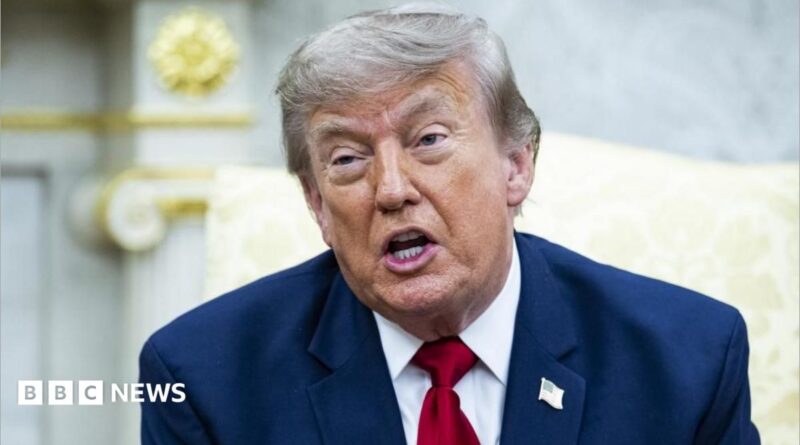
Trump scraps threat of 20% fee on Hormuz cargo as US resumes blockade of Iran ports
Centcom earlier said it had carried out a third night of attacks with the same aim, and on Tuesday Iran’s state media reported blasts in multiple cities, including Bushehr – home to a nuclear power plant.
Tehran said it had targeted US military facilities in Bahrain and Jordan after earlier hitting two United Arab Emirates tankers.
The ongoing strikes have underscored the strategic importance of the strait. Iran accuses the US of interfering in its management of Hormuz – but controlling it means Tehran can also threaten the global economy.
Trump on Monday declared that the US was now the “guardian” of the Strait of Hormuz, and vowed to impose a 20% charge on all cargo shipped through the waterway to pay for protecting it.
Raising the stakes further, Trump said the US would also reimpose its naval blockade on Iran in a bid to further squeeze the country’s struggling economy.
In his latest post on Truth Social, Trump wrote: “I have decided to replace the 20% United States Reimbursement Fee with Trade and Investment Deals that the various Gulf States will be making into the United States.
“Those Investments will be MASSIVE but, at the same time, extraordinarily good for them, and their future.” The US president provided no further details.
He also said that the strait “is open to ALL Ship traffic except for Iran” and that “oil is flowing like never before, thanks to the awesome Power of the United States Military”.
Speaking later after talks in Washington with the new Iraqi Prime Minister Ali al-Zaidi, Trump said: “I don’t like the concept of a fee, but at the same time, it’s not fair that we’re protecting this Strait for the entire world.”
He said he had changed his initial fee plan after receiving numerous calls from Gulf leaders.
In response to Trump’s announcement, Iran said it would remain in control of the Strait of Hormuz.
Iran’s Deputy Foreign Minister Kazem Gharibabadi said Trump’s blockade decision “has, in a way, dismantled” an earlier agreed truce deal, the AFP news agency reported.
The US first imposed a naval blockade of all Iranian ports in April to put pressure on Tehran. Roughly five weeks later, the US military said it had redirected 100 commercial vessels and disabled four under the blockade.
The US lifted the blockade in June as part of a deal – known as a memorandum of understanding – between the two countries that aimed to end the conflict, but a dispute over the strait has become a key point of contention.
Meanwhile, shipping data shows traffic through the strait has slowed to a two-months low. The benchmark Brent Crude oil price has also risen sharply.
Iran effectively shut down the waterway – through which some 25% of the world’s oil and 20% of global liquefied natural gas previously passed – after the US and Israel launched strikes against Iran on 28 February.
In a separate development on Tuesday, Israel’s Prime Minister Benjamin Netanyahu warned that his country’s retaliation against Iran would be “much more powerful” if it is attacked first.
“I will say it to the leaders of Iran: Do not count on things remaining quiet if you attack us,” he said in a video published on his social media.