Thinking Long-Term: The Legacy of Yahiya Emerick
Quiet service and a long-term vision for upcoming generations were the hallmarks of a little-known yet important Islamic teacher in the United States who passed away this week. Yahiya Emerick may not be a household name, but it is likely that Muslims growing up in North America will have encountered his books: he left a legacy of Islamic literature for various ages that is hard to match, certainly in the Anglophone world.
Yahiya John Joseph Emerick was born into an Irish-American Baptist family in the American Midwest in 1971. Having picked up a fascination with fantasy literature in his youth, he brought adaptable, creative writing skills and an active imagination into the world of Muslim writing after converting to Islam. That conversion came after some trouble during his teenage years in accepting the concept of the Trinity among Christians. In his first year of university during the late 1980s, he studied the Quran for some six months and, as he said during a rare interview“couldn’t deny the personal appeal from God to the reader.”
By contrast Emerick was disappointed in the writing quality of many English-language Islamic books during his early years in the faith. “I saw,” he said in the same interview with the UmmahReads blog, “that a lot of Islamic books were written in a very one-dimensional way without much verve or imagination. I wanted to write books that would show people how I saw Islam when I came into it. For me, Islam was a blend of spiritual, emotional, intellectual and practical things all woven together in an artistic tapestry that one could use to decorate their inner and outer world.”
Keep supporting MuslimMatters for the sake of Allah
Alhamdulillah, we’re at over 850 supporters. Help us get to 900 supporters this month. All it takes is a small gift from a reader like you to keep us going, for just $2 / month.
The Prophet (SAW) has taught us the best of deeds are those that done consistently, even if they are small.
Click here to support MuslimMatters with a monthly donation of $2 per month. Set it and collect blessings from Allah (swt) for the khayr you’re supporting without thinking about it.
As a history schoolteacher, Emerick began an impromptu fictional series about Ahmad and Layla Deen that formed part of his oeuvre: such fictional stories about and for Muslims were much rarer when he started out than they are now. On the importance of fiction for Muslim children, he explained, “Kids look almost exclusively for inspiration and identity from their peer group. Books are another window into viewing and adopting attitudes and if our kids spend their reading time reading only about non-Muslims and their world, then our Muslim kids will feel that the non-Muslim world is the ‘real’ world…Having some books with Muslim characters allows our kids to see that, in addition to the non-Muslim world, there are places and spaces to be Muslim, also. The two can even mix, and in that mix, Islam can still remain.”
In addition to fiction, Emerick wrote a large number of books explaining Islam for readers of various ages: these included an addition to the famous “Complete Idiot’s Guide to Understanding” series, which publishes basic explainers for novices and was particularly widespread during the 1990s and 2000s. Several of his books were written to explain the Quran, especially to teenagers. “Muslims take it for granted that, well, a kid from a Muslim family will be and stay Muslim by osmosis and association.” In a secular environment, “Muslims have…to do da’wah to our own children in order to win their loyalty for life. I write books, therefore, to bring Islam to our young people in a way tailored for them. Too many of our ‘scholars’ live in ivory minarets and fail to see the lives of the real people below them.”
On the growing body of Muslim literature in the Anglophone world, he remarked that he would like to see more “teenage, real life experiences. A lot more literature for the tween set. We need a monthly kids magazine and a separate monthly teen magazine. These have been tried in the past, but always failed, due to a variety of factors. We also need more diverse literature, not just flighty poetry or political books.”
Emerick’s body of work was particularly impressive given that he worked two jobs and largely self-published through his personal press, Amirah Publishing Company. In addition, he was involved in both activism and interfaith initiatives and founded the Islamic Foundation of North America bookstore. His books have covered a large number of topics and genres, and his death to cancer is a loss to the Muslim community.
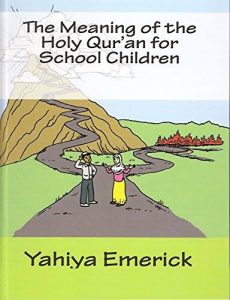
One of Yahiya Emerick’s many books.
One of his former students, Fawzia Syed, expressed her shock in a social media post. “Brother Yahiya” was her first Islamic Studies teacher, the first convert she had met, and one whose work she still uses as a “starter kit” for young Muslims.
“The depth of my sadness has honestly surprised me,” she wrote. Emerick had been her first Islamic studies teacher and an accessible one. As he worked on his Islam edition for the Complete Idiot’s Guide series during recesses, she recalled, “my friend and I would bother him while he was writing, asking him all kinds of questions. We’d ask him what he was writing about, about Islam, why he became Muslim, and probably every random question curious middle schoolers think of. One of the things I appreciate most is that I was never too intimidated to ask him questions. He was never impatient with answering, nor did he ever make feel any of my questions were silly. He was an authority figure, but I felt like I could ask him anything — either he would answer us or laugh it away.”
Serving upcoming generations for Allah’s sake was a major theme in Emerick’s life, as explained in his final thoughts in the UmmahReads interview: “I believe we, as Muslims, need to transform ourselves to meet this challenge. We must come out of our cocoons, smell the chai and see how we can make Islam relevant for the coming centuries. Future generations will either have an easier time being Muslim or a harder time based on our groundwork today. That’s a big responsibility and it is what Allah (swt) requires of us. Strive together in His cause, the Qur’an tells us, and we will be compensated with satisfaction and Allah’s good pleasure. Truly that is what seekers should work to achieve! Ameen.”
Emerick’s student, Syed, recalled that he had gifted her three of his books as his former student. After his signature at the end, he wrote, “Thinking long term.”
Innalillahi wa inna ilayhi rajioun. May Allah accept his service.