Between English and mother tongue: Kenya’s education language dilemma
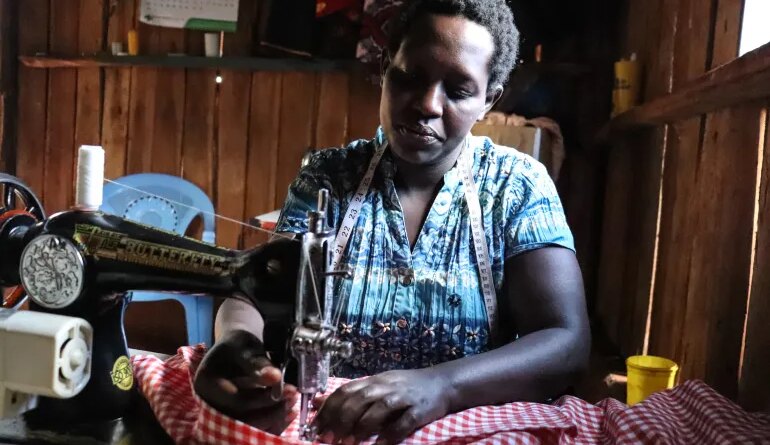
Kericho, Kenya – When Lona Chepkemoi walked into a technical college classroom in 2023, she found something she had rarely experienced during her years in school: She could understand what the teacher was saying.
After leaving primary school in 2008, Chepkemoi had failed her final exam, and her family could not afford to send her to secondary school. For years, the dream of becoming a fashion designer seemed out of reach.
Then a scholarship from her local member of parliament gave her a second chance.
But what surprised the now 33-year-old mother of five was not returning to education. It was hearing lessons delivered partly in Kalenjin, her mother tongue, she said.
“When I got to college, I felt at home because the language of instruction was my mother tongue [Kalenjin]and was mixed with a bit of Swahili and English, unlike in school when teachers only taught in English and exams were strictly only in English. Language here was accommodating, and it made me feel happy because I understood the concept quite well,” she told Al Jazeera.
For Chepkemoi, the difference went beyond comfort, it was comprehension.
Her experience reflects a wider global reality. According to UNESCO’s Global Education Monitoring (GEM) reports, about 40 percent of learners worldwide are not taught in a language they understand well, rising to about 90 percent in some low- and middle-income countries.
A second chance through familiar language
In Kenya, education policy provides for mother-tongue instruction in the early years of primary school, typically up to grade 3, before English becomes the main language of instruction from grade 4, with Kiswahili also widely used. In practice, however, classrooms often shift between languages depending on region, teacher capacity and student background.
Across much of Africa, the language of schooling still reflects colonial legacy systems, where English, French or Portuguese dominate classrooms even when children grow up speaking entirely different languages at home.
UNESCO’s Global Education Monitoring work shows multilingual classrooms are now the norm in many countries. The organisation has consistently argued that children learn best in a language they understand, describing mother-tongue-based multilingual education as key to improving literacy and learning outcomes.
When English meets the classroom reality
Chepkemoi was not alone in finding confidence through familiar language. Her husband, Philemon Tonui, enrolled at the same institution to study building and construction.
Although Tonui completed secondary school, he was unable to sit his final examinations because his family could not afford the fees, leaving him without a certificate.
For Tonui, the use of Kalenjin alongside English and Kiswahili made a significant difference.
“Nothing could beat that. I felt like if every level of education were instructed in their mother tongue, many people would excel in their education,” he told Al Jazeera.

Ismael Kiplang’at, a 28-year-old mason, also studied at the same institution. He recalls instructors making a deliberate effort to teach in languages students could understand.
“Our college was in a town with many communities in it, and even though the instructors did not understand all languages, at least they repeated their words in almost three languages just to make sure everyone was on board and understood the content. And those who came from other tribes always expressed satisfaction, saying that they really felt involved and not left out,” he said.
Now working as a mason three years after graduating, he credits that approach with helping him succeed.
“If education meant those tired English classes that we were taken through earlier in school, I would not have achieved my passion in masonry and earned a living,” he told Al Jazeera.
Between understanding and opportunity
Yet Kenya’s education system, like many across Africa, continues to face a structural tension: Early learning is most effective in familiar languages, but English remains essential for higher education, formal employment and global mobility.
Kiplang’at says he now practises English daily because he hopes to study further and work abroad.
For Shadrack Tonui, national chairperson of the Kenya Association of Technical Training Institutions, the challenge is not choosing between languages, but balancing them in multilingual classrooms.
“Generally, the mode of training is in English as the language of instruction and learning within the institutions. But of course, with the need to understand the flexibility of learning, there can be emphasis and use of a language that the learner will be able to understand at lower levels,” he told Al Jazeera.

He adds that institutions bring together students from diverse linguistic backgrounds, making it impractical to rely on one local language, while also stressing the need for English proficiency in the labour market.
The challenge is not unique to Kenya. UNESCO’s Global Education Monitoring work shows multilingual classrooms are now the norm in many countries, and education systems often struggle with teacher preparation, learning materials in local languages, and competing expectations from parents and employers over the role of English.
‘Why must we learn in another language?’
As for Chepkemoi, she is less concerned with policy than with practice. Most of her clients speak Kalenjin, while Kiswahili allows her to communicate with a wider customer base.
“Even though we were lucky to have teachers who would bring a point home while in college, we also had classmates from other communities who did not speak Kalenjin, and the teachers would explain it to them in Kiswahili,” she said.
For Kiplang’at, however, the debate ultimately comes down to one question: understanding.
“I ask myself sometimes why someone in Europe, Asia, or America learns in a language they grew up speaking, while we are expected to compete in theirs,” he said.