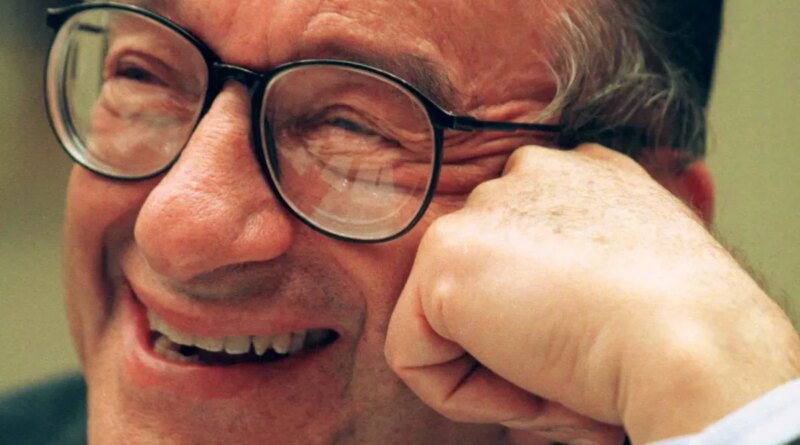
Former US Federal Reserve Chairman Alan Greenspan dies at age 100
Former United States Federal Reserve Chairman Alan Greenspan has died at the age of 100 due to complications from Parkinson’s disease.
“To me, he was my husband, who shaped my life from our very first date in 1984,” his wife of 29 years, NBC News correspondent Andrea Mitchell, said on Monday.
Recommended Stories
list of 4 itemsend of list
“He had ‘irrational exuberance’ for baseball, the Washington Commanders, tennis, golf, and music, especially jazz. He will be remembered for his brilliance and his kindness. Being his life partner was the joy of my life.”
In his more than 18 years at the helm of the Fed, Greenspan presided over a sustained era of American growth and prosperity, yet one that ended with devastating consequences in 2008, two years after he had left the central bank.
Originally appointed by US President Ronald Reagan in 1987, Greenspan was immediately tested after the stock market suffered the single worst one-day loss in US history, with the Dow Jones Industrial Average slumping more than 22 percent, which happened only two months into his tenure.
Greenspan won high praise for helping restore calm and stability. He assured Wall Street that the Fed would supply as much money to the financial system as was needed to restore calm. Stocks recovered, and the US economy emerged unscathed by the market crash.
Greenspan was so respected during his many years as head of the world’s most influential central bank that by the time he stepped down in 2006, he had presided over a surge in stock prices and a 10-year economic boom that began in March 1991 after an economic recession.
He also led the economy through the 1997–1998 Asian and Russian financial contagion, the collapse of the dot-com stocks bubble in 2000, and the turbulent economic aftermath of the September 11, 2001, attacks.
“Under his leadership, the Federal Reserve achieved a sustained era of price stability that supported economic growth and helped anchor the public’s confidence in the institution,” the US Fed said in a statement on Monday.
Greenspan, however, suffered a reputational blow not long after his term ended in 2006, when the US housing market collapsed, triggering the worst economic recession since the 1930s. Critics pointed to his policies that fuelled a series of asset price bubbles and laid the groundwork for the 2007–2009 financial crisis.
“I think the deification that came just before the financial crisis was never really deserved, and I think the lambasting that he took after he left was never fully deserved either,” Stephen Oliner, a former senior Fed official, told the Reuters news agency.
Greenspan himself later acknowledged that “I made a mistake” in assuming the nation’s banks, whose stability undergirds the financial system and the entire economy, could essentially regulate themselves.
Whatever Greenspan’s merits in the moment, his successors steadily pushed the Fed in a new direction, rolling out financial crisis response tools to address problems Greenspan had never confronted, such as zero interest rates, and shifting from opaque communications to more frequent speeches, a set inflation target, and regular press conferences.
After leaving his post, Greenspan continued to make headlines. In his 2007 memoir, The Age of Turbulence: Adventures in a New World, he made claims about the US war with Iraq.
“I am saddened that it is politically inconvenient to acknowledge what everyone knows: the Iraq war is largely about oil,” Greenspan’s book said.
Music came first
Born in New York City on March 6, 1926, Greenspan was the only child of Rose and Herbert Greenspan. His parents divorced when he was young, and he was raised in a small apartment in the Washington Heights section of New York with his mother and grandparents.
Greenspan’s first love was music, and he spent two years at New York’s Juilliard School studying the clarinet. He toured briefly with a swing band as a saxophone player before turning to economics studies at New York University.
In his youth, Greenspan was a friend and associate of the novelist Ayn Rand, who espoused the supremacy of the free markets and the profit motive in books such as Atlas Shrugged and The Fountainhead.