What Empty Seats At World Cup In Guadalajara Do And Don’t Tell Us
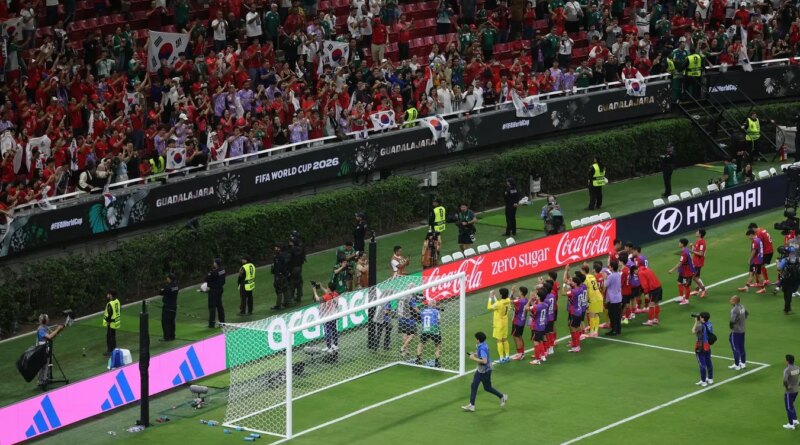
GUADALAJARA, MEXICO – JUNE 11: General view inside the stadium as players of Korea Republic acknowledge the fans after the team’s victory in the FIFA World Cup 2026 Group A match between Korea Republic and Czechia at Guadalajara Stadium on June 11, 2026 in Guadalajara, Mexico. (Photo by Lars Baron/Getty Images)
Getty Images
For those who wondered how long before the impact of FIFA’s unprecedentedly expensive World Cup ticket pricing might be visible, the answer was two matches.
After Mexican fans packed the Estadio Azteca to the brim in Thursday afternoon’s tournament opener in Mexico City, Match 2 in the Guadalajara suburb Zapopan was considerably less in demand, based on the pictures that emerged from the venue in suburban Guadalajara.
While South Korea and Czechia provided an entertaining spectacle, particularly after halftime, there were plenty of visible empty seats throughout the venue normally known as the Estadio Akron, particularly near midfield in what are presumably the most expensive tickets situated in hospitality areas.
That’s not to say the atmosphere was poor. Korean fans in particular – as well as some befriended locals – provided plenty of vocal support for the eventual winners, who rallied to a 2-1 victory behind a 67th minute leveler from Hwang In-beom and 80th-minute winner by Oh Hyeon-gyu.
But the sight on television immediately called into question FIFA’s decision to mark tickets up several fold from previous tournaments, and made the world wonder whether the 2026 World Cup will be remembered as the one where the fans stayed home.
Too Soon To Tell
However, the truth is that it is too soon to declare FIFA’s tactics a failure economically, even if you are ideologically opposed to their revenue-centric approach. Because there were several factors that could’ve made Thusday’s nightcape a uniquely poor draw.
For starters, the metro area of Guadalajara has the lowest real per capita GDP of any host market in the tournament, estimated at approximately $12,250 in 2023, including to data from LNPP (a Mexican applied research center) and INEGI (Mexico’s public geographic data agency). That’s fractionally lower than the Valley of Mexico, the terminology for Mexico City’s metro area, which is also four times the size of Guadalajara. In the North of Mexico, metro Monterrey’s real GDP per capita is about 50% higher than Guadalajara’s.
Additionally, the teams competing weren’t particularly strong draws for neutrals at a World Cup. The biggest star among them, South Korea’s Son Heung-min, is now on the downslope of his career playing for LAFC in MLS. And while he is enormously popular among South Korean fans, the plurality of those fans living in North America reside in Southern California, where he plays his club football. Czechia was making its first World Cup appearance in 20 years, and its most well-known players, Vladimir Coufal and Tomáš Souček, were both part of a West Ham side that suffered relegation from the Premier League at the end of this season.
Hangover Effect?
But maybe the most important reason not to judge the impact of FIFA’s pricing based on just this match is that it’s difficult to overstate how big a deal Mexico’s opener was several hours earlier.
In the final hours before kickoff, the average “get-in” price at had soared to nearly $4,000, according to the website TicketData. That was the most expensive tickets of any match at the tournament at the time, including the final, and came in what is the tournament’s second poorest market in terms of GDP.
Mexico’s victory over South Africa, which wrapped up by about 5 p.m. Eastern Time, was a nationwide party that had been eight years in the making. It’s understandable that the majority of the country’s football fans would’ve seen the second match of the tournament, one that kicked off an interminable five hours later, as an afterthought. And that’s to say nothing of a presumably real portion of fans who may have had every intention of heading to the Estadio Akron on Thursday night, but ultimately got caught up in the moment earlier in the afternoon and found themselves … let’s just say, incapable.
Friday features two host-nation matches, with Canada kicking off at 3 p.m. ET and the United States at 9 p.m. The following three days features 12 matches, including five involving previous World Cup-winning nations. If empty seats show up at any of those occasions, we can official begin to declare that FIFA got it wrong.4
In the interim, while Thursday night did not look good on TV, it may have been the exception rather than the rule. We’ll know soon.