Drones Stray Into Neighboring Countries as Russia and Ukraine Battle
The red alert came from a crisis control room buried under the Lithuanian capital. It sent the president, prime minister, mayor, school children and hundreds of thousands of other residents racing to underground shelters for cover from a fast approaching drone.
Military radar showed the drone coming in from the east, where Russia and its close ally Belarus have long loomed as a menace to NATO’s eastern flank.
But, according to Lithuanian officials, the drone that triggered the take-cover order last month in the capital, Vilnius, began its journey in Ukraine, as did dozens of others that in recent weeks have entered the airspace or waters of Lithuania, Estonia, Latvia, Finland and Romania. All are members of NATO and strong supporters of the Ukrainian military’s battle against the Kremlin.
Ukraine has been sending swarms of drones to hit Russian ports, oil terminals and other facilities on the Baltic Sea. They fly through Belarus and Russia, hugging their borders with Poland, the Baltic States and Finland. Some drones get through, like the ones that on Wednesday slammed into St. Petersburg, clouding the opening in the city of an annual economic conference attended by the Russian president, Vladimir V. Putin.
But others veer off course en route, sent astray by Russian “spoofing” — the use of counterfeit signals to deceive navigation systems — or Russian air defenses or possibly by Ukrainian programming errors. They end up menacing countries that have been among Ukraine’s staunchest allies.
Repeated recent episodes of drones changing direction highlight how the devices are scrambling clear lines between friend and foe, intent and result.
“This is our new reality,” said Gen. Renatas Pozela, the director of Lithuania’s fire and rescue service, the agency responsible, in coordination with the military, for alerting citizens to a possible attack.
Four Ukrainian maritime drones sent to attack Russian shipping in the Black Sea on Friday sped off course toward the coast of Romania and self-detonated, one in the port of Constanta and three out at sea. The authorities evacuated the port and ordered tourists off nearby beaches.
The Ukrainian Navy said it had lost control of them “as a result of enemy electronic warfare” and informed Romania of the mishap.
In Vilnius, the underground control room, equipped with computers, secure phone lines and screens showing live video feeds from across the country, is manned around the clock, overseeing a warning system to keep citizens safe in the event of fires, natural disasters and, in recent weeks, wayward drones.
The recent alert, sent to all mobile phones in Vilnius, was the first in the capital since Russia’s full-scale invasion of Ukraine more than four years ago. The authorities decided against using sirens and lifted the evacuation order after less than an hour.
The approaching drone, Mr. Pozela said, “came like lightning from a clear sky.”
As a result, he said: “Some people think we should stop supporting Ukraine, but this is just Russian propaganda. I think we should increase support.”
Mark Montgomery, a retired U.S. Navy rear admiral who advises Ukraine, said Ukraine had aimed to hit Russian fossil fuel facilities on the Baltic Sea even at the risk of alarming nearby friendly countries.
He said he hoped Ukraine could get overflight permission from countries whose airspace offers the shortest route to Russian targets, which Baltic governments have not agreed to. But, he added, “In the end when it is in your national security interest to get something done, you get it done.”
What happened to the drone that triggered the scramble for shelters in Vilnius is not known. It has not been found, unlike a Russian drone that exploded on a frozen Lithuanian lake in March and a Ukrainian one shot down by NATO warplanes over Estonia in May. Two Ukrainian drones crashed into a fuel depot in Latvia on May 7.
Romania, a member of NATO, like the Baltic States and Finland, has had to cope with stray drones from both Russia and Ukraine. In addition to the Ukrainian drones that exploded at Romania’s biggest port and off its coast on Friday, a Russian drone identified as a Geren-2 went astray on May 29 and struck a 10-story apartment building in the Danube River port city of Galati, injuring two people.
Russia has jumped on the alarm and confusion caused by errant Ukrainian drones to try to split Kyiv from its allies, painting Ukraine as a reckless partner that endangers the lives of its supporters. Hoping to undermine public trust in pro-Ukrainian governments in the region, Russia’s foreign minister, Sergey Lavrov, last month accused the Baltic States of allowing Ukraine to use their airspace for attacks on Russia.
In an interview, Deividas Matulionis, national security adviser to Lithuania’s president, called that “complete nonsense” and a “totally groundless” effort to distract attention from Russia’s responsibility for the war in Ukraine and to win propaganda points.
“Both Russia and Ukraine are using an increasing number of drones,” he said, “But we should always remember who is the aggressor and who is the victim.”
He added that Lithuania has asked Ukraine “to be more careful” when it sends drones north to Russian targets. Ukraine, he said, had apologized for stray drones.
“We are not blaming Ukraine,” he said.
Apportioning blame, however, has become a highly sensitive issue.
Officials in the Baltic States have accused Russia of deliberately redirecting Ukrainian drones into their territory to create tensions.
But Alexander Stubb, the president of nearby Finland, said in a recent interview with public broadcaster YLE that “The Russians want to avoid a situation where they are guilty of directing drones to NATO countries.”
More likely, he said, was that the Ukrainian drones that ended up in Finland had gone astray as a result of “accidental launches or programming problems” by Ukraine.
Whatever the reason, countries from the Balkans to the Baltics worry that explosive growth in the use of drones by both Russia and Ukraine is making them more vulnerable. All are stepping up their defenses, expanding detection systems built around radar to include acoustic sensors and other systems.
“At the beginning of the war, there were just few drones being used,” Mr. Matulionis, the national security adviser, said. “Now they are sending thousands.”
Laurynas Kasciunas, deputy chairman of the Lithuanian Parliament’s national security and defense committee, said the recent alert provided useful “shock therapy” in a region that, though long worried by possible Russian aggression, had not fully reckoned with the risks posed by the increasing use of drones by both Russia and Ukraine.
Members of Parliament, he said, had proceeded to a shelter in the Parliament building without any panic, though some used the occasion as an excuse for a cigarette, taking refuge in a smoking area near the shelter.
But some schools and kindergartens, he added, had misunderstood the alert and sent children into open sports fields, leaving them highly exposed. A government phone app listing nearby shelters crashed, and doors leading to many of the designated shelters were locked.
Valdas Benkunskas, the mayor of Vilnius, said municipal authorities were now working to ensure that all shelters “are open 24/7” for the city’s 640,000 residents.
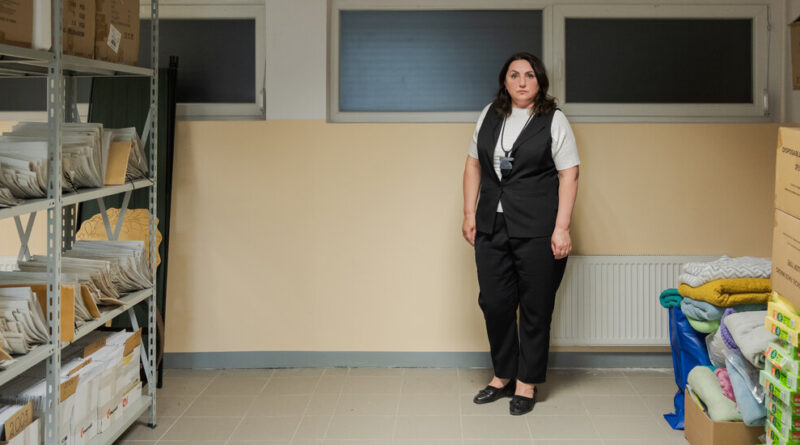
At a primary school in Baltupiai, a neighborhood in the north of Vilnius, an underground ballet studio and a gym in the basement have been stocked with water, food and medical kits. Ligita Visockiene, the principal, said that during the recent alert, some of her school’s 800 pupils started crying as teachers herded them into the basement. Others, she said, “were excited and joked around.”
Teachers noticed that some of the basement rooms have windows that would be blown out if a drone landed nearby, she said. The school has since brought a stack of wooden boards to cover the windows.
The principal remains a firm supporter of Ukraine. She has put a Ukrainian flag at the entrance to the school to “show solidarity” against Russia, and said she didn’t know or care whether the drone that set off alarms in Vilnius had been sent by Ukrainians.
The school has detailed plans for what to do in the event of attack but, she added, “we never thought we would have to actually use the plan.”
Thomas Dapkus in Vilnius, Lithuania, and Johanna Lemola in Helsinki contributed reporting.