
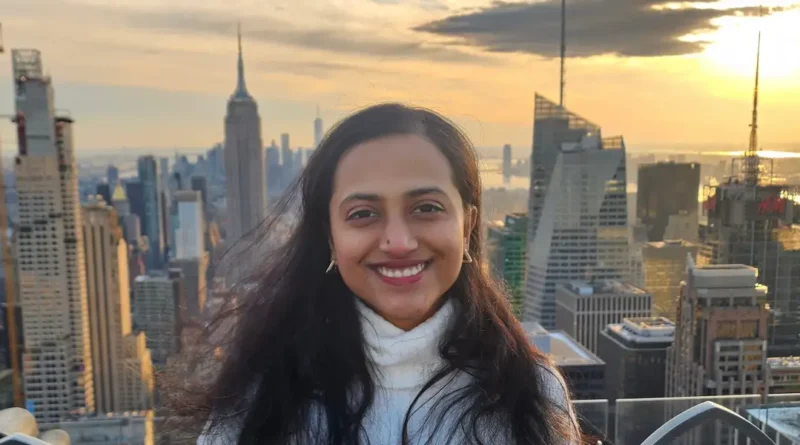
I left the US when I didn't get an H-1B visa. I'm living a new dream in the UK.
This as-told-to essay is based on an interview with 27-year-old engineer Sunjana Ramana, who moved from New York City to London in February. The following has been edited for length and clarity.
As a naive 22-year-old, living and working in America was my dream.
I come from a middle-class household in Hyderabad, India. I was accepted to Columbia for a master’s in electrical engineering, and I moved to New York in August 2021. I wanted to break into data science and engineering, and my focus was on meeting the right people in the US — those working at big companies with successful careers — so I could build my network.
During my 4½ years in the US, I tried to get an H-1B visabut wasn’t successful after three attempts. I moved to London in early 2026, where I’ve been exploring entrepreneurship. Instead of tying my dreams to being in America, I’ve taken a more open-ended approach to my career and life.
I felt the pressure of student debt
I remember paying over $70,000 in fees to go to Columbia, and my living expenses were roughly $2,000 to $2,500 a month, which came with a lot of financial pressure, even though my family was helping to support me. I simultaneously worked three part-time jobs in addition to my coursework. My entire focus was, “I cannot fail.”
A lot of immigrant students come to the US carrying significant financial pressure, which can feel incredibly overwhelming at times. There’s a mindset that failure simply isn’t an option because so much is riding on the opportunity.
I was disappointed that I never got a H-1B visa
I came to the US on an F-1 student visa. After graduating in February 2023, I joined a global insurance company that I’d interned with as a student. As a STEM graduate, I was eligible for three years of work authorization in the US called Optional Practical Training.
After I started working, I began the process of applying for the coveted H-1B, a type of employment visa that would allow me to continue working in the US. My employer put in three applications for me in 2023, 2024, and 2025. I received three rejections in a row. Most people are very hopeful about getting picked in the H-1B lottery. I felt the third year would be “my year.” When I wasn’t picked again, I was really disappointed.
As an international studentyou come to the US with the idea that this country has the best opportunities. You get to work with the best people and solve the best problems. You want to keep that streak going — to have continuity. Nobody wants to come out of the life that they’ve built.
My STEM OPT ended in early 2026, and since I didn’t get an H-1B visa, I had to leave the US.
I zeroed in on London and have built my business here
When I didn’t get the H-B visaI tried learning about my other options. For example, I attended an AI summit where I met people who had left the US for places like Germany, Australia, and the UK. I understood that if you really want to do something, there are opportunities everywhere.
Finally, after researching all available options and zeroing in on London as my next destination, I received a High Potential Individual (HPI) visa, which is a two-year work visa in the UK. It’s flexible because it’s not tied to a single employer, and you don’t need to secure a job before applying. It also enables self-employment with ease. In the US, I was always itching to build something in the AI space, so this felt like a good opportunity to finally pursue my entrepreneurial dream.
I got accepted into a founder-in-residence program offered by Antler, a VC firm, and started working on early ideas and prototypes for my own company, Flax. We’re a two-person tech company focused on helping to elevate founders and builders in the AI space.
Ramana has had to start from scratch in London. Courtesy of Sunjana Ramana.
Being in London has been a learning curve. I don’t know anybody here, so I’m starting from scratch and rebuilding my network. It’s a little uncomfortable, but I’ve always wanted to do something of my own, and my vision for my company has taken shape more clearly over time. A big milestone was hosting our first in-person AI hackathon in London, in partnership with Founders Factory and sponsored by AWS, which was also a key moment grounding me in the London ecosystem.
I hope I’ll have the freedom to go back to New York in the future if I want to. I was comfortable there, and it was a great place to begin my career. A week before I left for London, I went to the Brooklyn Bridge and felt very emotional at the thought of never coming back.
I no longer tie my dreams to the US
When I came to the US aged 22, my American Dream was all about career progression, networking, and global exposure, but today, as a 27-year-old, I see it was a mistake to tie those dreams to the country I was in.
I want to go back and tell my younger self not to associate the “dream” with America, because it doesn’t matter where you are. The dream should be aligned to you and your goals.
Ramana has learned to trust the process. Courtesy of Sunjana Ramana
One thing I’ve learned from my journey is that it’s important to talk about your experiences and build your personal brand online. You never know who will reach out to help you. When I posted that I was moving out of the US, I was overwhelmed by the amount of online positivity. I landed coffee meetings with people who commented, welcoming me to London, which led to more opportunities.
I’ve also learned to trust the process. When I didn’t get the H-1B visa, I felt like it was the end of everything I’d built over three years. I realized later, though, that I had tunnel vision; there are many other options beyond this specific visa.
No matter what, don’t lose hope.
Do you have a story to share about your US immigration journey? Contact the editors, Jane Zhang and Charissa Cheong, at janezhang@businessinsider.com and ccheong@businessinsider.com