On the Ground in South Sudan: Why Akobo Faces an Ebola Risk
To grasp the difficulties South Sudan would face if the Ebola virus took hold, it helps to look at the town of Akobo.
The center of the town is a collection of one-story buildings and kiosks along an unpaved main street. This week, a downpour reduced it to a series of swampy puddles filled with mud so deep that many people walked barefoot, balancing gingerly. When people fell, as they inevitably did, others laughed.
But flooding during the rainy season is just one of Akobo’s troubles.
In conversations here this week, nobody mentioned Ebola as a threat. Hunger and conflict are the more pressing concerns. The town lies hundreds of miles from the border with the Democratic Republic of Congo, where Ituri province stands at the epicenter of an Ebola outbreak announced by the World Health Organization this week.
But the dynamics in Akobo are a portrait of what makes South Sudan vulnerable to the virus. Poverty, lack of health care, insecurity and the government’s weak grip on the society would all make it harder to contain an outbreak.
The government in South Sudan’s capital, Juba, said on Thursday that there were no confirmed cases of Ebola in the country, but it urged people to take precautions. The Trump administration on Thursday imposed entry restrictions on U.S. citizens arriving to the United States from Congo, South Sudan and Uganda.
Akobo is in one of the most impoverished regions in South Sudan, a country that is one of the least developed in the world. Schoolteachers and health workers said they had not been paid for years. South Sudan is divided between forces loyal to President Salva Kiir and those loyal to the vice president, Riek Machar, who is under house arrest and on trial for treason.
In March, government troops massed outside Akobo, which at the time was held by opposition forces. The soldiers issued an ultimatum: withdraw or face annihilation. The opposition forces retreated, and the town’s population of 100,000 fled across the nearby river into Ethiopia.
“It was very difficult,” said David Chuak, 39, who fled with his wife and four children. “It was hard to find food and a place to sleep and even water.”
For days after the fighting, witnesses said, bodies littered the streets and the airstrip that is used to bring in aid workers.
Before the ultimatum, Akobo had a teaching hospital that was the pride not just of the town but of the region. The medical charity Doctors Without Borders, the aid agency CARE International and the International Committee of the Red Cross, were all deeply involved in its operations. The hospital treated combatants and civilians alike.
But when the government forces arrived, residents had to make difficult choices. Aside from their personal possessions, herds of precious cattle needed to be moved. The local radio station, 98.5 Akobo F.M., dismantled its equipment to take across the border, according to Sam Koang Malual, a journalist there.
Residents also removed everything they could from the hospital and carted it to Ethiopia rather than let it fall into government hands, said the commissioner who now runs Akobo, John Wiyual Lul. Some items were later sold, he said. Doctors Without Borders blamed looting and said that many items were wrecked on purpose.
“Medicines were not simply looted; they were intentionally sabotaged and destroyed, as if to prevent care from being delivered,” said Christophe Garnier, a senior official with the charity.
In April, opposition forces recaptured the town. Now, most residents have returned, and the town is trying to pick up the pieces. Desperately needed hospital equipment remains missing. The hospital’s buildings are largely intact, but its rooms are empty.
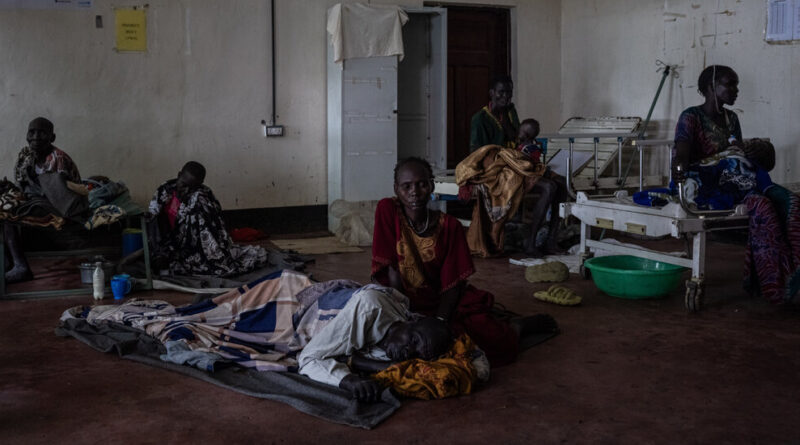
“We have nothing now,” said Wiyual Majiok, the hospital director. “No beds, no tables, no chairs.” He particularly lamented the loss of the hospital’s generators, which meant that there was no power or light. Seriously ill patients lay on the floors in near darkness.
Hospital workers in hospital scrubs were busy discarding expired and ruined medical supplies on Wednesday, pouring the liquid out onto the flooded ground. Even the hospital’s laboratory equipment and its stock of lifesaving drugs were gone.
A related emergency is hunger. The world’s main monitor of hunger, the Integrated Food Security Phase Classification, recently rated Akobo one of the parts of South Sudan with a high risk of famine. It gave it level 5, its highest level of concern. While the area is fertile, waves of displacement and conflict have undermined the region’s ability to produce food, the organization said.
Aid groups have established feeding stations in the town for adults and acutely malnourished children.
On Monday, some help arrived in the form of an airdrop of food into a large field on the outskirts of Akobo from a plane chartered by the U.N. World Food Program. The heavy white sacks splashed onto waterlogged ground, and dozens of women working together retrieved them, stacking them in neat piles for distribution.
Airdrops are less efficient and more expensive than trucking in supplies, but insecurity and flooded roads have prevented convoys of aid from arriving, according to Pierre Guillaume (PG) Wielezynski, a senior official with the program. On Wednesday, a downpour prevented even an airdrop.
The hunger crisis has provoked a fierce debate among aid workers and U.N. agencies, who support the country’s social sector. While in public they praise their partnership with the authorities in South Sudan, in private many accuse the government, as well as opposition leaders who control parts of the country, of effectively abnegating their responsibility for ordinary people.
“The responsibility to help the people is from the side of the U.N.,” said the commissioner, Mr. Lul, who holds a senior rank in the opposition’s military force.
Even with the strains, people in Akobo have taken steps to get the town back on its feet. Music played in makeshift bars on the main street on Wednesday and several business owners had set up Starlink devices to offer Wi-Fi.
Any respite may be temporary, however, and not just because of the risk of Ebola. When the rainy season ends, residents of the town said they expected the government’s military to resume its assault. Even before that, people were not safe, said Lt. Col S.P. Mishra, the head of the U.N. peacekeeping mission in the town.
“Airstrikes could happen at any time,” he said.