Pau Gasol Is The New Chair Of The IOC Athlete Commission
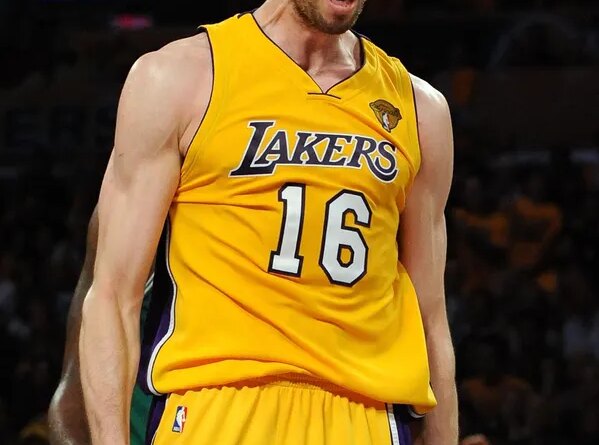
LOS ANGELES, CA – JUNE 03: Pau Gasol #16 of the Los Angeles Lakers reacts in the second half against the Boston Celtics in Game One of the 2010 NBA Finals at Staples Center on June 3, 2010 in Los Angeles, California. NOTE TO USER: User expressly acknowledges and agrees that, by downloading and/or using this Photograph, user is consenting to the terms and conditions of the Getty Images License Agreement (Photo by Lisa Blumenfeld/Getty Images)
Getty Images
(I recently interviewed Pau Gasol via written correspondence. His quotes are taken from the transcript of that interview.)
When Pau Gasol speaks about the Olympic Movement, he does so with authority—not only as one of basketball’s most decorated international stars, but now as a leading voice helping shape the future of athletes worldwide.
A two-time NBA champion, six-time Olympian, and one of Spain’s greatest sporting icons, Gasol has entered a new chapter of leadership through his role on the International Olympic Committee’s Athlete Commission. The transition from elite competitor to advocate has broadened his perspective. His mission now extends beyond performance and podiums.
MADRID, SPAIN – JULY 05: Pau Gasol #4 of Spain and Aaron Geramipoor #23 of Iran during friendly match between Spain and Iran to preparation to Tokyo 2021 Olympics Games on July 05, 2021 in Madrid, Spain. (Photo by Borja B. Hojas/Getty Images)
Getty Images
In All Things The Olympic Athlete Must Have A Voice
It centers on something deeper. “The priority,” Gasol tells me, “is not so much to rank issues, but to ensure that, across all of them, the athlete’s voice and interest is genuinely present in decision-making.”
That phrase—the athlete’s voice—surfaced repeatedly during our conversation. Yet for Gasol, the athlete is not simply a competitor. The modern Olympic challenge, he argues, is understanding the athlete “in their full dimension: as a competitor, of course, but also as a person.” As the Olympic Movement prepares for the 2028 Summer Olympics, that philosophy may become one of its defining tests.
The Olympic Athlete as a Whole Person
Gasol believes today’s most pressing Olympic debates—whether surrounding gender eligibility, athlete expression, mental health, or competitive integrity—cannot be separated. Each reflects a larger question: how can institutions better protect the dignity, humanity, and future of those who compete?
FIFA President Gianni Infantino (L) and IOC Athletes Commission Pau Gasol Saez arrive for the opening ceremony of the 145th IOC Session at La Scala Theatre in Milan on February 2, 2026. (Photo by PIERO CRUCIATTI / AFP via Getty Images)
AFP via Getty Images
“Decisions taken within the sporting sphere do not only affect competition or performance,” he explains. “They also affect the well-being, dignity, and future of those who compete.”
That broader lens is especially important as the IOC navigates complex issues such as safeguarding female competition categories and balancing athlete expression with Olympic neutrality. On gender eligibility, Gasol emphasizes that recent policy shifts reflect evolving science and extensive consultation with athletes and international federations. But policy alone, he says, is not enough.
“Equally important as the decision itself is how it is implemented.”
Implementation, in his view, must remain athlete-centered—protecting not only fairness but also psychological health, human dignity, and safety. The same principle applies to freedom of expression under Olympic neutrality rules.
2026 Milano-Cortina Olympics: The Helmet Of Remembrance
A clear example of freedom of expression under Olympic neutrality rules at the Milano-Cortina 2026 Winter Olympics involved Ukrainian skeleton athlete Vladyslav Heraskevych, whose case became one of the defining tests of the IOC’s modern athlete-expression policy.
TOPSHOT – Ukraine’s Vladyslav Heraskevych takes part in the skeleton men’s training session at Cortina Sliding Centre during the Milano Cortina 2026 Winter Olympic Games in Cortina d’Ampezzo on February 9, 2026. Ukrainian skeleton racer Vladyslav Heraskevych was disqualified from the Winter Olympics on February 12, 2024 after refusing to back down over his banned helmet, which depicts victims of his country’s war with Russia.In a statement, the International Olympic Committee said Heraskevych is “not allowed to participate at Milano-Cortina 2026 after refusing to adhere to the IOC athlete expression guidelines”. (Photo by FRANCK FIFE / AFP via Getty Images)
AFP via Getty Images
Heraskevych sought to compete wearing a specially designed helmet displaying images of Ukrainian athletes killed since Russia’s 2022 invasion of Ukraine. He described it as a memorial tribute rather than a political protest. During training runs, he was permitted to wear the helmet, but when competition began, the International Olympic Committee ruled that the helmet violated Rule 50.2 of the Olympic Charter, which states:
“No kind of demonstration or political, religious or racial propaganda is permitted in any Olympic sites, venues or other areas.”
The IOC offered a compromise: Heraskevych could wear a plain black armband or display the helmet in media areas after competition, where athlete expression is permitted. He refused, insisting the helmet itself was an essential act of remembrance.
As a result, he was barred from competition and stripped of his Olympic accreditation, making his case one of the most significant modern examples of how Olympic neutrality rules can restrict athlete expression on the field of play.
“We are not talking about an apolitical movement,” Gasol says, “but about a neutral one, capable of ensuring coexistence, respect, and dialogue across very diverse realities.”
PARIS, FRANCE – JULY 26: Former basketball player Pau Gasol and Catherine McDonnell attend with daughter Elisabet Gianna Gasol the red carpet ahead of the opening ceremony of the Olympic Games Paris 2024 on July 26, 2024 in Paris, France. (Photo by Matthew Stockman/Getty Images)
Getty Images
In an increasingly polarized world, Olympic neutrality may be less about silence than about creating space for respectful coexistence.
Mental Health Moves to the Center
Perhaps nowhere has the Olympic conversation evolved more dramatically since the 2020 Summer Olympics than in mental health. Gasol sees this as one of the movement’s most urgent priorities.
“It is essential to protect the athlete’s mental well-being while they compete,” he says, “to support it when they step away from competition, and to ensure an orderly transition into professional and personal life after elite sport.”
That transition—often overlooked—can be among the most difficult periods in an athlete’s life. Identity, purpose, and structure can disappear almost overnight. Everything athletes build through years of discipline, Gasol argues—resilience, leadership, focus—should retain meaning long after retirement. This holistic support model is increasingly reflected in programs like the IOC’s Athlete365 platform, which provides career coaching, education, and job placement resources. But Gasol believes more cultural change is needed.
TOKYO, JAPAN – JULY 23: (C) Alvaro Robles and (L) Pau Gasol of Team Spain pose during the Opening Ceremony of the Tokyo 2020 Olympic Games at Olympic Stadium on July 23, 2021 in Tokyo, Japan. (Photo by Matthias Hangst/Getty Images)
Getty Images
“It is no longer enough to look at the athlete solely through the lens of performance.”
Integrity And Fair Play
Gasol didn’t mince words when it came time to comment on the subject of athletes cheating: “It is essential to firmly uphold a strong anti-doping program, as well as an equally strong approach to any technical or equipment manipulation. In this regard, we must also make the most of what new technologies and artificial intelligence can offer to reinforce equal conditions in competition. Because, ultimately, what athletes need to be confident about is that they compete under clear rules, with effective oversight, and with full competitive equality.”
LA28: Logistics
Few Olympic leaders know Los Angeles as intimately as Gasol. After years starring for the Los Angeles Lakers, he speaks about the host city with unmistakable affection—and optimism. “Los Angeles has a unique energy, a strong sporting culture, and a proven ability to host global events,” he says. Still, athletes will judge the Games not only by spectacle, but by execution. “For athletes, details matter: distances, transport, safety, travel times, rest, and access to services.”
Those operational realities can directly affect performance. A delayed bus, excessive commute, or disrupted recovery routine can matter as much as anything that happens in competition.
Paris 2024 Olympics: Athlete Buses Were Hot And Late
Israel’s players arrive by bus before the start of the men’s group D football match between Mali and Israel during the Paris 2024 Olympic Games at the Parc des Princes in Paris on July 24, 2024. (Photo by FRANCK FIFE / AFP) (Photo by FRANCK FIFE/AFP via Getty Images)
AFP via Getty Images
Before competition in Paris had even begun, six members of South Korea’s swimming team moved out of the Olympic Village and into a hotel near Paris La Défense Arena, where swimming events were held. Their reason was straightforward: the official shuttle commute from the Village was taking too long and conditions on the buses were uncomfortable, especially in summer heat.
According to Reuters, the athletes cited “long journeys in hot buses” as the primary reason for relocating. Paris organizers later acknowledged “early logistical teething problems” and increased both transport staff and the number of available vehicles to address complaints.
The transportation problems were not isolated to one delegation. Australian Olympic officials also complained about overcrowded and overheated buses, with one team reportedly taken to the wrong venue. An Australian official described the issues as urgent because disrupted transportation was interfering with athletes’ preparation and recovery schedules. For Olympic athletes, transportation is not merely an inconvenience—it can directly affect performance. Commute time influences:
- Sleep and recovery
- Pre-race warm-up timing
- Nutrition and hydration
- Stress and mental readiness
Gasol believes LA’s experience hosting large-scale events provides a strong foundation, particularly as organizers emphasize efficiency and sustainability. “I am very confident that LA28 will do an outstanding job.”
Yet beyond infrastructure lies something more profound.
The LA28 Games Role As A Unifying Global Event
VAN NUYS, CALIFORNIA – SEPTEMBER 01: A mural reveals the new LA28 logo, with the “A” designed by Orlando Pride player Alex Morgan, at the Delano Recreation Center on September 01, 2020 in Van Nuys, California. The LA28 logo is for the Games of the XXXIV Olympiad hosted by Los Angeles in 2028. The 2028 Summer Olympics are scheduled to take place from July 21, 2028 to August 6, 2028. (Photo by Kevin Winter/Getty Images)
Getty Images
“We are living in a complex international context, marked by conflict, tension, and uncertainty,” he says. “This makes the role of the Olympic Games as a unifying force even more important.”
Athletes, he reminds us, do not compete in isolation from the world. They carry the hopes of many, as well as their burdens. For competitors arriving in Los Angeles in 2028, Gasol sees reasons for excitement beyond the traditional Olympic dream. The addition of new sports—including flag football, cricket, lacrosse, squash, and baseball/softball—will open the Games to entirely new athlete communities. “This makes the Games more open, more diverse, and more connected to the evolution of society and of sport itself.”
LOS ANGELES, CA – MAY 08: Venues for the opening and closing 2028 Olympic games were announced at the Los Angeles Memorial Coliseum in Los Angeles, CA on Thursday, May 8, 2025. The Coliseum and SoFi Stadium will share the opening ceremony and the Coliseum will be the site of the closing ceremony. (Myung J. Chun / Los Angeles Times via Getty Images)
Los Angeles Times via Getty Images
He is equally enthusiastic about the rise of mixed-gender events, which he sees as one of the Olympic Movement’s most meaningful innovations. “It reinforces a more modern, more balanced, and more coherent way of understanding the Games.” These developments build on major progress already achieved. Tokyo marked the first nearly gender-balanced Olympics. 2024 Summer Olympics reached full parity—50 percent women, 50 percent men.
“This is not just a figure,” Gasol says. “It is a message.”
PARIS, FRANCE – AUGUST 07: US’ Tom Schaar competes in the men’s park skateboarding final during the Paris 2024 Olympic Games at La Concorde in Paris on August 7, 2024. (Photo by Odd Andersen-Pool/Getty Images)
Getty Images
That message extends to younger generations as well. The addition of urban sports such as skateboarding, surfing, sport climbing, and 3×3 basketball has transformed Olympic engagement. Digital audiences have surged, helping the Games connect with new fans and cultures. Gasol sees these changes as evidence that the IOC is learning how to evolve.
The Human Future of Excellence
Asked what new challenges have emerged since 2020, Gasol resists framing them as problems. Instead, he sees an opportunity. Social media pressure, geopolitical instability, technological disruption, and expanding public scrutiny have made athletic life more complicated than ever. But they also invite a new model of athlete support. For Gasol, the central challenge is balance.
“Continuing to demand competitive excellence,” he says, “while doing so from a much more human, comprehensive, and responsible perspective toward the person behind the athlete.”
MILAN, ITALY – FEBRUARY 02: IOC Member Pau Gasol of Spain attends the Opening Ceremony of the 145th IOC Session at the Teatro alla Scala on February 02, 2026 in Milan, Italy. (Photo by Andreas Rentz/Getty Images)
Getty Images
That may ultimately become his most important Olympic legacy. As Los Angeles prepares to welcome the world in 2028, medals will still matter. Records will still fall. Nations will still celebrate. But if Pau Gasol’s vision is seen to fruition, the true success of the LA28 Games will be measured differently—not only by what athletes achieve, but by how well they are cared for while achieving it.