Rachel Reeves rowed with Scott Bessent over Iran war criticism
Unlock the White House Watch newsletter for free
Your guide to what Trump’s second term means for Washington, business and the world
US Treasury secretary Scott Bessent had a fierce row with UK chancellor Rachel Reeves in Washington last month over her outspoken criticism of the Iran war, according to people familiar with the matter.
The chancellor, who was in Washington for the spring meetings of the IMF, gave an interview to CNBC on April 15 claiming the goals of the Iran was had “never been clear”. Reeves expressed the view that she was “not convinced” that “we are safer today than we were a few weeks ago”, prompting furious criticism from Bessent.
When the pair met later that day Bessent berated Reeves over the remarks, according to people familiar with the situation. The Treasury secretary insisted the world was safer because of the US-Israeli war against Iran, even invoking the spectre of Tehran launching a nuclear attack on London.
Reeves responded angrily by telling Bessent she did not work for him and disliked how he had spoken to her.
She also reiterated her argument about the Iran conflict lacking clear goals and not necessarily making the world safer.
Earlier in the week, Bessent had told the British media that the Iran war was worth a “small bit of economic pain”, adding: “I wonder what the hit to global GDP would be if a nuclear weapon hit London?”
One UK official said: “Rachel has been frank — in private and in public — about the mistakes of the war and the economic cost.”
The dispute highlights policy disagreements between Bessent and Reeves over the war, even as they have maintained strong relations and worked well together on other issues. The two have spoken following the incident last month.
The UK’s decision to come out so strongly and publicly in favour of de-escalation has been driven in part by the economic damage the conflict is doing domestically.
In its World Economic Outlook issued that week, the IMF downgraded its forecasts for UK growth by more than any other G7 country, in part because of the heavy blow higher energy prices are expected to inflict on Britain.
The US Treasury secretary has good relations with UK government officials and was well received in all meetings with the King and Queen, a couple with whom he has a 30-year friendship, during last week’s state visit. Both the UK and US delegations viewed the state visit as a major success.
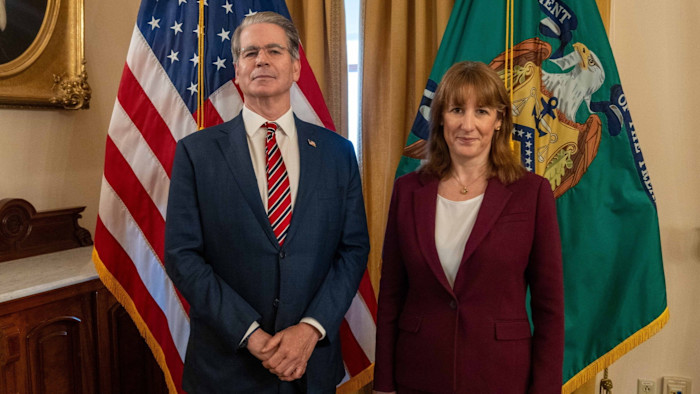
The meeting between the two finance ministers was attended by officials from the US Treasury, UK Treasury and UK Embassy.
An official readout by the US Treasury of the Bessent-Reeves meeting on April 15 said Bessent had “underscored the US Treasury’s commitment to [Operation] Economic Fury, leveraging all tools and authorities against those who continue to support Iran’s terrorist activities”.
The exchanges came during a week of meetings in Washington that were dominated by the fallout of the war on global energy markets and economies.
Reeves went on the offensive about the damage being done before she departed for Washington, using an interview with the Mirror newspaper to lambast the conflict as a “folly” that was doing harm to households and consumers.
“I am very frustrated and angry that the US went into this war without a clear exit plan, without a clear idea of what they were trying to achieve,” she said.
The next day Reeves doubled down on her criticism in the CNBC interview, saying: “I’m not convinced this conflict has made the world a safer place.” However, she insisted the US and UK have a very good relationship even if they do not have to agree on everything.
Reeves also joined 10 other finance ministers in calling for a “swift and lasting negotiated resolution to the conflict” in a joint statement issued at the start of the spring meetings of the IMF and World Bank in Washington.
Labour has also found itself largely on the side of British public opinion over the Iran conflict, with 65 per cent of people opposed and only 16 per cent supporting it, according to polling firm Ipsos.
The pain the crisis is inflicting on the UK was underscored last week when the Bank of England gave its first full economic outlook since the war broke out. It set out a range of scenarios for the economy and energy prices, warning that the most severe could push the central bank into “forceful” tightening of monetary policy to rein in inflation risks.
The UK Treasury and US Treasury declined to comment.