U.S. Mint Buys Drug Cartel Gold and Sells It as ‘American’
Every year, the United States Mint sells more than $1 billion of investment-grade gold coins. Each is stamped with an icon like the bald eagle, signifying the government’s guarantee, required by law, that the gold is 100 percent American.
“To hold a coin or medal produced by the Mint is to connect to the founding principles of our nation,” the Mint declares.
But a New York Times investigation has found that the government’s program of gold sales is based on a lie. The Mint is actually the last link in a chain that launders foreign gold, much of it illegally mined, for an insatiable market.
Now, even President Trump’s 24-karat gold coin, commemorating the United States’ 250th birthday, could come from a swirl of non-American gold from any number of sources.
The Mint, the biggest name in the global market for investment gold coins, is an example of how the industry’s guardrails have collapsed. Gold prices hover around $5,000 an ounce, about four times the price of a decade ago. That gives criminal organizations and fly-by-night operators a huge incentive to mine in wasteful, destructive and risky ways.
Investors buy gold as a hedge against instability. Nearly every terrorist attack, war and financial meltdown in the past quarter-century has fueled a gold-buying frenzy.
But as prices climb ever higher, wealthy buyers are actually helping to create the very instability they are trying to hedge against.
The industry’s biggest players speak about bright lines between legal and criminal gold. Buying from a reputable source, like the Mint, is supposed to ensure that criminals, terrorists and polluters do not profit. In fact, the Mint has looked away for decades as gold from dubious sources flows into its plant in West Point, N.Y.
We tracked hundreds of millions of dollars in foreign gold entering the Mint’s supply chain in recent years. That includes secondhand gold, with provenance that is difficult or even impossible to determine, and gold from countries like Colombia and Nicaragua, where the industry is linked to criminal groups.
When we first approached the Mint, a spokesman said that its gold came entirely from the United States, as the law requires. After we shared our findings, the Mint said the U.S. was its “primary” source and said it was taking steps to better track its gold.
Treasury Secretary Scott Bessent, whose department oversees the Mint, said he would investigate the gold procurement practices.
“This review is focused on ensuring that the U.S. Mint’s gold suppliers comply with the law and strictly satisfy their obligations, and that the Mint takes every step possible to continue to vigorously safeguard our national security and uphold market integrity,” he said in a written statement.
For illegally mined foreign gold to become an American Eagle coin, two seeming acts of alchemy occur.
First, the illegal gold becomes legal.
Second, it becomes American.
To see this sleight of hand at work, we headed into the heart of Clan del Golfo territory in northwestern Colombia. A six-hour drive from Medellín took us down the northern slope of the Andes and into the tropical lowlands.
The miners call the ranch La Mandinga, a name for an evil spirit.
For the past eight years, the Clan del Golfo has run La Mandinga with a short list of rules, a pair of mining supervisors told us. The most important: Nobody mines without cartel permission, and everybody pays.
Every month, the supervisors said, a man on a motorbike collects the Clan’s cut, $400 for each team of five. There are hundreds of teams, perhaps a thousand or more.
They work in open-air mines, using excavators and high-pressure hoses to turn La Mandinga’s hillsides into mud. Picking the tiny flecks of gold from that muck is impossible, so the miners mix the mud with mercury and stir by hand until the mercury binds to the gold.
All of this is illegal, environmentally destructive and toxic.
The Colombian authorities occasionally conduct airstrikes and raids on mines that support the Clan. But the miners at La Mandinga apparently need not worry, even though their operation directly abuts a military base. They operate with such impunity that, when we flew a drone over the area in February, we saw that workers had breached the base’s perimeter and were mining for gold on military land. [Related: See What Happened After We Found a Cartel Mine on a Military Base.]
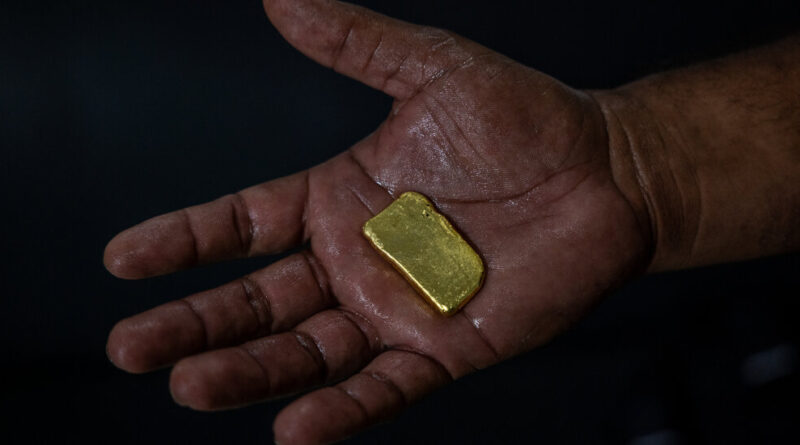
At day’s end, workers gather their gray globs of mercury and gold, each about the size of a marble, and wrap them in plastic. They stuff these marbles in their pockets and drive their motorbikes down La Mandinga’s dirt paths and into nearby Caucasia.
La Mandinga gold has no business making its way into the United States. Secretary of State Marco Rubio called the Clan “a violent and powerful criminal organization” last year when the United States designated the cartel a terrorist group.
The Treasury Department keeps Clan del Golfo leaders on a financial blacklist, banning American companies from doing business with them. Government organizations and academics have documented the cartel’s gold mining activities here for years. (A Colombian lawyer for the cartel did not return a call for comment.)
Caucasia is a gold-rush city. Businesses sell excavators, pumps and million-dollar dredges for illegal riverbed mining. Fancy cafes and dance clubs have sprung up. Miners can sell gold to any of hundreds of storefronts. Every month, two shop owners told us, the Clan collects $400 from them, too.
And just like that, the first metamorphosis is complete. The gold is legal. The mercury, the off-limits mining, the payments to the Clan — it is all erased.
How?
Mr. Cuevas showed us ledger entries on the shop’s computer. His suppliers from La Mandinga, he said, have registered under a Colombian program for small-scale miners, or barequeros. Nearly anyone can get a license, as long as they mine in authorized areas using only hand tools and no mercury.
Of course, La Mandinga’s workers are not mining only with hand tools. Or in authorized areas. And they are using mercury. Mr. Cuevas knows all of this. He mines in La Mandinga himself. But it is not his job to look beyond the paperwork. And the Colombian authorities rarely examine barequero gold’s origins to determine legality.
Instead, they ask one question: Does it have paperwork?
The shop where Mr. Cuevas works, like others in town, sells to a government-owned exporter. The exporter said it checks the same database that Mr. Cuevas uses, verifying that the gold is legal. The gold from La Mandinga is mixed with supplies from around Colombia and melted into bars. Export records show that many of them, worth about $255 million over the past year or so, arrive in Texas.
There the gold becomes American.
At a refinery outside Dallas called Dillon Gage, workers dump the imported gold into a glowing cauldron, mixing it with molten gold from other suppliers: South American mines, secondhand U.S. jewelry dealers and Peruvian pawn shops, according to records and interviews.
But to Dillon Gage’s customers, once that gold leaves the Dallas cauldron, it ceases to be foreign. Dillon Gage is in the United States and mixes American gold with Colombian gold. So, the industry logic goes, the end product must be American. “As far as they’re concerned, it originated within the U.S.,” said Terry Hanlon, Dillon Gage’s chief executive.
Mr. Hanlon said that his company was on the lookout for illegal gold. But at this point, the Mandinga gold is legal, thanks to the shop ledgers and export paperwork. That means Mr. Hanlon’s purchases and sales are legal. (Mr. Hanlon said that he was surprised we found cartel gold in his pipeline. The company suspended purchases from the Colombian exporter.)
Among Dillon Gage’s biggest clients are two Mint suppliers, Mr. Hanlon said. He said he gives his customers annual lists of his sources, so even though the customers treat the gold as American, they know its true origins.
La Mandinga is just one of many cartel-controlled mines in the region. Mr. Cuevas works at one of hundreds of shops in just one city. There are many exporters, and even more buyers. In this trillion-dollar market, notorious for fraud and money laundering, the distinctions between dirty gold and clean exist mainly on paper. Unless a customer is willing to check, the distinctions melt away.
A full supply chain audit in the United States would flag the risk of Clan del Golfo gold. Colombian gold is considered high-risk by industry standards, and the U.S. government itself has documented the Clan’s operations in Caucasiain particular.
But for two decades — a period covering nearly all of the post-Sept. 11 gold boom — the Mint never asked its suppliers where they bought gold, a Treasury Department inspector general audit found in 2024.
If it had, it would have found a remarkably transparent supply chain. Through import and export databases and interviews with intermediary companies, we found dozens of foreign sources in the Mint’s gold pipeline.
Those included industrial mines in Mexico and Peru. Some suppliers, like pawn shops, specialize in recycled jewelry.
One of the historically largest Mint suppliers, a Utah refiner called Asahi USA, is open about the fact that its cauldron contains gold from many different countries. Some of it comes from Dillon Gage. But there is gold from all over. “It’s commingled,” the company’s refining chief, Paul Healey, said. “And it comes out the other side.” Mr. Healey said the company would investigate our findings about the Clan del Golfo.
The Mint has said, in response to internal audits, that its gold counts as American because its suppliers offset any foreign gold with American gold. If the Mint buys a ton of gold, for example, it expects the supplier to buy that much American gold at some point.
U.S. law makes no allowance for this kind of trade-off. And for decades, the Mint has not enforced that provision or even asked its suppliers to comply, the Treasury’s inspector general found.
Some of that copper comes from a Congolese mine owned in part by the Chinese government, export records show.
The Mint’s sourcing practices have at times raised red flags inside the Treasury Department, including during Mr. Trump’s first term, when the inspector general began asking questions.
That investigation took five years to complete. Along the way, auditors found serious problems. They said that the Mint was not following its own policies and that the Mint’s gold-offset plan (one ton of foreign gold for one ton of American gold) might violate U.S. law.
The Biden administration responded in 2024, saying it was just months away from publishing new plans for investigating gold sources.
It never did.
A Treasury spokeswoman said that the Trump administration was already taking steps to identify its gold sources. It has not cut off foreign gold; doing so, she said, would make it impossible to meet demand. But the government monitors its purchases.
The Mint still has not released its gold-tracking policy.