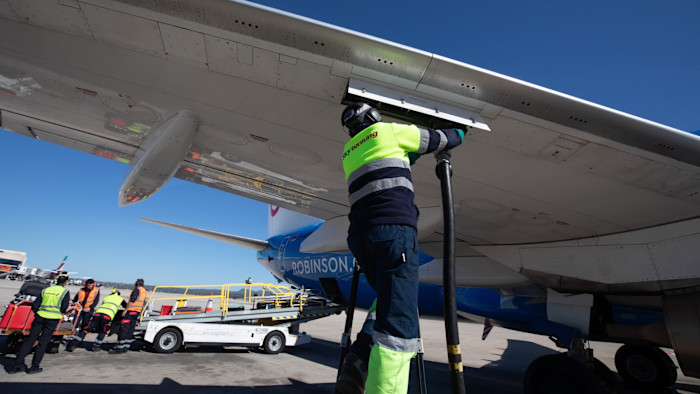
European airports face jet fuel shortages within three weeks
Stay informed with free updates
Simply sign up to the Airlines myFT Digest — delivered directly to your inbox.
European airports face “systemic” shortages of jet fuel if the Strait of Hormuz is not fully reopened within three weeks, the industry has warned.
ACI Europe, which represents EU airports, said jet fuel reserves were running low, while “the impact of military activity on demand” is further straining supplies.
In a letter seen by the FT, it warned EU transport commissioner Apostolos Tzitzikostas of “increasing concerns of the airport industry over the availability of jet fuel as well as the need for proactive EU monitoring and action”.
“If the passage through the Strait of Hormuz does not resume in any significant and stable way within the next three weeks, systemic jet fuel shortage is set to become a reality for the EU,” the letter said.
It added that the approach of the peak summer season “when air travel enables the whole tourism ecosystem upon which many [EU] economies rely” has intensified these concerns.
Some Asian countries such as Vietnam have begun rationing jet fuel because of shortages, but Europe has so far not had widespread shortages, though fuel prices have doubled and airlines have warned about cancellations.
Despite US President Donald Trump’s announcement of a two-week ceasefire in the Iran war, global oil prices have remained high.
Benchmark north-west European prices for jet fuel closed at $1,573 a tonne on Thursday, according to price reporting agency Argus Media, up from about $750 a tonne before the Iran war.
European airlines say they should have enough fuel for several weeks, but suppliers are unable to guarantee deliveries into May.
Four Italian airports last weekend introduced restrictions on jet fuel after disruption at a key supplier, although the shortage was not directly linked to the Strait of Hormuz, which is the transit route for about 40 per cent of the world’s jet fuel supply.
In its letter, ACI Europe called for EU-wide monitoring of supply to help the industry to co-ordinate its response. “There is for now no EU-wide mapping/assessment and monitoring of jet fuel production and availability,” it said.
“A supply crunch would severely disrupt airport operations and air connectivity, with the risk of harsh economic impacts for the communities affected and for Europe in case of a systemic shortage of jet fuel.”
Airlines have begun cutting services as higher jet fuel prices have made some routes unprofitable.
Delta Air Lines said this week that it would cut capacity by 3.5 per centincluding some midweek and overnight flights, to offset the hit from higher fuel prices. It expects $2bn in additional fuel costs between April and June.
Air New Zealand has also cut some flights because of higher fuel costs and Polish airline Lot is cutting some of its less popular services, and expects to raise ticket prices.
Additional reporting by Raphael Minder in Warsaw