Middle East crisis live: Red Cross ‘outraged’ as Israeli strikes on Lebanon kill at least 254; strait of Hormuz impasse continues
Welcome summary
Welcome to the Guardian’s continuing coverage of the US-Israel war on Iran.
The fragile two-week truce between the US and Iran was hanging in the balance on Thursday, with Tehran threatening to resume hostilities as Israel launched a major bombardment of Lebanon, killing at least 254 people, according to Lebanon’s Civil Defence.
As a result, the conditional opening of the strait of Hormuz is precariously placed. Iran is threatening to lock up the chokepoint if Israel keeps striking Lebanon. Just before 4am on Thursday, Hezbollah said it had fired rockets at northern Israel over “ceasefire violations”, reports said.
Washington and Tehran have both claimed victory in agreeing the ceasefire, but fractures emerged quickly as Israel carried out its heaviest strikes on Lebanon – including in central Beirut – since Hezbollah joined the war in early March.
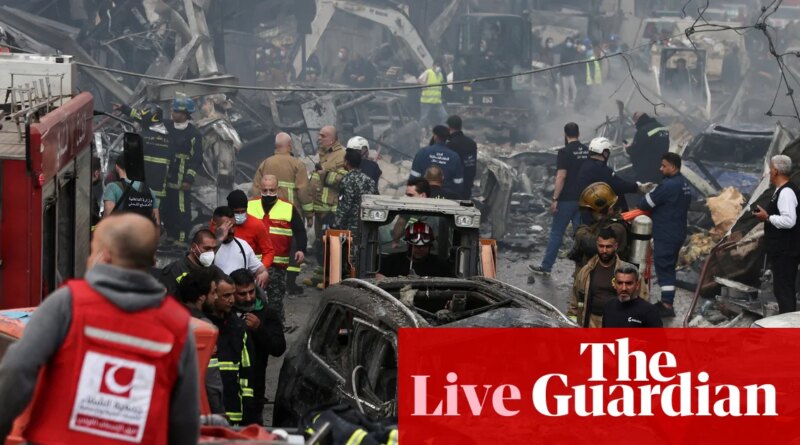
The UN rights chief, Volker Turk, called the scale of killing “horrific”, as Israeli bombarded Beirut without warning, triggering scenes of horror and panic. The Red Cross said it was “outraged by the devastating death and destruction” in densely populated areas across Lebanon.
Iran’s Revolutionary Guards warned they would “fulfil our duty and deliver a response” if Israel did not cease its strikes there, while Hezbollah said it had a “right” to respond.
Israeli prime minister, Benjamin Netanyahu, said the country remained prepared to confront Iran if necessary, as it still had “objectives to complete”, with the military saying it continued to pursue the goal of “disarming” Hezbollah in Lebanon. The Pentagon chief, Pete Hegseth, also vowed that US forces remained at the ready if the conflict flared up again.
The belligerent rhetoric came ahead of high-stakes talks in Pakistan expected on Friday, where the reopening of the strait of Hormuz will be a main talking point.
Here’s the main developments:
-
Iran announced alternative routes for ships travelling through the strait of Hormuz, citing the risk of sea mines in the main zone of the vital waterway. The statement shared instructions for an alternative entry and exit route through the strait.
-
The Trump administration on Wednesday stated Lebanon was not part of the ceasefire dealwith White House press secretary Karoline Leavitt claiming “that has been relayed to all parties”.
-
The US vice-president, JD Vance, also told reporters in Budapest that the US never promised to include Lebanon in the ceasefireand that Iran may have been under that impression due to a “misunderstanding”. Israel announced on Wednesday it did not consider Lebanon covered by the Iran-US truce.
-
Karoline Leavitt also dismissed “misreporting” that Trump is working from the original 10-point plan put forward by Tehran. She said the 10-point plan presented in public by Iran was “literally thrown in the garbage” by Trump – despite the fact Trump said on Truth Social that the US received a 10-point proposal from Iran that is believed to be a “workable basis on which to negotiate”. Leavitt claimed Iran actually put forward a “more reasonable and entirely different and condensed plan to the president”.
-
French president Emmanuel Macron said he has urged his US and Iranian counterparts, Donald Trump and Masoud Pezeshkian, to include Lebanon in the ceasefire reached with Iran. Australia’s foreign minister has urged the same.
-
Donald Trump vented his frustration with Nato during a private meeting with its secretary-general, Mark Rutteas relations in the alliance reached a crisis point. “He is clearly disappointed with many Nato allies, and I can see his point,” Rutte said on CNN, after spending more than two hours at the White House. “This was a very frank, very open discussion, but also a discussion between two good friends.”
-
Sir Keir Starmer will continue his tour of the Middle East on Thursday after he met with the Crown Prince of Saudi Arabia, Mohammed Bin Salman, as part of ongoing talks with allies to give shipping the “confidence” to pass through the strait of Hormuz.
Key events
Trump tells Iran to comply with ‘real agreement’
Donald Trump has just posted to Truth Social.
He says all US ships, aircraft, and military personnel would remain in place until Iran fully complied with “the real agreement”.
If for any reason it is not, which is highly unlikely, then the “Shootin’ Starts,” bigger, and better, and stronger than anyone has ever seen before. It was agreed, a long time ago, and despite all of the fake rhetoric to the contrary – NO NUCLEAR WEAPONS and, the Strait of Hormuz WILL BE OPEN & SAFE. In the meantime our great Military is Loading Up and Resting, looking forward, actually, to its next Conquest. AMERICA IS BACK!”
UN warns ceasefire at ‘grave risk’ if Israel keeps attacking Lebanon
The UN secretary-general has warned that ongoing Israeli attacks on Lebanon poses “a grave risk” to the fragile US-Iran truce, his spokesperson said.
“The ongoing military activity in Lebanon poses a grave risk to the ceasefire and the efforts toward a lasting and comprehensive peace in the region. The Secretary-General reiterates his call to all parties to immediately cease hostilities,” UN chief Antonio Guterres’s spokesman said in a statement on Wednesday.
Israeli strikes kill Al Jazeera correspondent and two Lebanese journalists: report
Israeli strikes on Wednesday killed an Al Jazeera correspondent in Gazaaccording to Al Jazeera and health officials there, as well as two Lebanese journalists in that country, according to the Committee to Protect Journalists.
Citing Al Jazeerathe Associated Press reported that Mohammed Wishah was targeted in a drone strike in west Gaza City. The Israeli military’s Arabic-language spokesperson, Avichay Adraee, claimed on X that Wishah was a member of Hamasreposting a 2024 tweet that described him as a “prominent commander” in its military wing, among other positions.
The Guardian has not been able to independently verify these claims.
Oil prices climb, stocks fall as ceasefire hangs in balance
Oil prices have climbed and stocks fallen on fears over the nascent US-Iran ceasefire, after Israel launched a major bombardment of Lebanon. In past two hours, Hezbollah said it had fired rockets at northern Israel in response to “ceasefire violations”.
Fears that the ceasefire could fall apart while crude remains stuck in Hormuz saw West Texas Intermediate oil jump around 3% Thursday, having plunged more than 16% the day before. Brent was up more than 2% following a 13% drop.
Equities also gave up some of their gains. In early trading in Asia, Tokyo, Hong Kong, Shanghai, Sydney, Singapore, Seoul and Taipei were all marginally down.
Gold eased to $4,712 an ounce.
Independent analysts say they have observed no change in traffic through the strait of Hormuz. That’s despite claims from the White House on Wednesday there had been an uptick in the number of ships transiting the strategic waterway since a US-announced ceasefire with Iran.
Windward, a maritime intelligence firm that tracks international shipping, said only 11 vessels transited the strait on Wednesday – about the same number from prior days.
Windward said all ships transiting the strait must still coordinate safe passage with Iranian authorities, who are requiring shippers to pay hefty tolls of up to $1 a barrel for outbound oil, paid in cryptocurrency. For context, the largest supertankers carry up to 3 million barrels of crude.
Windward said radio broadcasts from Iran to tankers in the Gulf on Wednesday warned that those transiting without approval would be attacked.
Welcome summary
Welcome to the Guardian’s continuing coverage of the US-Israel war on Iran.
The fragile two-week truce between the US and Iran was hanging in the balance on Thursday, with Tehran threatening to resume hostilities as Israel launched a major bombardment of Lebanon, killing at least 254 people, according to Lebanon’s Civil Defence.
As a result, the conditional opening of the strait of Hormuz is precariously placed. Iran is threatening to lock up the chokepoint if Israel keeps striking Lebanon. Just before 4am on Thursday, Hezbollah said it had fired rockets at northern Israel over “ceasefire violations”, reports said.
Washington and Tehran have both claimed victory in agreeing the ceasefire, but fractures emerged quickly as Israel carried out its heaviest strikes on Lebanon – including in central Beirut – since Hezbollah joined the war in early March.
The UN rights chief, Volker Turk, called the scale of killing “horrific”, as Israeli bombarded Beirut without warning, triggering scenes of horror and panic. The Red Cross said it was “outraged by the devastating death and destruction” in densely populated areas across Lebanon.
Iran’s Revolutionary Guards warned they would “fulfil our duty and deliver a response” if Israel did not cease its strikes there, while Hezbollah said it had a “right” to respond.
Israeli prime minister, Benjamin Netanyahu, said the country remained prepared to confront Iran if necessary, as it still had “objectives to complete”, with the military saying it continued to pursue the goal of “disarming” Hezbollah in Lebanon. The Pentagon chief, Pete Hegseth, also vowed that US forces remained at the ready if the conflict flared up again.
The belligerent rhetoric came ahead of high-stakes talks in Pakistan expected on Friday, where the reopening of the strait of Hormuz will be a main talking point.
Here’s the main developments:
-
Iran announced alternative routes for ships travelling through the strait of Hormuz, citing the risk of sea mines in the main zone of the vital waterway. The statement shared instructions for an alternative entry and exit route through the strait.
-
The Trump administration on Wednesday stated Lebanon was not part of the ceasefire dealwith White House press secretary Karoline Leavitt claiming “that has been relayed to all parties”.
-
The US vice-president, JD Vance, also told reporters in Budapest that the US never promised to include Lebanon in the ceasefireand that Iran may have been under that impression due to a “misunderstanding”. Israel announced on Wednesday it did not consider Lebanon covered by the Iran-US truce.
-
Karoline Leavitt also dismissed “misreporting” that Trump is working from the original 10-point plan put forward by Tehran. She said the 10-point plan presented in public by Iran was “literally thrown in the garbage” by Trump – despite the fact Trump said on Truth Social that the US received a 10-point proposal from Iran that is believed to be a “workable basis on which to negotiate”. Leavitt claimed Iran actually put forward a “more reasonable and entirely different and condensed plan to the president”.
-
French president Emmanuel Macron said he has urged his US and Iranian counterparts, Donald Trump and Masoud Pezeshkian, to include Lebanon in the ceasefire reached with Iran. Australia’s foreign minister has urged the same.
-
Donald Trump vented his frustration with Nato during a private meeting with its secretary-general, Mark Rutteas relations in the alliance reached a crisis point. “He is clearly disappointed with many Nato allies, and I can see his point,” Rutte said on CNN, after spending more than two hours at the White House. “This was a very frank, very open discussion, but also a discussion between two good friends.”
-
Sir Keir Starmer will continue his tour of the Middle East on Thursday after he met with the Crown Prince of Saudi Arabia, Mohammed Bin Salman, as part of ongoing talks with allies to give shipping the “confidence” to pass through the strait of Hormuz.