The Mirror We Refuse to Hold: On Darkness, Ignorance, and the Nature of Reflection
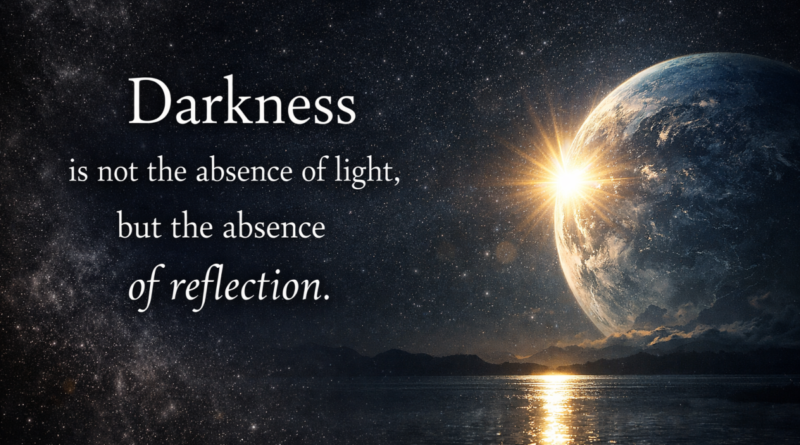
There is a fact about the universe that should unsettle us more than it does. Space—the cosmos in its vast totality—is bathed in light. Photons pour out of billions of stars in every direction, crossing the void in straight lines at the only speed the universe permits. And yet space appears dark. Not because light is absent, but because there is nothing there to receive it, to catch it, to turn it back toward an eye. Therefore, darkness is not the absence of light, but the absence of reflection.
This is not merely a fact about physics. It is a parable about the mind.
What Darkness Actually Is
We have long conceived of darkness as the privation of light—light’s shadow, light’s absence, light’s failure to arrive. This is intuitive, and in some mundane sense accurate. But the cosmos forces a more precise account. Consider that the beam of a flashlight in open space is, in a strict sense, invisible. The photons are there. They are traveling. They carry energy and information. But you cannot see the beam unless you are standing in its path, or unless something in the beam’s way catches the light and redirects it toward your eye. Darkness is not the failure of light to exist. It is the failure of light to find a surface that will give it back.
This is a small revolution in how we think about seeing. Vision is not passive reception. It is a transaction—an exchange between light and matter, in which matter reflects, absorbs, scatters, and returns. Without that exchange, light passes through reality like a ghost, present but invisible, carrying no information that any observer can receive.
The darkness of space, then, is a kind of relational failure. Light is doing its part. The cosmos is simply not there, in most of its volume, to meet it.
The Epistemic Parallel
Ignorance, by the standard account, is the absence of truth. We do not know something because the truth has not reached us—because we lack access, education, exposure. On this picture, the cure for ignorance is information delivery: more data, more teaching, more facts transmitted from the knowing to the unknowing.
But this account is wrong in the same way that the privation theory of darkness is wrong. Truth, like light, is not the limiting factor. The universe presents its evidence continuously. Reality offers itself for inspection at every moment. The structure of things, the patterns of history, the testimony of experience—all of it is radiating, available, impinging on us from every angle. And yet vast territories of the mind remain dark.
Ignorance is not the absence of truth. It is the absence of reflection.
By reflection here I mean something precise: the active, deliberate, and often uncomfortable process by which a mind turns incoming information back on itself—examines it, cross-references it, compares it against prior belief, allows it to disrupt comfortable conclusions, and receives what it has to give. This is the cognitive analog to what matter does with light. Without reflection, truth passes through us. We are present to it; it is present to us; and nothing is seen.
This reframes the problem of ignorance entirely. The question is not primarily one of access. Most modern ignorance is not the ignorance of the medieval peasant who had no library. It is the ignorance of the illuminated—of those who are surrounded by information and yet see nothing, because the information cannot find a reflective surface inside them. It bounces off, is filtered out, or simply passes through.
The Quran states this with almost clinical precision in 6:122:
Is one who was dead and we granted him life, and provided him with light that enables him to move among the people, equal to one in total darkness from which he can never exit? (6:122)
The verse does not say the person in darkness lacks light in the world around them. It says they cannot exit—they are sealed inside an absence of their own making, surrounded by a world that offers light they are constitutionally unable to receive. The one granted life and light moves among the people, in the same world, under the same sky. The difference is not the environment. It is the capacity for reception.
The Phenomenology of Non-Reflection
What does non-reflection look like from the inside? This is where the account must be honest, because non-reflection is not experienced as the absence of thought. It has its own phenomenology, its own texture. The unreflective mind is not blank; it is busy. It processes; it responds; it forms opinions; it feels certain. The difference is that its processing is not genuinely open to revision. The mind that does not reflect does not encounter information—it confirms prior conclusions. Input is sorted rapidly: affirming data is absorbed, disconfirming data is reclassified as irrelevant, malicious, or confused.
This is why the model of ignorance-as-absence is not merely incomplete but actively misleading. It implies that more information would fix the problem. But you cannot cure the absence of reflection by increasing the supply of light. A surface that does not reflect does not suddenly become reflective because you shine a brighter lamp at it. The failure is structural, not quantitative.
The reflective capacity—what Socrates was gesturing at when he spoke of the examined life, what the Quran presses toward in verse after verse with its repeated challenge a-fa-lā ta’qilūn (“do you not reason?”)—is not the mere presence of intelligence. It is a disposition, a willingness, a trained orientation of the mind toward its own contents and toward incoming evidence. It is, crucially, something that can be cultivated or atrophied. And like any neglected capacity, it does not announce its own absence.
The Quran returns to this imperative with striking insistence. The verb tafakkarūn—to reflect, to think deeply—appears across dozens of contexts, each time as both an invitation and a reproach:
They remember GOD while standing, sitting, and on their sides, and they reflect upon the creation of the heavens and the earth. (3:191)
Did they not roam the earth, then use their minds to understand, and use their ears to hear? Indeed, the real blindness is not the blindness of the eyes, but the blindness of the hearts inside the chests. (22:46)
Say, “Is the blind the same as the seer? Do you not reflect?” (6:50)
The last verse is almost a direct transcription of the cosmological problem. The blind and the seer inhabit the same world, receive the same light. What differs is not the light but the capacity to use it. And the Quran’s question is not rhetorical in the dismissive sense—it is a genuine demand: why do you not reflect? What is preventing it? The blindness of the hearts inside the chests is not a fate. It is a condition that was allowed to develop.
Two Modes of Reflection
It is worth distinguishing two things that “reflection” can mean, because both are necessary and they correspond to different cognitive failures.
The first is external reflection: the process of receiving evidence from the world and allowing it to genuinely update one’s picture of things. This is empirical openness, the willingness to be surprised, to have prior beliefs disconfirmed, to notice when reality is not behaving as one expected. Without this, the mind becomes a closed system—internally consistent, perhaps elaborate, but increasingly detached from the world it purports to describe. Truth passes through and nothing is altered.
The second is internal reflection: the examination of one’s own mental contents—one’s beliefs, motivations, assumptions, and the hidden architecture of one’s reasoning. This is the Socratic mode. It is asking not merely “is this true?” but “why do I believe this?”, “what would change my mind?”, “what am I not willing to consider, and why?” Without this, even external evidence that is received cannot be properly processed, because the machinery of cognition itself is opaque to the one using it. We see what our assumptions let us see, and we do not see the assumptions.
The Quran calls for both simultaneously. When it asks why do they not reflect on themselves? (30:8), it is summoning internal reflection—the self-directed gaze. When it asks why do they not reflect upon this scripture? (23:68) or why do they not reflect on the camels and how they are created? (88:17), it is directing attention outward, toward creation and revelation as objects of sustained inquiry. The two modes reinforce each other: a mind that will not examine itself cannot honestly examine anything else, and a mind that refuses to attend carefully to external reality will find that its internal reflections become increasingly circular and self-serving.
We will show them our proofs in the horizons, and within themselves, until they realize that this is the truth.± Is your Lord not sufficient, as a witness of all things? (41:53)
Both modes are vulnerable to the same failure: they require an openness that is genuinely costly. Reflection disturbs. It unsettles comfortable beliefs. It surfaces contradictions. It requires entertaining the possibility that one has been wrong about things one cares about. This cost is real, and the mind has evolved highly efficient mechanisms for avoiding it while generating the sensation of having paid it. We feel as though we have considered something when we have merely exposed ourselves to it. We feel as though we have weighed evidence when we have ranked it by how well it fits our priors. Reflection is mimicked constantly and achieved rarely.
God’s Light
There is something further in the astronomical metaphor worth drawing out. The places in space that are not dark—that are luminous, that return light to an observer—are the places where matter has gathered. Stars, planets, nebulae: the regions where the universe has, through the slow force of gravity, concentrated itself into structure.
Structure is what enables reflection. A diffuse cloud of gas reflects poorly; a dense body reflects well. The analogy holds. A mind that has not been structured—that has not built up organized knowledge, frameworks for evaluation, habits of questioning, disciplined exposure to difficult problems—cannot reflect well, regardless of how much light falls on it. Intelligence alone is not sufficient; intelligence is the raw material, like hydrogen, which gravity has not yet organized into anything that burns or shines back.
This is an argument for what we might call intellectual density: the deliberate construction, over time, of a mind that is structured enough to catch and return what encounters it. Not rigidity—rigidity is the wrong kind of density, the kind that absorbs light and converts it to heat without giving anything back. The right kind of intellectual structure is more like a well-ground lens: it bends incoming light, focuses it, makes it do work, and sends it out again changed and clarified.
The twenty-fourth chapter of the Quran takes up precisely this imagery in one of the most philosophically dense passages in the entire text. In the famous Light Verse (24:35), God’s light is described not as illuminating a dark room but as nūrun ‘alā nūr—light upon light, layered and self-compounding.
GOD is the light of the heavens and the earth. The allegory of His light is that of a concave mirror behind a lamp that is placed inside a glass container. The glass container is like a bright, pearl-like star. The fuel thereof is supplied from a blessed oil-producing tree, that is neither eastern, nor western. Its oil is almost self-radiating; needs no fire to ignite it. Light upon light. GOD guides to His light whomever He wills. GOD thus cites the parables for the people. GOD is fully aware of all things. (24:35)
The image is not of a lamp that pierces darkness but of a structure—a niche, within it a lamp, within the lamp a glass like a brilliant star—that catches, concentrates, and amplifies whatever light it receives. The point is not that light comes from without and darkness is the default. The point is that certain structures are constituted to gather light and intensify it, while the absence of such structure leaves the surrounding space apparently dark despite the light’s presence everywhere.
The same chapter then offers two counter-allegories, and the contrast between them is illuminating in ways the text itself seems to intend. The first (24:40) is of a person adrift in layered oceanic darkness—waves above waves, fog above that, darkness compounded upon darkness—who stretches out their hand and can barely see it. The second (24:43) describes clouds that carry hail and cast their shadow across the earth, blinding white light where they part, darkening everything beneath where they mass.
Do you not realize that GOD drives the clouds, then gathers them together, then piles them on each other, then you see the rain coming out of them? He sends down from the sky loads of snow to cover whomever He wills, while diverting it from whomever He wills. The brightness of the snow almost blinds the eyes. (24:43)
The key distinction is not between darkness and light but between what each figure does with the light that reaches them. The word the Quran reaches for elsewhere to describe the rejector—kāfir, typically rendered “disbeliever” or “unappreciative”—carries in its root the sense of one who covers over or buries: the farmer who covers seed with earth, the one who conceals what has been given. It is not the absence of receipt but the act of concealment. The dark cloud does not lack light—light falls on it, as it falls on everything. What the cloud does is absorb and block rather than return and reflect. The snow on the mountain above that same cloud catches the same light and gives it back so brilliantly that it can hurt to look at directly. Same sky. Same source. Opposite relationships to what was received.
Another allegory is that of being in total darkness in the midst of a violent ocean, with waves upon waves, in addition to thick fog. Darkness upon darkness—if he looked at his own hand, he could barely see it. Whomever GOD deprives of light, will have no light. (24:40)
This is why the oceanic darkness verse is not a picture of hopelessness. God floods everything with light—the drowning person, even in that compounded dark, can barely see their hand. Not cannot. Barely. A thread of light reaches even there, which is precisely the point: the light never fully abandons. What the verse is describing is not the withdrawal of light but the near-total suppression of the reflective capacity—layer upon layer of one’s own making—until only the faintest trace gets through. And even then, it gets through. The final line seals the logic: Whomever GOD deprives of light, will have no light (24:40). The deprivation is not arbitrary. It is the terminus of a process the self initiates and maintains, the end state of covering over what was given until covering becomes the only thing one knows how to do.
This is the cosmological version of the moral problem. God’s light floods creation the way photons flood the vacuum—universally, without preference, reaching everything. What varies is what creation does with it. Some structures receive, concentrate, and radiate back, so brilliantly that the return can seem to exceed what was given. Others layer over themselves until almost nothing returns—not because the light stopped coming, but because the surface that should have caught it has been buried.
The First Failure: Iblis and the Logic of Arrogance
There is a story in the Quran that grounds all of this not in abstraction but in a concrete, named failure—a failure that the text treats as the primordial pattern of everything that follows.
When God commanded the angels to prostrate before the newly created Adam, all complied except one. Iblis—the figure who becomes Satan, the Adversary—refused. His stated reason was not ignorance. It was a logical deduction: I am better than him. You created me from fire and created him from clay (7:12; 38:76). The argument has a form. It uses a premise (fire is superior to clay), applies a comparative operator (I am therefore superior to him), and reaches a conclusion (I should not prostrate). The reasoning looks like reasoning. It proceeds from premises to conclusions. It uses categories and makes inferences.
And it is catastrophically wrong—not despite its logical form but because of what it refuses to reflect on.
The failure of Iblis is not stupidity. He is not uninformed. He is, within the Quranic cosmology, one of the closest beings to the divine, present at the moment of creation, addressed directly by God. The light is as available to him as to any being that exists. His failure is the failure of reflection in its deepest sense: the refusal to examine why the command was given, what it meant, and whether his own categories were adequate to evaluate it. He applied a pre-existing hierarchy (fire > clay) to a situation that the hierarchy was not designed to capture. He did not ask whether his framework was appropriate. He did not entertain the possibility that Adam represented something his categories could not see. He reflected on the question just enough to generate a conclusion that confirmed what he already believed about himself—and then he stopped.
This is the structure of arrogance, and it is identical to the structure of non-reflection. The arrogant mind is not the mind that thinks too much. It is the mind that has settled its most important questions in advance and uses subsequent reasoning not to genuinely inquire but to generate justifications for what it already holds. Every new input is processed through a framework that cannot be questioned, because questioning the framework would threaten conclusions the mind is not willing to relinquish. The result is what we see with Iblis: an agent in possession of more information than almost any other being in the Quranic narrative, surrounded by the clearest possible light, who nonetheless ends up in the most profound darkness.
And crucially—the Quran makes this unavoidable—his darkness is then projected outward. Iblis, having refused to reflect on himself, dedicates his remaining existence to preventing reflection in others:
Recite for them the news of one who was given our proofs, but chose to disregard them. Consequently, the devil pursued him, until he became a strayer… he insisted on sticking to the ground, and pursued his own opinions. Thus, he is like the dog; whether you pet him or scold him, he pants. Such is the example of people who reject our proofs. Narrate these narrations, that they may reflect. (7:175–176)
The person described here is not someone from whom the proofs were withheld. He was given them. He received the light. The failure is what he did—or refused to do—with what he had. And the description the Quran reaches for is behavioral: he stuck to the ground, pursued his own opinions, operated on a closed loop. Like the dog, his responses were fixed regardless of input—petting or scolding produced the same panting. The external world ceased to be a source of genuine information and became merely a background against which predetermined responses were performed.
This is Iblis’s legacy: not external darkness imposed from without, but the internal collapse of the reflective surface, which then generates its own darkness and its own bad logic, and which—unchallengeable from within—presents itself as clarity.
Darkness as a Choice
The philosophical stakes here are not merely epistemological. They are moral.
If ignorance were truly the absence of truth, then the ignorant person would be primarily a victim—of circumstance, of limited access, of information poverty. And there are such victims, and their situation is genuinely unjust. But most of the ignorance that matters in the contemporary world is not this kind. It is chosen, or at least permitted. It is the result not of truth’s failure to arrive but of reflection’s failure to engage.
And this means that most ignorance is, at some level, a decision—often not a conscious one, but a decision nonetheless. The choice not to examine one’s beliefs. The choice to receive information that confirms rather than challenges. The choice to be surrounded by people who see things the same way and to call this community rather than recognizing it as an echo chamber. These are choices in the sense that they are courses of action that an agent maintains, and could cease to maintain, and for which an agent bears some responsibility.
This is what makes the metaphor of light and darkness morally charged in the traditions that invoke it. In the Quran, nūr and ẓulumāt—light and darkness—are not merely conditions but orientations. The contrast is not between knowing and not knowing but between those who face the light and those who turn away. The problem is not the photons. The problem is the posture.
A scripture that we revealed to you, in order to lead the people out of darkness into the light. (14:1)
The verse does not say the people are in darkness because no light has been provided. The scripture is the instrument by which they are led out—which implies that the light was already available, that the darkness was a location they were in, and that movement was possible. What the scripture does is not create the light. It directs the reflective capacity toward what was already there.
Darkness, in this moral register, is not what happens to you. It is what you allow to persist. It is the absence of reflection treated not as a misfortune but as a preference.
This is a scripture that we sent down to you, that is sacred—perhaps they reflect on its verses. Those who possess intelligence will take heed. (38:29)
Note the conditionality. Not they will reflect, but perhaps they reflect. The scripture is offered. The light is sent. What happens next is not determined by the giver. It depends entirely on what the receiver does with what arrives.
What Follows
None of this is comfortable, which is perhaps evidence that it is in the right vicinity.
If darkness is the absence of reflection rather than the absence of light, then adding more light—more content, more debate, more facts, more exposure—cannot be the primary remedy. The remedy is the cultivation of reflective capacity itself: the habits of mind that allow incoming truth to find a surface and return something of value. This is slower work, less satisfying than information delivery, and much harder to scale. It cannot be done to a person; it can only be done by a person. It requires the willingness to be unsettled, which is precisely what non-reflection has evolved to prevent.
And if ignorance is the absence of reflection rather than the absence of truth, then the proper response to encountering ignorance—in others, and especially in oneself—is not primarily to supply more information but to ask what is preventing the information already present from being genuinely received. What is the surface condition? What would need to change for the light that is already there to be returned? The Quran offers a posture for exactly this situation—one that does not meet non-reflection with force or contempt but holds its own reflective orientation intact:
The worshipers of the Most Gracious are those who tread the earth gently, and when the ignorant speak to them, they only utter peace. (25:63)
This is not passivity. It is the recognition that you cannot reflect light into a surface that has hardened against it, and that the most one can do, in that moment, is refuse to harden in return.
Let the human reflect on his creation. (86:5)
Why do they not reflect on themselves? GOD did not create the heavens and the earth, and everything between them, except for a specific purpose. (30:8)
The command is both outward and inward. Look at what was made. Look at yourself. The cosmos is structured to return light when it is met by a surface capable of receiving it. The human being is built, the Quran insists, precisely as such a surface—capable of reflection, equipped for it, called to it. The question is whether that capacity is exercised or allowed to atrophy, developed into something that blazes and gives back, or layered over until even the hand stretched out before the face is invisible.
It is worth noting, in closing, that one of the Quran’s own names for itself is al-Dhikr—the Reminder. Not the Revealer, not the Instructor, not the Proof, though it is all of those things too. The Reminder. The name carries a particular assumption: that what is being offered is not entirely new information arriving into a void, but the reactivation of something already present, already available, already within reach. A reminder does not create the capacity to understand. It finds that capacity and calls it back to attention.
Therefore, you shall remind; perhaps the reminder will benefit. The reverent will take heed. (87:9–10)
Perhaps. The word recurs throughout the Quran wherever reflection is at stake, and it is never accidental. The reminder goes out. The light floods the vacuum. Whether it finds a surface to return from is not in the reminder’s power to determine. That is the one variable the cosmos leaves entirely to us.
The cosmos is drenched in light. It appears dark because most of it is empty—because there is nothing there to catch what is offered and give it back.
The question is whether we intend to be something, or nothing.