US to deploy more troops even as Donald Trump praises Iran peace talks
Unlock the White House Watch newsletter for free
Your guide to what Trump’s second term means for Washington, business and the world
The US is planning to send thousands more troops to the Middle East that could be used in land operations in Iran even as President Donald Trump claimed peace talks with Tehran were making progress.
The Pentagon is set to deploy elements of the Army’s 82nd Airborne Division to the Middle East, according to two people familiar with the matter.
About 3,000 soldiers from the elite paratrooper division would be deployed, one of the people said, while another person familiar cautioned that it could ultimately be fewer. The troops will join the thousands of Marines who are aboard warships en route to the region.
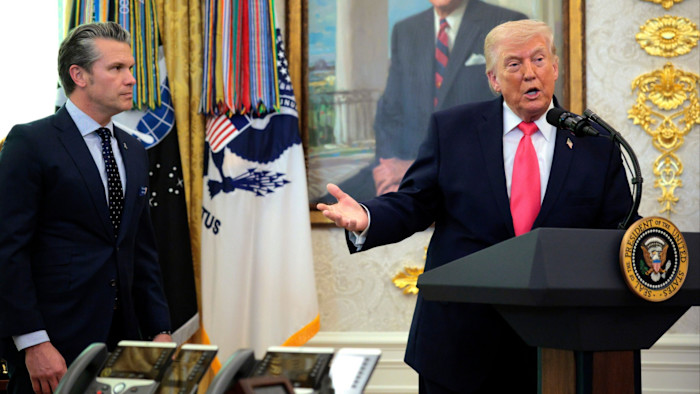
Speaking at the White House on Tuesday, Trump said the US was in contact with the “right people” in Iran, emphasising that vice-president JD Vance and secretary of state Marco Rubio were involved in the talks.
Iran has denied it is participating in any talks with the US but confirmed that mediation efforts by other nations were under way.
Trump’s comments came ahead of a Friday deadline he set for Iran to agree to end the conflict or face the prospect of additional and more intense US strikes and a possible US deployment of ground troops on Iranian soil.
“I can tell you, they’d like to make a deal,” Trump said of the Iranian government, though he did not specify which officials were involved in the negotiations. “They’re talking to us, and they’re talking sense,” he said.
Trump added that Iran had already abandoned its nuclear ambitions and had made a big concession in the energy field — though he declined to provide any details.
“It was a very significant prize, and they gave it to us, and they said they were going to give it. So that meant one thing to me, we’re dealing with the right people,” he said.
The addition of the elite paratroopers from the 82nd Airborne, which is designed to deploy within 18 hours, as well as two Marine Expeditionary Units (MEUs) means the US will add around 10,000 troops to the 50,000 already in the region.
The USS Tripoli, with 2,200 members of the 31st MEU, is expected to arrive in the Middle East by the end of the week.
The Boxer Amphibious Ready Group Pentagon, carrying another 4,500 troops, including 2,200 Marines of the 11th MEU, is expected to arrive in three to four weeks.
The presence of the 82nd Airborne and the MEUs, which are specially trained to seize and hold land, brings US forces closer to readiness for a possible ground operation.
The US has struck more than 9,000 targets in Iran since the start of the war, said Central Command, which oversees American military operations in the Middle East, on Tuesday.
Iran has hit back at targets in the region, including energy facilities in the Gulf, with the strategic Strait of Hormuz, through which about a fifth of the world’s oil passes, all but closed to shipping.
Iran on Tuesday circulated a letter to member countries of the International Maritime Organization saying “non-hostile vessels” can transit the Strait “in co-ordination with Iranian authorities”. The White House did not confirm whether this was the concession Trump was referring to.
In his comments at the White House Trump said US defence secretary Pete Hegseth and General Dan Caine, the top US military officer, were “quite disappointed” about the possibility of negotiations to end the war in Iran.
“Pete didn’t want it to be settled, these guys are doing a great job, that’s a good attitude,” Trump said.
Standing beside the president a few minutes earlier, Hegseth addressed the Iranian government, saying: “We negotiate with bombs. You have a choice, as we loiter over the top of Tehran . . . about your future.”