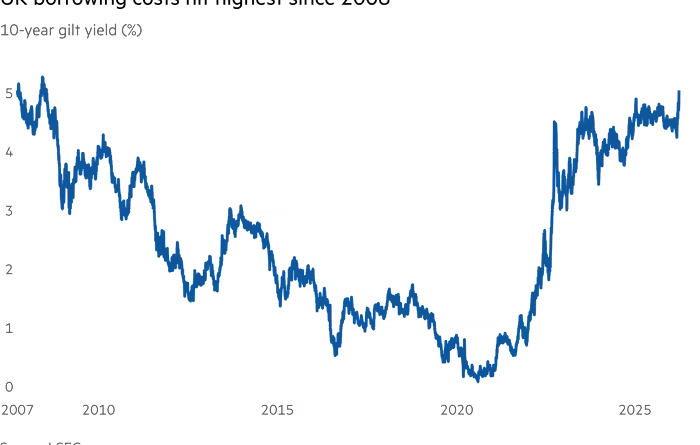
UK borrowing costs reach highest level since 2008 as economic hit from war mounts
The UK’s borrowing costs soared to their highest level since 2008 on Friday amid growing fears of an inflation shock, as the economic hit from the Middle East war mounted.
Ten-year gilt yields, a benchmark for long-term government borrowing costs, surged to 5 per cent, deepening a three-week long rout in bond markets as traders raised bets on interest rate rises from the Bank of England.
On a day that laid bare the growing risks to the economy, lenders pulled mortgage deals and households were warned to expect a 20 per cent increase in energy bills from July.
The gilt market turmoil and wider economic repercussions from the conflict are a major blow to chancellor Rachel Reeves, who this month used her Spring Statement to hail the “stability” the government had brought to the public finances.
“The markets are feeding off the developments in the Middle East and the associated worsening outlook for energy prices as well as the possible policy reaction,” from the central bank, said Paul Dales, UK economist at Capital Economics.
With inflation rising and borrowing costs squeezing households, “you are easily at risk of a recession”, he added.
UK debt has been hit hardest in the global bond sell-off because its dependence on imported energy means a rise in oil and gas prices could quickly feed through to broader inflation.
Investors’ fears over resurgent inflation were compounded this week after the BoE opened the door to higher rates if the energy shock from the conflict was prolonged.
In a sign of the alarm in markets, two-year gilt yields — which track expectations for BoE interest rates — soared 0.17 percentage points on Friday to 4.57 per cent, taking them to their highest level in more than a year, as oil prices traded at close to $110 a barrel.
Traders are now anticipating three quarter-point rate rises this year, in a sharp contrast to before the conflict, when they were expecting the central bank to deliver lower borrowing costs.
“Unfortunately when gilts move, they move big,” said Pooja Kumra, rates strategist at TD Securities. “The extremely hawkish twist from the BoE was certainly not anticipated by market participants, where there had still been hope for delayed cuts.”
The pound was down 0.8 per cent against the dollar at $1.333.
As the rout in gilts deepened, lenders raised mortgage rates, with the average rate for a two-year fix hitting 5.35 per cent on Friday, the highest in a year, according to finance site Moneyfacts.
In another indication of the economic pain facing the UK, Cornwall Insight, a respected consultancy, said that the energy price cap for July to September would put typical annual household gas and electricity bills at £1,972, up from £1,641 between April and June.
The steep rise in borrowing costs also exacerbates the challenge facing Reeves, who is said by colleagues to be spending “virtually all her time” focused on the Iran war and assessing what support she may need to give households and businesses to cope with an energy price surge.
One Treasury insider said the mood in the department over the past week had been “pretty bleak”, noting that the conflict threatened to undo a lot of her plans. “It feels really disheartening,” they said.
Reeves had ordered an internal Treasury audit of the energy subsidy package of 2022 as she sought to ensure any future efforts were more narrowly focused on those who most need the support, insiders said.
The chancellor has said that any support would be “targeted” on the most vulnerable groups, but such a move would be a blow a hole in her fiscal plans, along with the risk of higher inflation and interest rates not coming down as quickly as she had hoped.

The Treasury insists that Reeves’ fiscal rules are sacrosanct, raising the prospect that she might have to raise taxes again in her autumn Budget to balance the books.
Reeves doubled the headroom against her key fiscal rule to £22bn in the November Budget, but some economists warn this could quickly be whittled away by higher interest costs and lower growth rates when the Office for Budget Responsibility next delivers its economic forecasts.
Concerns over the hit from an energy shock were exacerbated on Friday by figures showing the UK had borrowed a higher than predicted £14.3bn in February.
Gilt yields in effect set the interest rate that the government has to pay on new borrowing, and are already the highest compared with G7 nations, as a result of the UK’s persistent inflation and elevated levels of borrowing in recent years.
The government plans to sell £252bn of gilts this year and already pays more than £100bn annually in interest costs on its outstanding debt.