Counting the Sacred Text: A History of Numerical Verification in Scripture Preservation
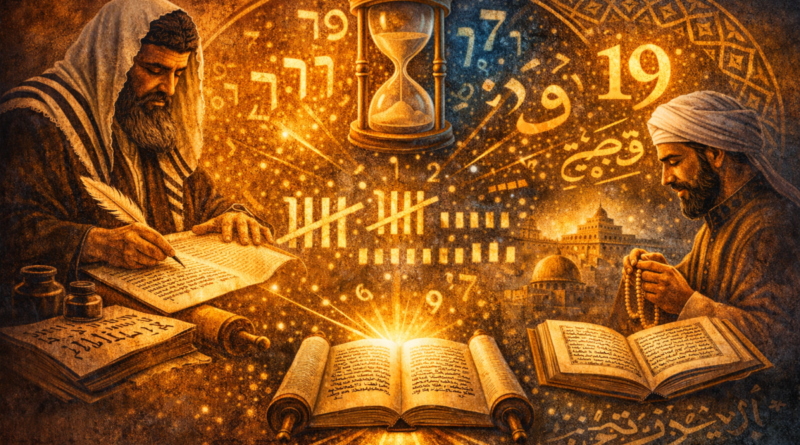
In most languages, the word for “scribe” evokes an image of someone who writes. In Hebrew, the word is sofer (סוֹפֵר), and it means, at its root, s-p-r (ס-פ-ר), one who counts.
That etymology is not incidental. It encodes a technology of preservation that is among the most durable and sophisticated ever devised for protecting sacred texts against the entropy of transmission. Across millennia, across three major textual traditions, and in cultural contexts as different from one another as Babylonian temple schools and medieval Tiberias, the act of enumerating the constituent units of a text—its letters, words, verses, and structural midpoints—served as the primary mechanism by which scribes could verify fidelity to an exemplar and detect corruption in copies.
This article traces that history from its origins in the broader ancient Near Eastern scribal culture, through the elaborate verification systems of the Hebrew Sopherim and Masoretes, into the early Islamic world’s distinct approach to textual protection through memorization and controlled codification, and into the Quran’s own internal numerical architecture—a system that appears to embed verification within the text itself.
Counting in the Ancient Near East
The Original Data Problem
Writing first appeared in the ancient Near East not as literature but as accounting. The earliest cuneiform inscriptions, dated to around 3200 BCE at the Sumerian city of Uruk, were records of livestock and commodity transactions—essentially spreadsheets pressed into clay. Scribes in the great temple bureaucracies of Mesopotamia were, from the beginning, quantitative professionals. Their purpose was to record how many, and their professional identity was inseparable from numerical accuracy.
By the Old Babylonian period (roughly 2000–1600 BCE), cuneiform scribal schools—the edubba, or “tablet house”—were producing students trained in both the mechanics of writing and the discipline of enumeration. Multiplication tables, metrological tables correlating measurement values to sexagesimal numbers, and complex series texts all demanded careful counting and verification. Mathematical tablets from this period, such as those in the collection at Nippur, often bear colophons—scribal annotations at the end of a tablet—that record the number of sections, the identity of the scribe, and sometimes the original from which a copy was made.
This colophon tradition was the ancient scribe’s digital checksum: a way of encoding metadata about a text so that later copyists could verify completeness. By the Neo-Assyrian period (9th–7th centuries BCE), the great library of Ashurbanipal at Nineveh had standardised this practice on an institutional scale. Tablets were numbered within series, colophons were standardised across multiple exemplars, and catalogues existed to track the holdings. Scribal notes recording “checked and verified against its original” appear on literary, divinatory, and medical texts alike.
What the Mesopotamian scribal tradition established, then, was the foundational principle that underlies all later counting traditions: enumeration is not a product of the text, it is a guardian of it. A count is not a curiosity to be noted after the fact; it is a prospective control, a number that a future copyist must reproduce or explain.
Egypt and the Intersection of Numerics and Sanctity
Egyptian scribal practice, while less well documented than Mesopotamian, shared the bureaucratic and quantitative orientation. Egyptian temple scribes attached to institutions like the per-ankh (“house of life”) were responsible for copying and maintaining religious, medical, and magical texts with a precision that had obvious ritual stakes. Errors in a funerary text or a ritual formula were not merely scholarly mistakes—they could be catastrophically efficacious in the wrong direction.
The Egyptian tradition did not develop the elaborate letter-counting apparatus that would appear in the Hebrew scribal world, but it did establish the conceptual environment in which scribal exactitude was a form of cultic obligation, and in which errors required formal correction procedures rather than informal revision. This fusion of numeracy, accuracy, and sacral duty is the conceptual ground from which the more sophisticated Jewish textual verification systems would grow.
The Hebrew Scribal Tradition and the Sopherim
Ezra and the Centralization of Scribal Authority
The Hebrew scribal tradition emerges into clear historical view in the post-exilic period, with the figure of Ezra, described in the biblical text as “a scribe skilled in the Law of Moses” (Ezra 7:6). Whether or not the full portrait of Ezra as a radical legal reformer is historically accurate in all its details, his position in the tradition marks a decisive moment: the point at which the copying and guardianship of Torah became a defined professional vocation with institutional weight.
Before the Babylonian exile, scribes in Israel and Judah worked in royal court and temple contexts, as in other ancient Near Eastern societies. After the return from exile in the 6th century BCE, their function transformed. The written Torah became the constitutive document of a reconstituted community, and the scribe became its custodian. The class of scribes known as the Sopherim—from the Hebrew root s-f-r, to count—developed practices of verification that would, over centuries, become increasingly sophisticated.
The Babylonian Talmud preserves the key etymological testimony. In the tractate Kiddushin (30a), the text explains why the early sages were called Soferim: “because they would count all the letters in the Torah.” The passage goes on to specify what this counting established: the letter vav in the word gaḥon (“belly,” in Leviticus 11:42) was designated the middle letter of the Torah scroll, and the phrase darosh darash (Leviticus 10:16) was designated the middle word.
This passage is often cited as evidence of systematic letter-counting as a preservation technique, and it is genuinely important. But it is worth being precise about what the Talmud actually says—and what it also acknowledges. Rav Yosef, in the same passage, raises the question of whether the vav of gaḥon falls in the first or second half of the Torah and suggests simply counting the letters to find out. The reply is striking: “We are not experts in the deficient and plene forms of words”—meaning that the precise spelling variations in words (where certain vowel-letters may or may not be included) made it impossible, in the rabbinic period, to resolve the question definitively even by direct counting. Modern counts of Torah scrolls, which contain approximately 304,805 letters, confirm the Talmud’s discomfort: the vav of gaḥon is not, by any straightforward letter count, the midpoint of the Torah as we have it.
This is not a scandal. It is a feature. The Talmudic tradition is transparent about the limits and uncertainties of its own counting tradition, which is itself a form of intellectual honesty that later numerological claims about scripture would not always replicate.
What the Sopherim Actually Counted
Setting aside the specific midpoint controversy, the Sopherim‘s general practices of textual verification are well attested and historically significant. The Talmudic tractate Sofrim and various Masoretic notes preserve evidence of a systematic practice of recording, for each book of the Torah and the broader Hebrew Bible:
- The total number of letters
- The total number of words
- The total number of verses (pesuqim)
- The middle letter, middle word, and middle verse of each book
- Unusual forms, rare spellings, and anomalous constructions
- Scribal corrections (tiqqune sopherim)—instances where the received text was read or noted differently from what was written, often for reasons of reverence
These counts served a specific function: a copyist finishing a new scroll could verify its completeness by replicating these statistics. If the letter count differed from the established total, the scroll was potentially defective. If the middle letter did not fall in the expected location, something had been added or subtracted. The count was not an exercise in mysticism—it was a checksum.
The Sopherim also developed rules governing the physical production of scrolls: the type of animal skin to be used, the preparation of ink, the number of lines per column, the required margins, and the dimensions of the writing surface. These material standards complemented the numerical ones, creating a comprehensive quality-control framework that operated on both the micro-level (individual letter forms) and the macro-level (aggregate statistics).
The Masoretes and the Science of the Text
Origins and Context
The Masoretes—from the Hebrew masorah, meaning “tradition” or, in some analyses, related to masar, “to hand down”—were Jewish scholar-scribes who worked primarily from the 6th to the 10th centuries CE, based chiefly in Tiberias on the western shore of the Sea of Galilee, as well as in Jerusalem and Babylonia. Their emergence was prompted by a specific historical crisis: as Hebrew ceased to be a vernacular language for most Jewish communities and Aramaic and then Arabic became the dominant spoken tongues, the fear grew that the precise pronunciation and reading of the scriptural text would be lost even if the written letters were preserved.
The Masoretes responded to this crisis with a project of remarkable intellectual ambition. They did not alter the received consonantal text—that, for them, was inviolable. What they did was surround it with an elaborate apparatus of notation and annotation designed to freeze every aspect of its transmission in amber.
Three distinct Masoretic vocalization systems developed: the Babylonian (using supralinear pointing), the Palestinian (a simpler dot-and-stroke system), and the Tiberian, which was the most comprehensive and precise and which ultimately became normative for all subsequent manuscript and printed traditions. The Tiberian system was the work of several generations of Tiberias-based scholars, most prominently the families of Ben Asher and Ben Naphtali, with the Ben Asher tradition ultimately prevailing. Maimonides (1135–1204 CE), the most authoritative medieval halakhist, endorsed the codex associated with Aaron ben Moses ben Asher as the standard for Torah production, a judgment that has held ever since.
The Three Layers of the Masoretic Apparatus
The Masoretic contribution to scripture preservation operated on three interlocking levels.
First, the Naqdanim (pointers) added vowel signs (niqquud) and cantillation marks (te’amim) to the consonantal text. These were not inventions but transcriptions: the vowel sounds and cantillation patterns had been transmitted orally for centuries. The Masoretes wrote them down, transforming an oral tradition into a written one so that generations no longer fluent in biblical Hebrew could read the text correctly. The Tiberian system distinguished short vowels, long vowels, and reduced vowels with a precision that no earlier system had achieved, and it encoded grammatical information (such as the doubling of consonants and the distinction between plosive and fricative pronunciations) that would otherwise have been lost.
Second, the Masoretes added marginal notes known collectively as the Masorah. This body of annotation is divided into two main categories. The Masorah Parva (small Masorah) appears in the side margins, consisting of brief notes in abbreviated form that record, among other things, how many times a particular word or spelling occurs in the Hebrew Bible, whether a form is unique, and whether a spelling is full (plene) or defective. The Masorah Magna (great Masorah) appears in the upper and lower margins and expands these notes, sometimes listing all occurrences of a rare form with their locations, providing cross-references, and supplying more detailed textual comments. At the ends of books, a Masorah Finalis offered summary statistics for the book just completed.
Third, and related to the first two, the Masoretes continued and formalized the Sopherim‘s counting tradition. As the tractate Sofrim records, they counted the number of letters, words, verses, and parashas in each book and indicated its middle word. They noted all peculiar and unusual forms, indicating how frequently each occurred. These counts, embedded in the Masorah, functioned as a redundant verification system: a copyist who reproduced the Masoretic notes accurately would also, in the process, be verifying the text they enclosed.
The Aleppo Codex, produced around 900–925 CE in Tiberias, represents the culmination of this tradition. The consonantal text was copied by Solomon ben Buyaʿa, while Aaron ben Asher provided the vocalization, cantillation marks, and Masorah. The Aleppo Codex was the model used by Maimonides and other medieval scholars. It once contained the entire Hebrew Bible but has suffered significant losses; the Leningrad Codex (Codex Leningradensis), dated to 1008/1009 CE, is the oldest complete manuscript of the Hebrew Bible in the Masoretic tradition and remains the base text for the critical editions (BHS, BHQ) used by scholars today.
The Masorah as Quality Control
The genius of the Masoretic system was that it transformed the text into a self-verifying object. The marginal notes do not merely supplement the biblical text—they constitute an ongoing audit of it. A Masorah Parva note saying “this word occurs three times in the Torah” is, simultaneously, a reading aid, a cross-reference tool, and an error-detection mechanism. If a copyist accidentally omits or duplicates a word that the Masorah records as occurring three times, the discrepancy will be visible to any reader who checks the marginal annotation.
The effect of the Masorah was to ensure remarkably accurate transmission of the text, including its inherent anomalies and discrepancies. The text was sacred, not a perceived understanding of it, and a scribe was to be neither more nor less than a scribe, no matter how creative or how careless he might be. Unique or rare formations of words or phrases, especially those vulnerable to error, were noted so that the next scribe would not change them to more familiar or more understandable forms.
This last point is significant. The Masorah protected not only the words people expected to find but also the words that surprised them—the difficult readings, the unusual constructions, the apparent grammatical anomalies. A later scribe confronting a text that seemed wrong was explicitly discouraged from “correcting” it, because the marginal note announced that the text was exactly as it was supposed to be. The Masoretic apparatus thus inoculated the text against the very human impulse to improve what one copies.
The Quranic Tradition—Written from the Beginning
The Kitab: A Scripture That Calls Itself a Book
A widely repeated assumption—found in Western academic literature, among Orientalists, and in popular Islamic discourse alike—holds that the Quran was primarily an oral revelation later committed to writing, and that the written text only achieved its final form through post-prophetic compilation efforts. The Quran itself contradicts this assumption at every turn.
The most immediate evidence is terminological. The Quran refers to itself throughout its text by multiple names, foremost among them al-kitab (ٱلْكِتَـٰب)—”the book” or “the scripture.” The very first word of Sura 2 deploys this term: “This scripture is infallible; a beacon for the righteous.” A text that names itself a book in its own second verse is not presenting itself as an oral phenomenon that happened to be written down. It is announcing that writtenness is constitutive of what it is.
The word Quran (ٱلْقُرْءَان) itself confirms this. It derives from the Arabic root ق-ر-أ, which carries the specific meaning of reading from something written—as distinct from tala (تلا), the more general word for recitation. The very first revelation, Sura 96, commands: “Read, in the name of your Lord, who created” (96:1), and specifies the mechanism in the following verse: “He teaches by means of the pen” (96:4). The pen (al-qalam) is the instrument; writing is the mode; and the second revelation, Sura 68, opens by swearing by the pen and what people write (68:1). From the first three revelations, the Quran establishes that it was delivered through a written medium, not merely an oral one.
The Quran further states that its collection and compilation into complete form occurred during the Prophet’s lifetime: “It is we who will collect it into Quran. Once we recite it, you shall follow such a Quran” (75:17–18). The singular address—”you”—is directed at Muhammad, and it places the responsibility for following the completed Quran on him while he was still alive. This is not a post-prophetic project; it is a divine one, completed before the Prophet’s death.
Even the Prophet’s contemporaries acknowledged the written Quran as such. Sura 25:5 records the accusation of his opponents that he had written the scripture using the verb iktatabaha (اكْتَتَبَهَا)and had it dictated to him. This is a polemical charge from adversaries, but it inadvertently confirms that everyone at the time understood the Quran to exist in written form during the Prophet’s life.
Writing as Co-Equal with Recitation
The Quran’s insistence on its written nature has a direct bearing on how its preservation worked. The obsessive spelling consistency found across the earliest surviving manuscripts—across thousands of copies, from different regions, spanning the first two centuries of Islam—cannot be explained by oral transmission alone. If the Quran had been primarily oral, one would expect the variations in spelling that naturally accompany any phonetic transcription by multiple independent scribes. Instead, what scholars find is the opposite: an almost computer-like uniformity in orthography, including the preservation of unconventional spellings that have no phonetic rationale.
For example, the name Abraham (Ibrahim) is spelled one way throughout the entire Quran—except in Sura 2, where all 15 occurrences use an alternate spelling without the ya, a distinction that does not affect pronunciation but was maintained with absolute consistency across all manuscripts. A second example is equally telling: the word bism (“in the name of”) in 96:1—“Read, in the name of your Lord, who created”—is spelled across all manuscripts with an alif (بِٱسْمِ), even though the alif is silent and has no effect on recitation. This is a different spelling from the same word as it appears in the basmala (بِسْمِ), where the alif is absent. The two spellings sound identical when recited; only the written form differs—and that difference was preserved with the same absolute fidelity across the entire manuscript tradition. This is not what oral-to-written transmission produces; it is what written-to-written transmission produces, from a fixed original in which every letter was deliberate.
This matters for the history of Quranic preservation because it means the Quran’s textual fidelity was anchored in the written text from its origin, not retrofitted onto it. The manuscript tradition inherited a fixed written form, not a set of competing transcriptions of an oral tradition. The Quran’s own command—“Do not tire of writing the details, no matter how small” (2:282), addressing the writing of financial contracts—was issued to a community expected to be literate. The same community that was commanded to write down every loan was certainly expected to preserve in writing the far more sacred text they had received.
The Quran’s most concentrated statement about its own scribal transmission comes in the following verses:
“Indeed, this is a reminder. Whoever wills shall take heed. In honorable scriptures (suhuf). Exalted and pure. Written by the hands of messengers (safaratin).” — Quran 80:11–15
The word safaratin is used in this scribal sense nowhere else in the Quran—a hapax legomenon at the precise moment the text describes its own physical production. It is not an accident of vocabulary. The Arabic root س-ف-ر (s-f-r) is the direct cognate of the Hebrew root ס-פ-ר (s-p-r), from which the tradition traced in Part One derives everything at once: sofer (scribe), sefer (book), and mispar (number). Both roots descend from the same Proto-Semitic ancestor, whose core meaning braids together writing, counting, and recording into a single act.
The Quran, in the only verse where it names its own scribes, reaches for a word that is etymologically the same word the Hebrew tradition used for the men who counted every letter of the Torah. The soferim counted; the safaratin wrote; and the root they share is the root that, across every branch of the Abrahamic textual tradition, meant to place something permanently beyond the reach of forgetting.
The Quran’s Internal Numerical Structure
A Text That Counts Itself
What distinguishes the Quran’s relationship to numbers from other ancient scriptures is that the Quran does not merely submit to counting as an external verification discipline—it appears, in a range of verifiable and structurally coherent ways, to anticipate being counted. The numerical properties are not imposed retrospectively on the text by later analysts; they emerge from the text as it stands, fixed since the Uthmanic codification of the 7th century, and they operate at multiple simultaneous registers: lexical frequency, calendrical encoding, structural symmetry, and the behavior of the mysterious disjointed letters (muqatta’at) that open twenty-nine of the Quran’s suras.
This is continuous with the broader tradition documented in this article. The Hebrew Sopherim discovered that their sacred text had a countable midpoint; the Masoretes found that the text, submitted to rigorous enumeration, disclosed a stable statistical fingerprint that could anchor future copying. The question the Quran poses is whether a sacred text can go further—whether the counting is not merely a post-hoc guardian of the text but is built into the architecture of revelation itself.
One data point captures this possibility with unusual precision. Sura 2 is the longest chapter in the Quran, containing 286 verses. Its structural midpoint is verse 143. That verse reads:
“We thus made you a middle (وَسَطًا) community, that you may serve as witnesses among the people, and the messenger serves as a witness among you.” — Quran 2:143
The word wasatan—middle, central, balanced—appears at the mathematical center of the Quran’s longest chapter. Where the Hebrew Sopherim labored to locate the midpoint of the Torah and mark it with a sign, the Quran’s midpoint announces itself: the text declares its own centrality at the precise location that centrality falls.
Theological Symmetry and Lexical Frequency
The most striking individual case of Quranic numerical symmetry is one that is simultaneously a theological argument. Sura 3:59 states:
“The example of Jesus, as far as God is concerned, is the same as that of Adam; He created him from dust, then said to him, ‘Be,’ and he was.” — Quran 3:59
The verse equates Jesus and Adam as instances of the same divine creative act—both brought into existence without a biological father, both the product of the divine command kun (“Be”). This is the Quran’s direct counter to Christological claims that the miraculous birth of Jesus implies divinity.
The numerical correlate of this theological claim is verifiable: the name Jesus (Isa, عيسى) appears exactly 25 times in the Quran, and the name Adam (آدم) also appears exactly 25 times. They are the only two figures in the Quran explicitly declared equal, and they occur with identical frequency. This is confirmed by every concordance of the Quranic text and is widely acknowledged across both Muslim and non-Muslim reference sources.
Calendrical Intelligence
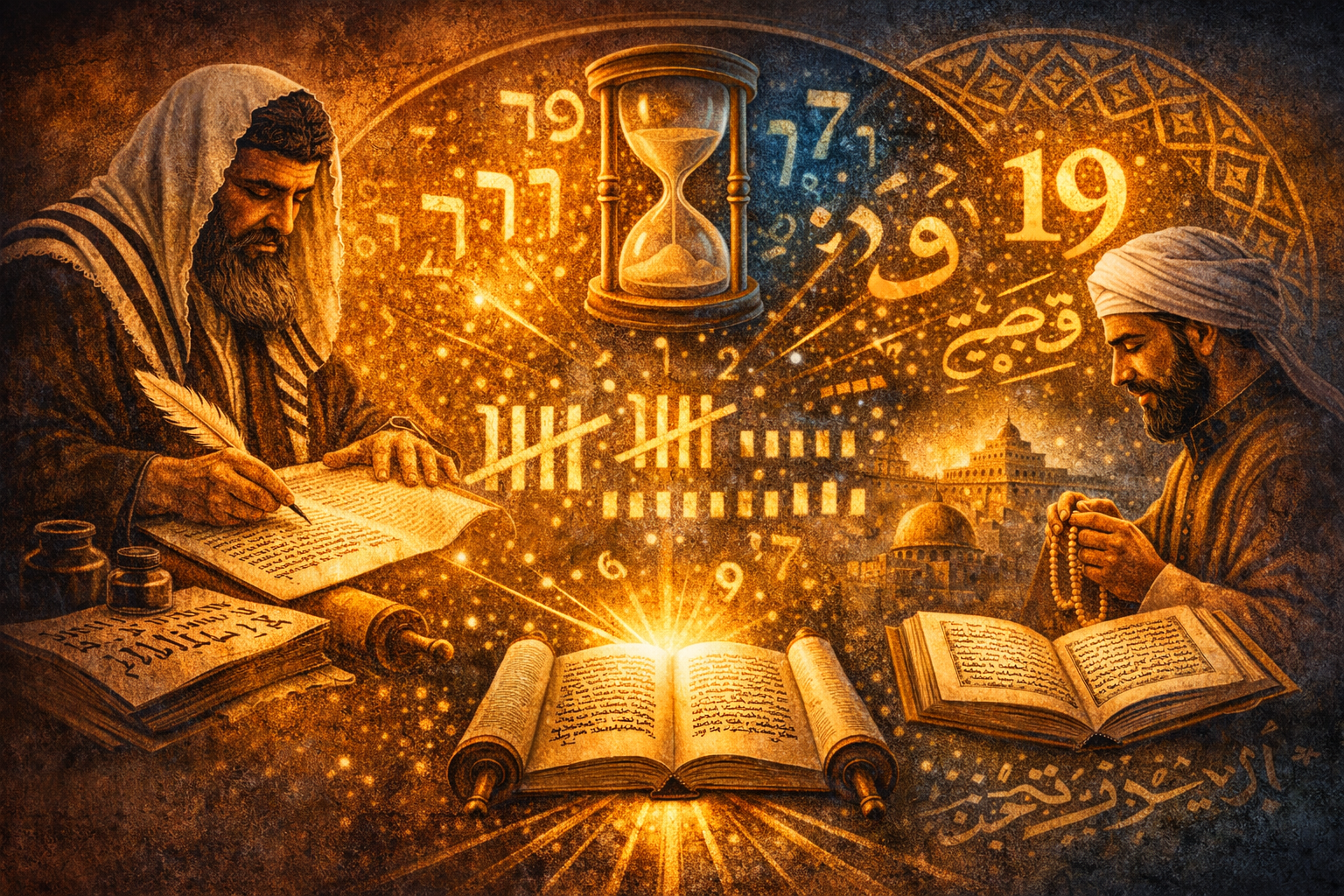
Among the most precisely calibrated of the Quran’s numerical features is what might be called its calendrical architecture—the way its word frequencies correspond to the structure of time itself, and do so in a way that acknowledges two distinct calendar systems simultaneously.
The word yawm (day) in its pure singular form appears 365 times in the Quran—the number of days in a solar year. This count, which has been verified independently using Quranic concordances including Hanna Kassis’s scholarly Concordance of the Qur’an, refers strictly to the bare singular form without attached pronouns or demonstratives. The plural forms ayyam and yawmayn (days and two days) together appear 30 times—the average length of a calendar month. The word shahr (month) in the singular appears exactly 12 times—as the Quran itself states in 9:36:
“The count of months, as far as God is concerned, is twelve.” — Quran 9:36
The word Sabbath (sabt)—a day of weekly rest commanded to the Children of Israel—appears exactly 7 times, once for each day of the week in which it falls.
What elevates this beyond coincidence is the dual-calendar dimension. The Quran uses two different words for “year”: sanah (سنة), which refers to the solar year, and ‘am (عام), which refers to the lunar year. These are not interchangeable in classical Arabic, and their distinct usage throughout the Quran is consistent with this semantic distinction. The word ‘am in all its forms appears 9 times in the Quran; sanah in all its forms appears 19 times. This distinction encodes precisely the numerical relationship between the two calendar systems: 300 solar years equal 309 lunar years—a difference of 9. The Quran encodes this relationship explicitly in Sura 18:25, which describes the People of the Cave as remaining for “three hundred years, increased by nine”—the very calculation that converts solar years to their lunar equivalent.
They stayed in their cave three hundred years, increased by nine. — Quran 18:25
(٢٥) وَلَبِثُوا۟ فِى كَهْفِهِمْ ثَلَـٰثَ مِا۟ئَةٍ سِنِينَ وَٱزْدَادُوا۟ تِسْعًا
The Metonic cycle—the astronomical observation that 19 solar years correspond to almost exactly 235 lunar months, after which the sun, moon, and earth return to the same relative alignment—is the mathematical basis of every lunisolar calendar. The word sanah (solar year) appears 19 times. Moreover, if one counts every verse in the Quran where the words for sun (shams) and moon (qamar) appear together in the same verse, the total is exactly 19. And the final verse where sun and moon appear together is 75:9, describing the eschatological dissolution of the very celestial bodies whose 19-year cycle the number encodes.
“And the sun and the moon crash into one another”— Quran 75:9
The Declaration of Nineteen
Before examining how the number 19 operates across the Quran’s structure, it is worth establishing that the Quran names this number explicitly and assigns it a specific function. Sura 74—one of the earliest revelations—addresses those who dismiss the Quran as a human composition. Verses 74:24–25 record the charge directly: “This is but clever magic. This is human made.” The Quran’s response comes five verses later at 74:30: “Over it is nineteen.”
The verse that follows—74:31, the longest in the sura—specifies that this number serves five distinct purposes: to disturb those who reject the scripture, to convince Jews and Christians of its divine origin, to strengthen the faith of believers, to remove doubt from the hearts of those who received earlier scriptures, and to expose those who harbor doubt. The number is not presented as mystical or hidden; it is presented as a publicly verifiable feature of the text—one whose function is explicitly polemical and apologetic, a counter to the charge of human authorship. Verse 74:35 calls it “one of the great miracles.”
[74:18] For he reflected, then decided.
[74:19] Miserable is what he decided.
[74:20] Miserable indeed is what he decided.
[74:21] He looked.
[74:22] He frowned and whined.
[74:23] Then he turned away arrogantly.[74:24] He said, “This is but clever magic!
[74:25] “This is human made.”[74:26] I will commit him to retribution.
[74:27] What retribution!
[74:28] Thorough and comprehensive.
[74:29] Obvious to all the people.[74:30] Over it is nineteen.
[74:31] We appointed angels to be guardians of Hell, and we assigned their number (19)(1) to disturb the disbelievers,
(2) to convince the Christians and Jews (that this is a divine scripture),
(3) to strengthen the faith of the faithful,
(4) to remove all traces of doubt from the hearts of Christians, Jews, as well as the believers, and
(5) to expose those who harbor doubt in their hearts,and the disbelievers; they will say, “What did GOD mean by this allegory?” GOD thus sends astray whomever He wills, and guides whomever He wills. None knows the soldiers of your Lord except He. This is a reminder for the people.
[74:32] Absolutely, (I swear) by the moon.
[74:33] And the night as it passes.
[74:34] And the morning as it shines.
[74:35] This is one of the great (miracles).
[74:36] A warning to the human race.
Crucially, the structure of Sura 74 itself demonstrates the pattern it announces. The first 19 verses contain exactly 57 words (19 × 3). The words from 74:1 to 74:30—the verse that names nineteen—total exactly 95 (19 × 5). The letters from the beginning of the sura to the word “nineteen” in verse 30 total exactly 361 (19 × 19). The number of words of verse 31, which states the function of the numbe 19, contains 57 (19 × 3) words. The sura does not merely declare its organizing principle; it embodies it in the very count of words and letters leading up to the declaration.
The Gateway Phrase and Its Number
With the Quran’s own declaration of 19 as a structural organizing principle established, its operation becomes visible throughout the text—beginning with the phrase that opens every sura. The basmala—Bismillah ir-Rahman ir-Rahim, “In the name of God, the Most Gracious, the Most Merciful”—consists of exactly 19 Arabic letters: ب-س-م (3), ا-ل-ل-ه (4), ا-ل-ر-ح-م-ن (6), ا-ل-ر-ح-ي-م (6). This letter count has been consistent across every manuscript since the earliest written copies. Of the 114 suras in the Quran, 113 open with the basmala, and Sura 27 contains an additional basmala in its body at verse 30—meaning the phrase appears a total of 114 times in the text: 19 × 6. The total number of suras is itself 114: 19 × 6.
The three names of God of the basmala are each distributed throughout the Quran’s numbered verses in multiples of 19. Allah (God)—the most frequently occurring name of God in the Quran—appears 2,698 times (19 × 142). Al-Rahman (the Most Gracious) appears 57 times (19 × 3). Al-Rahim (the Most Merciful) appears 114 times (19 × 6). And The basmala thus functions as a structural key to the entire text: its 19 letters open a book whose sura count is 19 × 6, whose opening phrase recurs 19 × 6 times, and whose divine names are each distributed through the body of the text in distinct multiples of 19. This is not a pattern that can be altered by a copyist without disturbing multiple independent numerical relationships simultaneously.
The Disjointed Letters
The basmala‘s relationship to 19 is matched at the level of the individual suras by the muqatta’at—the mysterious isolated letters that open 29 of the Quran’s chapters, such as Alif Lam Mim (ا ل م) at the beginning of Sura 2 or Qaf (ق) at the beginning of Sura 50. These letters have resisted definitive interpretation throughout Islamic intellectual history. What textual analysis has made increasingly apparent is that they function as numerical signatures, anchoring each sura—and in some cases the entire text—to the same 19-based structure the Quran declares in Sura 74.
The letter Qaf (ق) opens both Sura 42 and Sura 50. Despite Sura 42 being approximately twice as long as Sura 50, both suras contain exactly 57 occurrences of the letter Qaf—57 being 19 × 3. The initials Ha Mim (ح م) open seven consecutive suras: 40 through 46. The total count of all Ha and Mim letters across all seven of these suras is 2,147—which is 19 × 113. The triple initial Ayn Seen Qaf (ع س ق) appears uniquely at the opening of Sura 42, and the combined count of those three letters in the sura is 209—which is 19 × 11.
The geometric precision of the initial system extends beyond frequency counts into the spatial structure of the text. The letter Ṭā (ط) appears 1,273 times across the entire Quran—and 1,273 is 19 × 67, where 67 is itself the 19th prime number. Since 1,273 is odd, it has a single central value: the 637th occurrence. The first 636 occurrences of Ṭā fall in Suras 1 through 19; the remaining 636 fall from Sura 20 verse 2 through the end of the Quran. The single Ṭā that divides them perfectly in half is the first letter of Sura 20, verse 1—the initial Ṭā Hā (طه) that opens the sura. The initial does not merely inaugurate its chapter; it occupies the exact geometric midpoint of every occurrence of its letter across the entire 114-sura text. The muqatta’at function simultaneously as chapter headings and as positional anchors in the letter-distribution architecture of the whole.
Distinguishing Structure from Numerology
The features described above are categorically different from the kind of numerological manipulation that has, historically, given sacred-text counting a poor reputation. The discipline is conservative and reproducible: any reader with a Quranic concordance can verify these counts independently.
This is the same principle that animated the Masoretic Sopherim when they recorded that a particular word form appears x times in a particular book—a note that any subsequent copyist could verify or refute by counting. The Quranic structural numbers function in an analogous way: they constitute a distributed, redundant verification system in which the removal or alteration of any significant portion of text would disturb multiple independent numerical relationships simultaneously. A text where yawm appears 365 times, where Qaf appears 57 times in each of its two suras, and where the basmala‘s divine names are distributed in multiples of 19, is a text that cannot be silently altered in any one of these respects without the alteration being detectable in the others.
This is distinct from a fundamentally different enterprise that has sometimes been confused with it: the extraction of hidden meaning, prophecy, or secret knowledge from numerical patterns in sacred texts without justification. The most prominent modern example is the so-called Bible Code, popularized in the 1990s, which claimed to find encoded predictions of future events—assassinations, wars, natural disasters—concealed within the Hebrew text of the Torah through a technique called equidistant letter sequencing (ELS), in which letters are selected at fixed intervals to spell out hidden words and phrases. The statistical case for the Bible Code was examined and dismantled by mathematicians, including a detailed refutation published in Statistical Science by Brendan McKay and colleagues, who demonstrated that the same methodology applied to any sufficiently long text—including War and Peace—would produce equally “significant” results. The technique is not a counting method; it is a pattern-extraction method, and the patterns it finds are a function of the analyst’s freedom to choose starting point, interval, and search terms after the fact.
The counting tradition traced in this essay operates on an entirely different epistemological basis. It does not extract hidden meaning from the text; it counts what is openly present. The Sopherim counted every letter of the Torah not to find prophecy but to verify that no letter had been added or removed. The Masoretes recorded word frequencies in the margins not to reveal secrets but to make copying errors detectable. The Quranic counts described here are simple frequency tallies of surface-level features, verifiable by any reader with a concordance and a consistent counting rule. The meaning, where it exists, is in the correspondence between the count and something already stated openly in the text—the Quran’s own declaration that the month count is twelve, its own equation of Jesus and Adam, its own announcement of nineteen as a structural principle. The numbers confirm what the text says.
The Quran’s invocation of the number 19 in Sura 74 is itself structured on this principle. The declaration is not made in a mystical register but in a polemical one—as a response to the charge of human composition (74:18-20), as a feature that will “convince” those who already possess scriptures and “strengthen” those who already believe (74:30). It presents the number as a publicly verifiable structural signature: something that is simply there in the text, waiting to be counted. And the structure of the sura leading up to that declaration already embodies the very pattern it names—which is precisely the kind of redundant self-verification that separates structural observation from numerological assertion.
Shared Logic, Different Technologies
What All Counting Traditions Have in Common
The Sopherim’s letter counts, the Masoretic apparatus, and the Quran’s internal numerical architecture all share a common epistemic intuition: that numbers are harder to corrupt than meaning.
Words can be misread, misinterpreted, harmonized, or unconsciously improved. But if the letter-count of a book is known to be 304,805, and a copy comes in at 304,804 or 304,806, the discrepancy is objective and detectable in a way that no amount of subjective comparison of “sense” or “flow” can replace. Enumeration is a language of verification that transcends the interpretive disputes that inevitably surround textual content.
This is why the tradition is fundamentally conservative in its best forms. The Masoretic notes do not ask whether the text should say what it says; they record that it does say what it says, this many times, in this form. The Sofer‘s letter count does not evaluate whether the spelling of a word is theologically important; it simply records that it is spelled this way, and that any copy not spelled this way is deviant. The counting apparatus brackets the question of meaning and works entirely at the level of form.
The Quranic system, if one accepts the structural coherence of the features outlined above, represents a more radical version of the same principle. Rather than a marginal annotation recording how many times a word appears, the count is distributed across the text itself: the word appears exactly this many times, the initial letter distributes in exactly this pattern, and the deviation of any copy from these totals is self-announcing. The text becomes its own Masorah.
The Limits of Counting
Counting also has well-documented limits as a preservation technology, and the honest traditions have acknowledged them.
The Talmudic admission that “we are not experts in the deficient and plene forms”—meaning that orthographic ambiguity makes precise letter-counting difficult—is a candid acknowledgment that the tool works only where the text is unambiguous. Where textual traditions diverge, counting becomes circular: it tells you that your copy matches your exemplar, but if your exemplar itself contains a transmission error, counting will faithfully preserve that error.
The Masoretic apparatus, for all its sophistication, could not and did not prevent regional manuscript variants, competing vocalization systems (Tiberian vs. Babylonian vs. Palestinian), or the disagreements between the Ben Asher and Ben Naphtali schools on thousands of pointing details. What it did was substantially narrow the range of permissible variation and create transparency about where variation existed. That is not nothing—it is, in fact, an enormous intellectual achievement. But it is not perfect preservation.
The Dead Sea Scrolls, discovered in 1947 in caves near Qumran and dating from roughly the 3rd century BCE to the 1st century CE, offer the most powerful external validation of the Masoretic tradition’s overall accuracy. Comparison of the Great Isaiah Scroll (dating to approximately 150 BCE) with the Masoretic text copied roughly a thousand years later reveals remarkable agreement—the texts are substantially identical despite the millennium separating them. This is the strongest empirical evidence available that the Masoretic system of verification, whatever its theoretical limitations, worked in practice.
Conclusion: The Ethics of Counting
The history of counting as a preservation practice is, at its core, a history of epistemic humility expressed through obsessive attention to detail. The Sofer (סוֹפֵר) who counts 304,805 letters is making a confession as much as an assertion: the text is not mine to alter, and I will prove my fidelity by submitting to a discipline that makes alteration detectable. That discipline required institutional infrastructure—scribal schools, systems for destroying defective scrolls, traditions of cross-checking, communities of memorizers—and it required cultural commitment to the idea that the text existed before and would exist after any individual copyist. The copyist’s job was not creative but custodial: to hand on exactly what was received.
Across the traditions examined here, a common pattern emerges. The Babylonian colophon recorded how many sections a tablet contained, so that future archivists could detect incompleteness. The Sopherim counted every letter of the Torah, so that future scribes could detect addition or subtraction. The Masoretes built a statistical scaffold around the consonantal text, so that any departure from the received form would be visible in the marginal notes. In each case, human intelligence was consciously deployed to protect the text: scholars labored to discover the counts, institutions were built to preserve them, and generations of copyists were trained to apply them.
The Quran presents a different and stranger case. Its numerical architecture—the 365 occurrences of yawm, the 19-letter basmala opening a book of 19 × 6 suras, the letter Qaf distributed with perfect symmetry across suras of unequal length, the initial Ṭā positioned at the exact midpoint of its 1,273 occurrences across the entire text—does not appear to have been designed by its recipients. The early Muslim community had no concordances, no computational tools, and no tradition of Masoretic letter-counting to draw on. They preserved the text with extraordinary fidelity; they did not discover its numerical properties for over a millennium. The verification system was present from the beginning, fully operational, embedded in a text whose first audience had no means of detecting it and no awareness that it was there.
This is what separates the Quranic structure from every other counting tradition in this essay. The Sopherim found the midpoint of the Torah by counting. The midpoint of Sura 2 announces itself as wasatan—middle—at verse 143, whether anyone counts or not. The Masoretes built the Masorah to protect the text from outside. The Quran’s numerical relationships protect it from within, distributed redundantly across letter frequencies, word counts, and calendrical correspondences in a way that makes silent alteration structurally self-defeating. Where other traditions placed a fence around the text, the Quran—if this architecture is what it appears to be—is its own fence.
The community that received it in 7th-century Arabia was, by any historical measure, uniquely ill-equipped to have produced such a structure. They had no scribal academies, no literary predecessors, no tradition of written prose, no mathematical notation for tracking letter distributions across thousands of lines of text. Classical Arabic grammar itself was derived from the Quran after the fact; the norms were extracted from the text, not applied to it. The recipients transmitted something they had not made and could not, with the tools available to them, have fully understood. They preserved the spelling of bism with its silent alif in Sura 96, distinct from its spelling in the basmala, not because they understood why the distinction mattered numerically, but because fidelity to the written form was the discipline the text had imposed on them. They counted no letters, yet the letters were counted. They built no scaffold, yet the monument stands.
The Quran poses a final conundrum—not about counting, but about the relationship between the counter and the counted. Every other preservation system prior was built by human intelligence acting on a text from the outside. However, the Quranic structure demonstrates how a text can carry its own preservation mechanism inside itself, invisible to its first readers, awaiting the tools that would eventually make it visible. The Sopherim knew they were counting. The safaratin knew they were writing. Whether the structure they transmitted knew what it was doing is a question that falls outside the boundary of textual analysis—and precisely at the boundary where that analysis becomes something else.
Critics can always find grounds to dispute a count—to question whether a suffix should be included, whether a spelling variant should register as the same word, whether a particular manuscript tradition is the right baseline. Such objections are legitimate as far as they go. But they miss the more significant point when the text itself is the one raising the subject. The Quran does not merely exhibit numerical patterns that analysts have subsequently discovered; it declares in Sura 74 that nineteen is a structural principle, names the function it serves, and identifies the audiences it is meant to address—including, explicitly, Jews and Christians familiar with their own scriptural traditions of textual precision.
When a text announces its own organizing number and then instantiates that number in the count of letters leading up to the announcement, the question is no longer whether the count can be disputed. The question is what kind of author would embed such a system in a text delivered to a community with no tools to detect it. Disputing the arithmetic is answering a question nobody asked. The question the text poses is one of intent—and that is a question that counting alone cannot answer, but that counting makes impossible to avoid.
This is to ascertain that they have delivered their Lord’s messages. He is fully aware of what they have. He has counted the numbers of all things. — Quran 72:18
SOURCES & RELATED ARTICLES
https://qurantalk.gitbook.io/quran-initial-count/introduction/sura-74
https://qurantalk.gitbook.io/quran-initial-count/h.m.-hm
https://qurantalk.gitbook.io/quran-initial-count/q-q
https://qurantalk.gitbook.io/quran-initial-count/a.s.q-asq
https://qurantalk.gitbook.io/quran-initial-count/t.-ha.-s.-m.-t-h-s-m