Keir Starmer vows to protect ‘working people’ from Iran energy price fallout
Unlock the Editor’s Digest for free
Roula Khalaf, Editor of the FT, selects her favourite stories in this weekly newsletter.
Sir Keir Starmer has opened the door to a state bailout of household energy bills if the crisis in Iran persists, as he warned: “The longer this goes on, the more dangerous the situation becomes.”
The UK prime minister, who spoke to Donald Trump in a 15-minute call on Sunday, called for a de-escalation of the crisis to contain the economic and political fallout and made it clear Britain would not be drawn into the “wider war”.
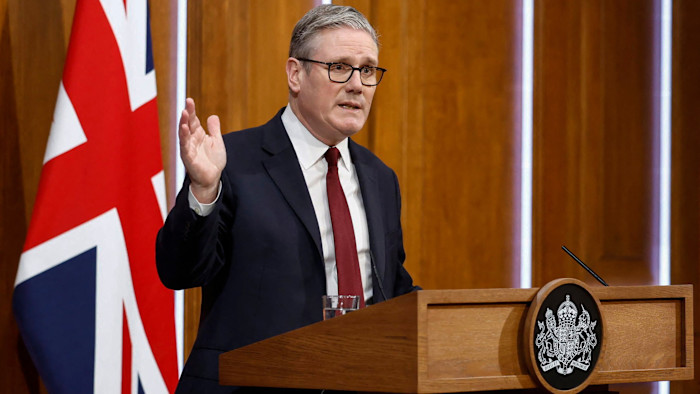
Speaking at a Downing Street press conference, Starmer said Britain would only take part in any mission in the Strait of Hormuz as part of a “viable, collective plan”, working with the US and European and Gulf allies.
He insisted that the government would protect “working people” from rising energy costs and claimed that the public finances were strong enough to support such a scheme.
Asked whether wealthier households would be excluded from any help with bills, Starmer said: “We’re not ruling anything out.”
The prime minister argued he had been right to keep Britain out of the Iran war, claiming that Kemi Badenoch, Conservative leader, and Nigel Farage, Reform UK leader, would have rushed into the conflict.
Although Starmer insisted that the UK-US relationship was in a “good” state, he said it would have been reckless to join the attack. “That’s not leading, it’s following,” he said.
Starmer’s comments reveal the mounting concern in Downing Street over how the UK should respond as the conflict continues.
The prime minister declined to commit any Royal Navy ships to the region, in spite of Trump telling the FT on Sunday that he wanted Nato countries to offer their support to keep open the Strait of Hormuz.
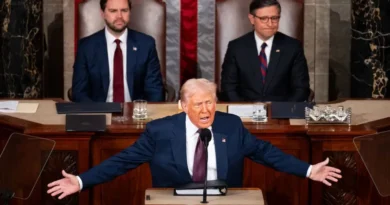
“It’s only appropriate that people who are the beneficiaries of the strait will help to make sure nothing bad happens there,” Trump said. “If there’s no response or it’s a negative response, I think it will be very bad for the future of Nato.”
Starmer said that the conflict was never going to be a matter for the Nato alliance, which is founded on the principle of collective defence, but Britain was working with the allies on a plan to stabilise the region.
He said Britain had drones in the region capable of operating against minefields and spoke about the UK’s anti-drone capability already in the area.
While Starmer continues to resist being pulled into the conflict, government officials admit the government may be unable to avoid having to deploy a hugely costly effort to cushion households and businesses from the economic fallout.
The PM claimed the government had “brought stability back to the public finances” and they were in better shape than when the last Conservative government launched an energy support package after Russia’s full-scale invasion of Ukraine.
Tory ministers spent almost £80bn on support for households and businesses in the two fiscal years after the start of the Ukraine war, according to estimates published by the Office for Budget Responsibility in 2023. That is equivalent to more than 3 per cent of a single year’s GDP.
In the short term Starmer said he was issuing a “legal direction” to energy companies to ensure that the £150 of savings per household from last year’s Budget, from changes to levies on bills, would be passed on to consumers.
He confirmed that the government would help rural communities with the cost of heating oilwith £53mn of support for the most “exposed” households.
Starmer refused to be drawn over whether any future support system to prevent households getting hit by rising gas bills would be limited to the most vulnerable.
Chancellor Rachel Reeves said on Saturday that any such programme would be “targeted”, in contrast to the universal scheme instigated by Liz Truss during her brief premiership in 2022.
Households are protected until the end of June when Ofgem’s quarterly price cap will be revised. The government is already coming under pressure to also scrap plans to lift fuel duty by 5p per litre from this September.
Asked whether wealthier families would not receive any support, Starmer said his instinct was always to help “working people” in such situations.
He added: “We are not ruling anything out but it is very difficult to say at this juncture what the position will be in July, or what the position will be in September.”