France votes in mayoral elections ahead of 2027 showdown
Unlock the Editor’s Digest for free
Roula Khalaf, Editor of the FT, selects her favourite stories in this weekly newsletter.
France on Sunday kicks off the first round of mayoral elections that will set the stage for the presidential battle of 2027 and gauge the strength of the far right in major cities.
The vote in 35,000 municipalities will be a test of parties’ strategies and potential alliances in a fragmented political landscape, ahead of next year’s presidential election to succeed Emmanuel Macron.
Marine Le Pen’s far-right Rassemblement National is looking to gain ground in southern France and build on its northern bastions, with the port cities of Toulon and Marseille among their key targets — although smaller cities outside those areas will matter too.
“It would show that their sociological strongholds are truly extending,” said Mathieu Gallard of pollster Ipsos Bva. Taking more big cities would be “symbolically important” for the RN, he added, cautioning however that the quirks of voting patterns in local elections did not have a direct translation into national ones.
Candidates who garner at least 10 per cent of the first-round vote will advance to the second round on March 22, triggering horse-trading to determine whether those candidates clinch alliances or step aside. Their decisions will go a long way to determining the final winner.
Voters largely choose their mayors based on local issues and personalities. Major concerns are security, maintaining local public services, the economy and access to healthcare, according to a recent Ipsos poll.
But national issues such as mounting worries over drug trafficking are also a factor, especially ahead of the presidential contest.
The RN only runs about a dozen cities, the largest of which is Perpignan where incumbent Louis Aliot is seeking a second term. Eric Ciotti, whose party is allied with the RN, is in pole position to capture Nice, France’s fifth-biggest city, which could be a major victory for the far right.
The RN want to build momentum ahead of the presidential campaign in which Le Pen and her number two Jordan Bardella are polling far ahead of rivals. If Le Pen is convicted in a pending appeal for alleged embezzlement of EU funds, then Bardella will run in her place.

The municipal elections may also give an indication of the strength of the so-called “republican front” in France, or the strategy of parties banding together to keep the far right out of power. The tactics helped deprive the RN of many seats in parliamentary elections in 2024.
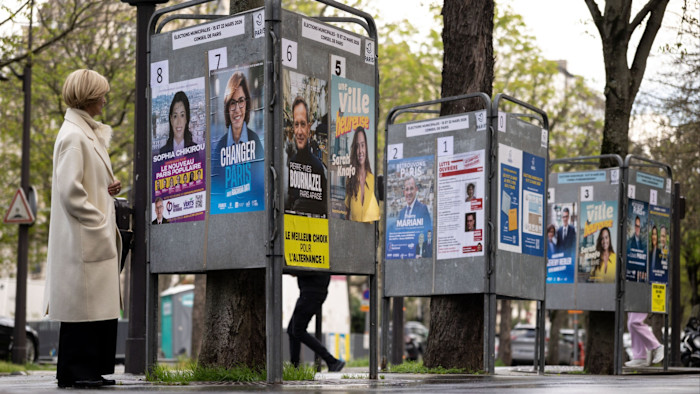
In Paris, the Socialists are seeking to extend 25 years in power with their candidate Emmanuel Grégoirea longtime lieutenant of the outgoing mayor Anne Hidalgo, the frontrunner.
Conservative candidate Rachida Dati, who was until recently Macron’s culture minister, is polling second but she is being squeezed between centrist candidate Pierre-Yves Bournazel and a far-right newcomer Sarah Knafo.
Bournazel is from Édouard Philippe’s party, Horizons. He is backed by Macron’s Renaissance party because it is so weak at the local level that it has chosen not to run its own candidate in most places.

Up to five candidates could potentially make the run-off in Paris, so alliances will be crucial.
Dati’s chances of winning the run-off will largely depend on whether she can strike a deal with Bournazel — highlighting how difficult it will be for the parties currently backing the government to field a common candidate to succeed Macron.
Édouard Philippe, a centre-right ally of Macron and a leading candidate for 2027, has a lot riding on the municipal elections. He is running to retain his job as mayor of Le Havre in northern France, and has staked his presidential bid on winning there.
Polling predicts a tight race that Philippe could lose to a communist candidate if there is a three-way run-off.

The left, meanwhile, is caught up in bitter divides between the far left of Jean-Luc Mélenchon and the centre-left Socialists, who remain much stronger on the local level than nationally.
The Socialists still run major cities like Paris, Nantes, Lille, Montpellier and Rennes, but Mélenchon’s France Unbowed party (LFI) is putting pressure on them as he seeks the upper hand for 2027.
Another key race to watch will be Marseille, the second-biggest city in France, where a fragmented field raises the risk that the RN candidate Franck Allisio could snatch a long-shot win against incumbent leftwing mayor Benoît Payan.
If the LFI candidate qualifies for the run-off and declines to make a deal with Payan, then the RN might win.
Data visualisation by Martin Stabe