Analysis-Attack on Iran could buoy Trump in talks with China's Xi
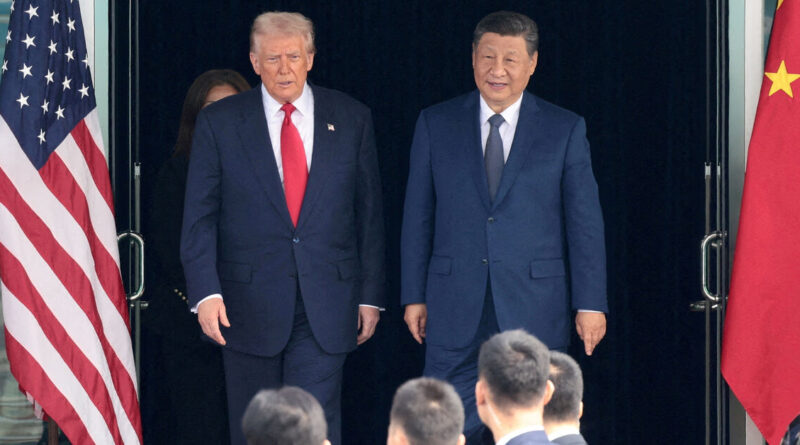
WASHINGTON/BEIJING, March 3 (Reuters) – The U.S. military campaign against Iran has put Chinese leader Xi Jinping on the back foot ahead of an expected summit with U.S. President Donald Trump, who for the second time in as many months has turned America’s military against one of Beijing’s close partners.
Trump is set to arrive in Beijing at the end of March following the U.S. capture of Venezuelan President Nicolas Maduro in a risky Caracas raid in January and the U.S.-Israeli air war that on Saturday killed Iran’s Supreme LeaderAyatollah Ali Khamenei, the former leaders of two countries that have been major oil suppliers for China.
It is far from clear how that meeting, which the Trump administration has said will focus on trade, will play out, or indeed whether it will even go ahead.
Just last week, it appeared Trump would go to Beijing in a weakened position following a U.S. Supreme Court decision invalidating many of his tariffs. But now it is Xi who may be off-balance and struggling to mount a forceful response to the biggest U.S. military operation since the Iraq war.
While Beijing has condemned the U.S.-led operations as “unacceptable” and called for restraint, its measured response shows both its limited ability to influence U.S. military action and the transactional nature of its diplomatic partnerships, experts say.
China is “proving to be a feckless friend for its authoritarian allies,” Nicholas Burns, the former U.S. ambassador to Beijing under President Joe Biden, said on X.
Xi now faces the awkward prospect of feting Trump on the world stage, or backing out of the proposed March 31 to April 2 meeting. Beijing has yet to confirm the summit dates.
Should Xi decide to proceed, he may do so betting that in the long run it is Washington that will be diminished if it becomes entangled in a drawn-out Middle East conflict.
Trump has said the operation against Iran could run for about four weeks, which would bring it close to the eve of the China trip.
China’s embassy in Washington did not respond to a request for comment on whether the Iran situation had changed plans to host Trump. Asked about the implications of the Iran strikes on talks with Xi, a White House official said Trump was “taking decisive action to eliminate major national security threats,” but did not mention China.
CHINA UNIQUELY EXPOSED
For China, the danger from the U.S. military operation is both practical and symbolic.
China, the world’s largest buyer of Iranian oil, last year got 13.4% of its total oil imported by sea from the country. That makes it uniquely exposed to any supply disruption as the conflict unfolds, particularly in the event of a blockage of the Strait of Hormuz, the world’s most vital oil export route.
While China can diversify its imports, it would suffer significant price pressure from a near-term loss of Iranian oil, tightening margins for its manufacturing base on which the Chinese economy is heavily reliant, analysts say.
The U.S. attack on Iran also serves as a reminder to Beijing – and its partners – of the U.S. military’s ability to strike not only in its backyard, but around the world.
“The strikes on Iran and the potential regime change will severely impact China’s interests,” said Zhao Minghao, international relations expert at Shanghai’s Fudan University.
“China is assessing the deeper intentions behind U.S. actions in Venezuela and Iran, as the U.S. may increase pressure on China by controlling the international energy market,” Zhao said.
None of that would have been lost on the White House, which published the dates for Trump’s China trip as it was staging for the Iran attack. A source familiar with U.S.-China discussions told Reuters the White House was still awaiting a formal invitation from Chinese officials.
COUNTING ON LIMITED CHINESE RESPONSE
For now, the United States is betting that its Iran operation will not trigger any Chinese military response.
One U.S. official told Reuters there wasn’t an expectation that China would provide material support to Iran during U.S. operations, or that a continued U.S. focus on the Middle East would embolden Beijing in the short term in the Indo-Pacific, where it has pursued a historic military build-up.
The main U.S. concern is that difficulty in rapidly replenishing reserves of munitions would reduce “medium-term deterrence” over the threat of Chinese military action against Taiwan, the official said.
Constrained in its ability to counter the U.S. military’s global reach, China is likely to stand back and let the United States own any Middle East chaos that results, reinforcing Beijing’s narrative that Washington is reckless and destabilizing, say analysts.
Zha Daojiong, an expert in energy security at China’s Peking University, told Reuters that Chinese officials would not feel compelled to aid Iran in the conflict and would push back against the “purely rhetorical construction” in the West that it had an alliance with Iran.
“The direct parties to the conflict make their own bed and get to sleep in it,” Zha said.
(Reporting by Michael Martina, Trevor Hunnicutt and David Brunnstrom in Washington and Mei Mei Chu, Antoni Slodkowski, Liz Lee and Laurie Chen in Beijing; Editing by Don Durfee and Bill Berkrot)