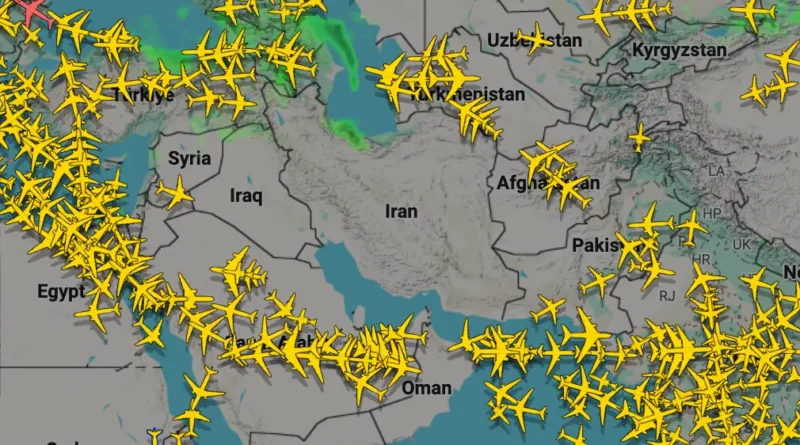
Air travel has been thrown into chaos with cancellations, diversions, and airspace closures after strikes on Iran
Some of the world’s most congested airspace has been disrupted by the US and Israel’s strikes on Iran.
Iran, Iraq, Kuwait, Bahrain, and Qatar have all closed their airspaces. Dubai International Airport, the world’s busiest airport for international traffic, has suspended all flights until further notice.
A video shared by Flightradar24 showed airplanes deserting the region on Saturday morning.
Data from the aviation analytics firm Cirium shows that about 1,600 of the roughly 4,000 scheduled flights to the region have been canceled as of 1:00 p.m. Central European time Sunday. Factoring in outbound cancellations, that number is closer to 3,200. That follows the thousands also canceled on Saturday.
The three major Middle Eastern airlines — Qatar AirwaysEtihad Airways, and Emirates — operate major hubs that connect passengers to destinations around the world, creating a massive ripple effect of disruptions. All three said that flights would remain temporarily suspended through at least noon Monday.
Qatar has so far canceled about 92% of flights to and from Doha. Emirates has canceled about 83% of flights to and from Dubai, and Etihad has canceled about 88% of flights to and from Abu Dhabi.
Dubai International Airport — the world’s busiest megahub for international traffic — was damaged by an apparent missile strike on Sunday morning. Zayed International Airport in Abu Dhabi was similarly hit. It’s unclear how that could further impact operations even if the airspace opens back up.
A Cirium spokesperson said these airlines collectively carry 90,000 transiting passengers through their hubs daily — not including those destined for the Middle East.
Major airline disruption
Even for flights that don’t land in the region, it’s a key corridor for flying between Europe and Asia. Some flights appeared to re-route over Saudi Arabia. Other airlines were avoiding the region altogether.
Detours are costly for airlines: They have to pay for extra fuel, labor, and any associated passenger compensation. And it’s possible mass diversions could overwhelm certain airports.
In a post on X, Emirates said it was temporarily suspending all flights to and from Dubai, its home base. That’s equal to about 500 flights a day, according to Cirium.
Emirates urged customers to check their flight statuses before visiting the airport. “We are actively monitoring the situation and engaging with relevant authorities,” the airline added.
Qatar Airways said all flights to and from the country were suspended until at least midnight UTC, or 7 p.m. ET. It also expects delays when usual operations resume.
Doha’s Hamad International Airport advised passengers “not to proceed to the airport.” Additional staff were deployed there to help passengers affected by the disruption, the airline said.
Etihad Airways, which is based in Abu Dhabi, said all departures and arrivals to the city were suspended until 2 p.m. local time Sunday.
Kuwait’s civil aviation ministry said a drone attack left some airport employees with minor injuries and damaged a passenger terminal.
Saudia said flights to and from affected airports were canceled until at least Tuesday.
Diversions and flights to nowhere
For those already in the air during the strikes, many flights diverted to other nearby airports or turned back to their origins.
Flightradar24 shows an Emirates flight from Orlando to Dubai diverted to Istanbul in a 14-hour flight to nowhere. A Qatar flight from New York to Doha crossed the Atlantic but then diverted to Rome after about 10 hours in the air.
An American Airlines flight from Philadelphia to Doha had flown for more than six hours when it turned around over Ireland and started heading back across the Atlantic Ocean, flight-tracking data showed. It looks like the total flight-to-nowhere will last about 13 hours.
An Air Canada flight from Toronto to Dubai was over the Mediterranean Sea before U-turning. Passengers appear to face a total journey time of 10 hours.
In a video statement posted to Truth Social on Saturday morning, President Donald Trump vowed to destroy Iran’s missile program and navy, and ensure that the country can “never” have a nuclear weapon.
There is likely more disruption to emerge. When Iran launched strikes on a US air base in Qatar last June, more than 160 flights were diverted.
Similar cancellations and reroutes happened in February 2022 when Russia invaded Ukraine, and again in April 2025 amid rising tensions between India and Pakistan.
Air India, for example, had to reroute flights around Pakistani airspace last year, requiring some long-haul services between India and Europe and North America to add a fuel stop in Vienna.
Some airlines, like Finnair, still fly the long way around Russia on certain long-haul treks rather than canceling the service altogether.