Widows who work the same jobs that killed their husbands
Bimla is in her late 20s and already a widow. She breaks sandstone in a quarry in the Indian state of Rajasthan, shaping tiles from the same rocks that once coated her husband’s lungs. He died from silicosis in 2021.
Silicosis is a lung disease caused by inhaling fine silica dust generated when rock, like sandstone, is broken. It scars the lungs over time, making breathing difficult. There is no cure, and many sandstone miners in Rajasthan with silicosis don’t live past 40, according to a 2020 report. Independent estimates suggest over half of mine workers are afflicted with the disease, and as many as 800,000 people in Rajasthan may have it.
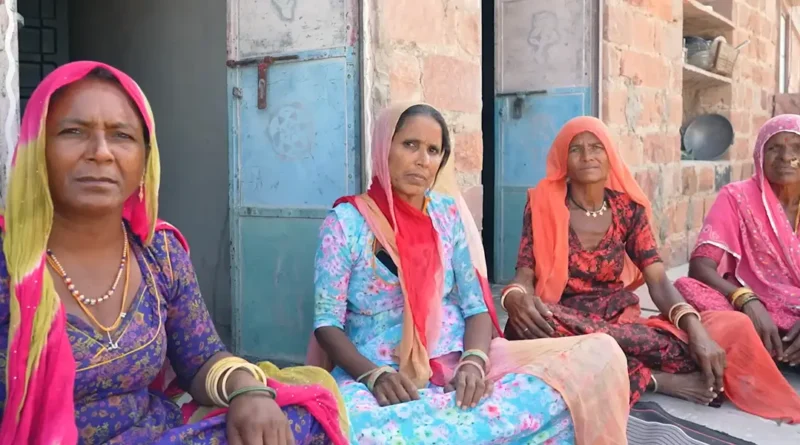
In Bimla’s village of about 30 homes, 20 women were widows when Business Insider visited in September (see the video footage below). When asked if their husbands died for the same reason as hers, Bimla said, “All of them.”
Like Bimla, many of the widows in her villagenear Bhil-Basti, work breaking stones, the same type of labor their former husbands did. The pay is minimal — $2 to $3 a day and about half of what men earn — but they have little choice in the matter.
Many of the women have taken on debt from quarry operators and moneylenders to pay for medical bills, funerals, and to support their children.
“They can’t complain, because they’ve taken out loans,” said activist Rana Sengupta, who heads a local NGO called the Mine Labour Protection Campaign and calls the situation a contemporary form of slavery. “No one is tied in chains, but they cannot escape, either.”
Workers earn pennies on the dollar
Bimla said she’s over 100,000 rupees in debt. Suhail Bhat / Business Insider
The state of Rajasthan sits on more than 960 million tons of mineable sandstone valued at over $160 billion. In 2024 and 2025, about $59 million worth of sandstone was exported from India.
The stone has built palaces and the president’s house in India and is shipped abroad for bathrooms, driveways, and cobbled roads.
In a state exporting tens of millions of dollars’ worth of stoneBimla counts her household budget in rupees. She said she earns up to 7,000 rupees a month — about $80 — to support herself and her four children.
A sandstone quarry in Rajasthan. Abrar Fayaz / Mehran Bhat / Business Insider
The government provides 25 kilograms of grain per month, but it is not enough to feed her entire family, she said at the time of filming. “I stay hungry myself, but I feed them: This is not a good life.”
She’s taken out loans because her income isn’t enough to support the household. That’s on top of the debt her husband had, which is now her responsibility. “Yes, it is still there; it wasn’t paid back,” she said.
Every month, 3,000 rupees ($33) of her earnings go toward repayments. At the time of filming, her loans amounted to more than 100,000 rupees ($1,100), she said.
The debt that keeps them there
Sapna said she thinks she’ll never be able to pay off all her debt. Suhail Bhat / Business Insider
Sapna’s story follows a similar arc. Sapna, who lives in the same village as Bimla, has been working in the quarry for years. (Many women in the village don’t have last names.)
Both Sapna’s husband and daughter died from silicosis. Her daughter was only 20 when she passed, she said. “Breaking stone has ruined my life,” Sapna said. She now has silicosis, too.
Sapna still works despite being sick. Suhail Bhat / Business Insider
She still works when she can, earning about 300 rupees ($3) a day. She’s in debt to her boss at the quarry, who charges 70% interest and requires payment every 15 days, she said. Business Insider was unable to reach Sapna’s boss for comment. Another mine owner we contacted did not respond to any phone calls.
She’s taken multiple loans over the years to cover her husband’s debt and support herself. She says she no longer knows how much she owes, and doesn’t think she’ll ever be able to pay it all. “I can’t work much, so this debt is not going anywhere.”
Temperatures can reach over 100 degrees Fahrenheit in the quarries. A woman seeks shade under an umbrella while breaking stone into tiles. Abrar Fayaz / Mehran Bhat / Business Insider
Mine owners lease the land from the government and hire contractors to recruit workers and negotiate loans. The system does not prioritize workers, Sengupta said.
“The owners who give out these loans have a long-term plan: ‘I am now free to exploit these workers anytime,'” Sengupta told Business Insider.
‘It hurts to be called a widow’
Radha Bai said she is uneducated and therefore has little choice but to work in the mines. Abrar Fayaz / Mehran Bhat / Business Insider
Radha Bai, a widow living in the same village as Bimla and Sapna, began working at the quarry in 1983. A few years later, silicosis killed her husband.
Four decades on, she is in her 60s and still breaking stones. At the time of filming, she made about 30 tiles a day, earning 30 cents. She still mourns the passing of her husband. “It hurts to be called a widow,” she said, adding that, “My husband was amazing.”
Workers at these quarries are constantly exposed to dust that can cause deadly silicosis. Suhail Bhat / Business Insider
Radha Bai never learned to read or write, leaving her with few other options than to continue working at the quarry. “I know how to write half of my name,” she said, adding, “So what work can I do now? You can only achieve your dreams if you’re educated,” she said.
Sending their children to school costs money. Bimla said she’s working to afford her children’s education. Another worker, Navraji Ram, told Business Insider he’d taken out loans to send his children to school.
Parents work in the quarries to help pay for their children to go to school. Suhail Bhat / Business Insider
“I will put all my efforts toward their education, but I won’t let them work in the mining industry,” Navraji Ram said.
Business Insider senior producer Olivia Nemec emailed and called every number listed on the Ministry of Mines, Department of Labor, and Rajasthan’s local state labor and mining departments for comment on debt bondage, what’s being done to hold mine owners accountable, and why so few people are receiving state aid for silicosis. Half of the numbers weren’t in service, including the one for the state’s silicosis help desk. Other numbers, no one responded. Two calls to phone numbers listed for the Rajasthan State Labor Department were answered, but in both instances, the officials hung up after Nemec began asking questions. Nemec received no responses via email, either.