Talent Is A Given; U.S. Men’s Hockey Team Earns Gold With Chemistry
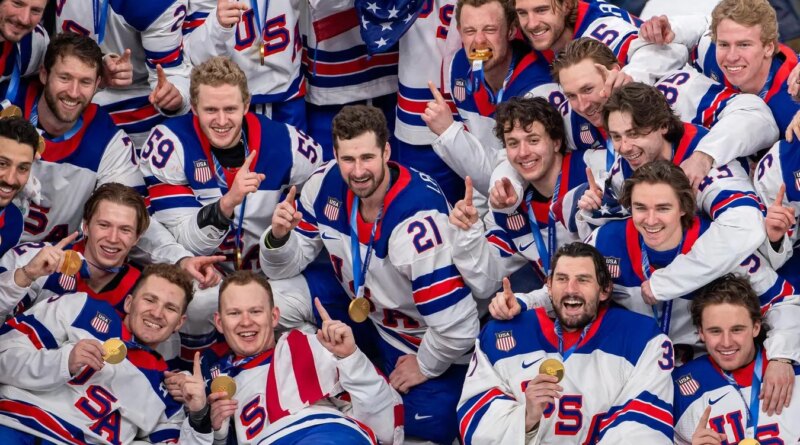
Team USA pose for group photo during the Men’s Gold Medal match between Canada and United States on day sixteen of the Milano Cortina 2026 Winter Olympic games at Milano Santagiulia Ice Hockey Arena on February 22, 2026 in Milan, Italy.
Getty Images
It wasn’t a miracle that allowed the U.S. men’s hockey team to win its first Olympic gold medal since 1980.
It was chemistry.
The U.S. men are Olympic champions for the first time in 48 years following an electric Jack Hughes overtime winner to defeat archrival Canada 2-1, the same score and situation in which the U.S. women’s team defeated Canada three days earlier.
In eight meetings between the U.S. and Canada in the Olympic gold medal game, it is only the United States’ second win. It’s the third gold medal ever for the U.S. men in the first Games to feature NHL players since Sochi 2014.
And what a group of players general manager Bill Guerin and head coach Mike Sullivan assembled.
Jack Hughes of Team United States Quinn Hughes of Team United States celebrate the victory and Gold Medal during the Men`s Ice Hockey final match between USA and Canada on day sixteen of the Milano Cortina 2026 Winter Olympic games at Milano Santagiulia Ice Hockey Arena on February 22, 2026 in Milan, Italy.
Getty Images
Two pairs of brothers. NHL linemates. College alums. Even a son-in-law (Boston Bruins defenseman Charlie McAvoy is married to Sullivan’s daughter, Kiley).
This Olympic hockey roster was a group that shared many connections, and when it mattered most, those connections and the chemistry they’ve built helped lift the U.S. over Canada in the most important game many of these players had ever started in.
Indeed, when the U.S. roster was announced in January 2026, some raised an eyebrow at the names that didn’t appear on it. Elite talent and 30-goal scorers were overlooked for a roster that prioritized size and grit. Some even classified it as a risk.
But Sullivan knew what he wanted out of this group. And in the end, he got it.
“One of the things that Guerin and I talked about from the very beginning was trying to build a team in the true sense of the word,” Sullivan said.
“We looked at a deep group of American talent, and these decisions were very difficult. When you look at how this group was constructed, there was a thought process that we had players who could play in all situations. Maybe the most important aspect is the personality of the team. The team was built with personality in mind; we were loaded with personality up and down our lineup.
“There are whiskey drinkers and milk drinkers” Sullivan added with a chuckle, “and we got a lot of whiskey drinkers in this group.”
In the NHL, some of these players face-off against one another regularly as fierce division rivals. They have fought one another. They have defeated one another in playoff agony.
But when they arrived at the Olympic Village in Milan, they became a cohesive unit.
Some teams, including Canadachose not to remain in the Olympic village for the duration of the tournament, opting instead for well-appointed hotel rooms with comfortable beds and blackout shades and no roommates.
Not Team USA. The men embraced the village lifestyle, with many treating it like a return to billet or college days.
“It felt like a family,” Quinn Hughes said. “I was able to room with Jack for two weeks or whatever it was, and it was very special for me.”
And right across the hall from the Hughes brothers? The other U.S. men’s hockey team siblings: the Tkachuk brothers.
“They left their door open the entire two weeks,” Quinn said with a chuckle. “They never closed it.”
“Spending time in the village with these guys, it was one of my favorite experiences of this whole thing,” Quinn continued, adding that the team would hang out in the cafeteria together and introduce themselves to athletes from other nations and sports. “But whether we stayed in the village or not, you still have to go out there and perform.”
Perform they did, and when it mattered most.
Team USA got on the board first just minutes into the game when Matt Boldy took an Auston Matthews pass down the ice and shot it past goaltender Jordan Binnington.
Shots on goal for both teams were even at eight after one period. But Canada peppered U.S. goaltender Connor Hellebuyck with shots throughout the second and finally evened the score on a Cale Makar goal less than two minutes before the second intermission.
In the third period, Canada’s relentless onslaught continued, registering 10 shots on goal in the first five minutes. Hellebuyck held on and the game went to overtime tied at one.
There wasn’t much bonus hockey to be had in this one. Just 1:41 into overtime, Jack Hughes took a Zach Werenski pass and shot it past Binnington’s left pads for the golden goal.
Hughes may have manifested the goal. Late the night before the game, Quinn, who couldn’t sleep, asked Jack if he was still awake too.
“Yeah,” Jack replied. “Dreaming about scoring the game winner.”
Jack Hughes #86 of Team United States scores the game-winning goal against Connor McDavid #97 and Jordan Binnington #50 of Team Canada in overtime during the Men’s Gold Medal match between Canada and the United States on day 16 of the Milano Cortina 2026 Winter Olympic games at Milano Santagiulia Ice Hockey Arena on February 22, 2026 in Milan, Italy.
Getty Images
If it hadn’t been for the goaltending heroics of Hellebuyck, however, there may not have been an overtime for Jack to play hero in. He stopped 41 of 42 shots, including two in the third period that might have turned Team USA’s gold medal dream into a nightmare.
Connor Hellebuyck #37 and Vincent Trocheck #16 of Team United States celebrate winning the gold medals after the team’s 2-1 overtime victory in the Men’s Gold Medal match between Canada and the United States on day 16 of the Milano Cortina 2026 Winter Olympic games at Milano Santagiulia Ice Hockey Arena on February 22, 2026 in Milan, Italy.
Getty Images
“Hellebuyck was a hero tonight for our team without a doubt,” Sullivan said. “Connor was part of the foundation of this group from the get-go, dating back to the Four Nations and throughout the course of this tournament. He’s just a high-stakes player in a high-stakes environment. I think that’s where players build their legacy and I think Connor did that tonight.”
The U.S., of course, could not close it out against Canada in the Four Nations.
At the Olympics, they did.
One of the most important members of Team USA was not on the ice for the celebration. After the win, Matthew Tkachuk, Auston Matthews and Zach Werenski held a No. 13 Johnny Gaudreau jersey high and skated around the ice in tribute to their late teammate and friend.
Gaudreau, who was killed in 2024 along with his brother Matthew when they were hit by a drunk driver while they were riding their bikes, had always dreamed of playing for Team USA in the Olympics. Sullivan said that had he been alive, he would have been part of this team.
Team USA pose for a team photo with Johnny Gaudreau’s children during the Ice Hockey Men’s Gold Medal Game match between Canada and USA on day sixteen of the Milano Cortina 2026 Winter Olympic games at Milano Santagiulia Ice Hockey Arena on February 22, 2026 in Milan, Italy.
Getty Images
After they posed for their official team picture, Matthew Tkachuk and Werenski skated toward the boards and collected two of Johnny’s children with his wife, Meredith: three-year-old Noa and two-year-old Johnny Jr.
They carried them to center ice to pose for a team picture, holding Gaudreau’s jersey in the middle of the group as Meredith and Gaudreau’s parents, Guy and Jane, looked on from the stands.
“We’re obviously thinking of him, and the impact he’s had on so many guys in our room is special,” Matthews said. “He was here with us in spirit for the whole tournament.”
While not a “Miracle on Ice,” the U.S. men capturing their first gold medal in 46 yearsand this special group that made it happen, will also be remembered forever as one of the great moments in U.S. hockey history.