New Union Chief Bruce Meyer Takes Hard Line On Salary Cap As Expected
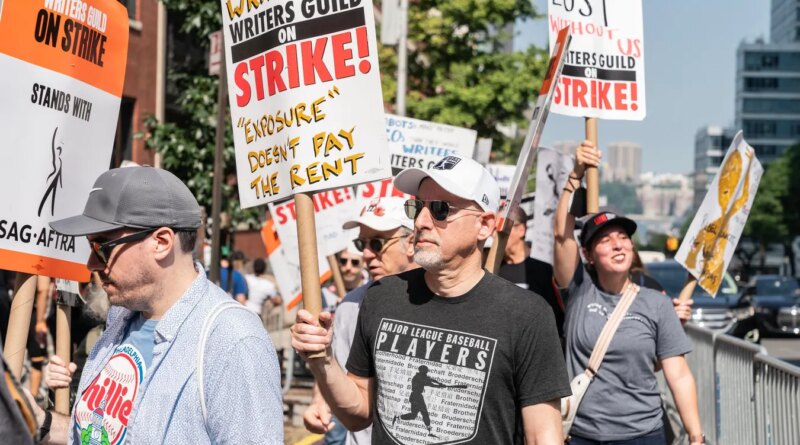
New executive director of the Major League Baseball Players Association Bruce Meyer joined striking members of the Writers Guild of America on the picket line last year. (Photo by Lev Radin/Pacific Press/LightRocket via Getty Images)
Pacific Press/LightRocket via Getty Images
GOODYEAR, Ariz. – In his first days as the new executive director of the Major League Baseball Players Association, Bruce Meyer is taking a hard line against the salary cap as he makes his maiden tour of Arizona’s baseball spring-training camps.
On Saturday, he visited the Cincinnati Reds at the Goodyear Ballpark sports complex, which they share with the Cleveland Guardians.
With collective bargaining negotiations vs. the owners set to begin sometime this spring, Meyer expects a lockout when the current contract expires on Dec. 1, he told Forbes during one of his initial interviews since replacing Tony Clark earlier in the week.
Meyer was very clear about the union’s bargaining position. Salary cap? No way. Floor? Possibly. Qualifying offer? Gone. Salary arbitration? Good, with some fixes. No surprises, really.
When asked if congratulations were in order for landing the new job, he quipped: “You better be careful what you wish for.”
Meyer Echoes Players on Cap Issue
Meyer was MLBPA deputy director when Clark resigned on Tuesday due to an improper personal relationship with his wife’s sister, Clark also hired at the union. Meyer is a labor negotiator and lawyer who previously held the same deputy position when Don Fehr led the National Hockey League Players Association. Fehr transitioned from baseball to hockey, which is a salary-cap league. Meyer is well aware of the difference.
“The notion that somehow a salary cap leads to peace and good will is absolutely inaccurate,” he said outside the Reds clubhouse and offices. “Basically, you still fight over the money. The fans may not realize that, since 1994, the cap-sports have had way more work stoppages, way more missed games than we have because the percentages they pay the players have gone down over time. They get you into the system and then they lock you out to get those numbers down.”
Major League Baseball has missed zero games since the strike of 1994-1995 wiped out the end of the ’94 season, plus the playoffs and World Series, and delayed the start of the 1995 season. Replacement players were utilized by all except one team that spring leaving a stain on the sport that lasted a generation.
There have been similar threats to the game in 2002 and 2022, but deals were reached at the last minute. That may not happen this time.
The owners will almost certainly propose a cap again in upcoming negotiations, despite the players’ and their leadership’s vociferous opposition. It’s a non-starter and non-negotiable, meaning a lockout is a fait accompli. It’s just a matter of how long the lockout will last.
“Hope springs eternal,” Meyer said. “I think people on the other side have already said there’s going to be a lockout. Just as a matter of labor negotiation, their strategy is going to be to try and put as much pressure on the players as possible. That’s what a lockout is and means. But never say never. “
Meyer: Floor Yes, Salary Cap No
The players favor a floor or minimum salary amount spent per team, but not a restrictive cap, Meyers added.
“We’d be fine with a floor without a cap,” he said. “It’s somehow misunderstood that we’re against a floor in and of itself. The problem is that the league has made it very clear in bargaining and otherwise in public statements they wouldn’t agree to a floor without a salary cap or something worse.”
There are all kinds of differences between Meyer and Clark, both physically and texturally. A former player, Clark is a big man at 6-foot-8 with broad shoulders and lately a long, shaggy white beard. Meyer is small and slender with a well-cropped grey beard, the epitome of a labor lawyer.
While Clark was prone to long, unwieldy answers to questions, Meyer is pretty concise and unemotional in his responses. His no-nonsense approach might make a big difference at the negotiating table, which Meyer has managed well since joining the union in 2018.
“I don’t think and the players don’t think it’s going to affect bargaining at all,” Meyer said. “I’ve been the lead negotiator in bargaining since I joined. At the end of the day, no matter who’s the lead bargainer, it comes down to the players. The players are the ones who determine our priorities. The players are the ones who tell us what they want us to fight for. That’s not going to change.”
What the players don’t want is a cap. Several – such as Chris Bassitt of the Baltimore Orioles and Brent Rooker of the Athletics – have come out strongly against it.
“Salary caps are designed to suppress wages so owners can make more money,” Rooker said on Wednesday. “That’s pretty much it. That’s the goal behind them. They are not trying to accomplish anything else. That’s not good for players, that’s not good for the league, that’s not good for competitive balance or parity. We’re not going to tolerate that being implemented into our game.”
Meyer is taking the same stance: “We don’t think it’s in the players’ interest. None of the previous leaders of this union have thought it’s good for the players, nor has any group of players in the past. We don’t see any reason to believe it’s suddenly going to be good for the players, but it will be for the owners. That’s why they want it so badly. Our historical position and concerns remain in place. There’s nothing I know of to lead us to consider it to be a good thing.”