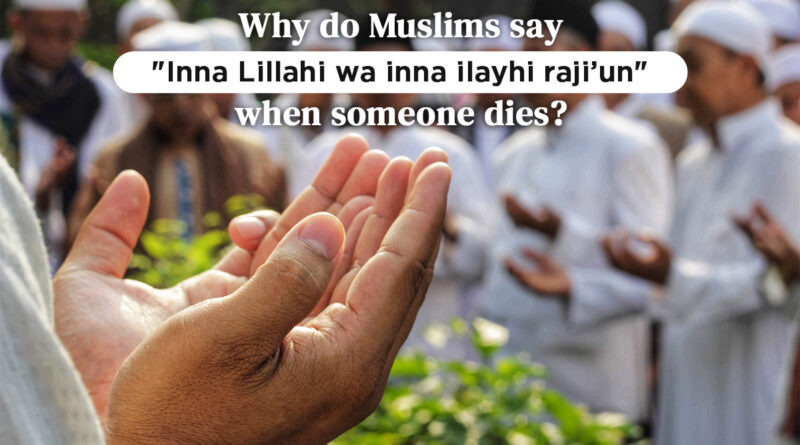
“Inna Lillahi wa inna ilayhi raji’un” – When to say?

Islam is a religion that is very close to nature and human life. It teaches us everything that individuals may encounter in their lives. Islam provides complete guidance on every aspect of life, including how to respond to various events, especially those that bring grief and sorrow. It guides us how to face them with patience, treating them as the Will and Command of Allah سُبْحَانَهُ وَتَعَالَى. More importantly, Islam expects Muslims to remain firm on core Islamic beliefs, whatever the circumstances are. Islamic teachings emphasize facing such occasions with grace, while praying and seeking mercy and guidance from Allah سُبْحَانَهُ وَتَعَالَى.
The death of a loved one, a close friend, or a relative is one of the saddest moments for everyone. There is every likelihood that an individual might stray from the right path due to the emotional impact of the death of someone. Like in the event of many other happenings and occasions, Islam has taught us to face the sad demise of loved ones while remaining steadfast in faith. Muslims face it with a verse of prayer and reflection, saying “اِنَّا لِلہِ وَاِنَّاۗ اِلَيْہِ رٰجِعُوْنَ”, (Inna Lillahi wa inna ilayhi raji’un), which translates to “Surely we are for Allah, and to Him we shall return”.
In this blog, we will explore why Muslims recite this verse, its origin, and how it relates to patience and Islamic faith, in light of Islamic teachings on how to react to such losses.
Origin of “Inna Lillahi wa inna ilayhi raji'un”
This phrase originates directly from the Quran. It appears in Surah Al-Baqarah in the 156thth verse, in continuation of the subject narrated in its 155th verse.
Arabic Text
- We will certainly test you with something of fear and hunger and a loss of wealth and lives and fruits. And give good news to those who are patient.
- Those who, when a calamity befalls them, say, “Indeed, to Him we belong, and to Him we will return.”
Translation
- Be sure, we shall try you with something of fear and hunger and loss of wealth and life and the fruits (of your labour); but give tidings of happiness to those who have patience.
- Who say when assailed by adversity: “Surely we are for Allah, and to Him we shall return.”
The lesson learned from these two verses is that the death of someone close to you is one of the trials and tests of this worldly life, as is fear, hunger, and loss of wealth. So, true believers are expected to face these adversities with patience and relate them to the Will and Command of Allah سُبْحَانَهُ وَتَعَالَى. Accordingly, when a Muslim recites this phrase, it demonstrates patience and firm belief in Allah’s سُبْحَانَهُ وَتَعَالَى Will and Mercy. In a broader sense, reciting “Inna Lillahi wa inna ilayhi raji’un” at the time of deep grief and sorrow is also an act of worship, which is the basis of Islamic theology.
The Concept Behind Saying “Inna Lillahi wa inna ilayhi raji’un” When Someone Dies
The concept behind reciting this phrase at someone’s death lies in its meaning. To better understand it, we can break this phrase into two parts, as follows:
- Aunt Lillahi – It translates to “Indeed, we belong to Allah Glory be to Him. It implies that everything in this universe, including our lives, entirely belongs to Allah Glory be to Him, or in other words, everything is His Creation.
- to inna ilayhi raji'un – This part of the verse translates to “and indeed, to Him we shall return”. It implies that since everything, including the humans and their lives, is the Creation of Allah سُبْحَانَهُ وَتَعَالَى, hence, we are destined to return to Him.
When read together, the phrase explains a clear Islamic concept of absolute Authority and Command of Allah سُبْحَانَهُ وَتَعَالَى. It tells us that everything that exists in the Universe is the Creation of Allah, سُبْحَانَهُ وَتَعَالَى, and actually belongs to Him. Being His Creation and Belonging to Him, eventually every soul will have to return to Allah سُبْحَانَهُ وَتَعَالَى. When we truly understand this basic belief and remain firm on it, we get an emotional and spiritual relief from the deep sorrow and grief of the death of even the closest of our relationships. It also teaches us that relying on Allah’s سُبْحَانَهُ وَتَعَالَى Will and Mercy relieves us of the deepest stress and grief we face in other aspects of our lives, such as the loss of wealth, health, and so on.
The times of stress, grief, and sorrow, especially on the death of someone close to us, are often emotionally shocking. We can get into emotional, spiritual, and mental trauma, which is quite normal. Reciting this phrase during such an event is not the denial of spiritual or emotional sufferings; it is, in fact, an expression of complete reliance on Allah سُبْحَانَهُ وَتَعَالَى. It is actually a declaration of faith by a believer. By reciting this phrase, we:
- Reaffirm our sincere and firm belief in Allah's Glory be to Him
- Accept that every hardship and sorrow, such as death, comes by the Will and Command of God Almighty.
- Recall that this worldly life is a transitional phase and that everyone must return to their Creator.
Hence, the concept is not the denial of a sorrowful event; it is a matter of firm belief in Allah’s سُبْحَانَهُ وَتَعَالَى Absolute Authority. The purpose is quite clear: to provide emotional and spiritual strength to face such a sorrowful event while adhering to Islamic beliefs and teachings.
In this context, we should also reflect on the 185th verse of Surah Al-e-Imranwhich explicitly states that every soul will certainly face death.
Translation:
Every soul will know the taste of death. You will get your recompense in full on the Day of Resurrection, and he who is spared the Fire and finds his way to Paradise will meet his desire. As for the life of this world, it is nothing but a merchandise of vanity.
Reciting “Inna Lillahi wa inna ilayhi raji'un” – Hadith Reference
The Sunnah of the Prophet Muhammad, may God bless him and grant him peace, also supports the concept of reciting this phrase during times of calamities and hardship, including the event of the death of someone close to us. Hadith 918b of Sahih Muslim narrates it in detail, as follows:
Translation:
If any servant (of Allah) who suffers a calamity says:” We belong to Allah and to Him shall we return; O Allah, reward me for my affliction and give me something better than it in exchange for it,” Allah will give him reward for the affliction, and will give him something better than it in exchange.
Reciting This Phrase Is Not Restricted Only To Death
Although Muslims recite this phrase on hearing the sad news of someone’s death, it is not restricted to deaths; “Inna Lillahi wa inna ilayhi raji’un” can be recited during any major calamity, as also mentioned in the Hadith referred to above. Accordingly, it is recommended by scholars to recite this phrase while facing hard times as follows:
- Deteriorating health conditions.
- Financial losses and hardship.
- Suffering from accidents and other disastrous situations.
Some scholars also recommend that, if someone’s precious item is missing, reciting this phrase may help find it.
FAQs
What is the translation of “Inna Lillahi wa inna ilayhi raji’un”?
This phrase translates to “Surely we are for Allah, and to Him we shall return”. It is a sort of affirmation of faith that we are the Creation of Allah, سُبْحَانَهُ وَتَعَالَى, hence we are destined to return to Him.
Is it mandatory for us to recite this phrase on hearing the news of someone’s death?
No, it is not obligatory; it is optional. But it is highly recommended to recite it at someone’s death. It is not only an affirmation of our faith in Allah’s سُبْحَانَهُ وَتَعَالَى but also a reflection of patience and remembrance of our own death.
Can we also recite this phrase on other hardships?
Yes, it can also be recited during hardships other than death, such as loss of wealth, sickness, and distress.
Is any reward associated with the recitation of this phrase?
Yes, as mentioned in Hadith 918b of Sahih Muslimthose who recite this phrase during calamities will be rewarded by Allah Glory be to Him on the Day of Resurrection.
Should we recite this phrase silently or loudly?
There is no restriction on how it is recited. It can be recited both loudly and silently, depending on the situation.
Conclusion
The teachings of Islam are quite elaborate, covering every aspect of life, whether social life or the performance of various religious rituals. It also teaches us how to react during times of stress, sorrow, and grief, such as the death of someone. It is a common practice in Muslim societies across the world to recite a specific phrase, “Inna Lillahi wa inna ilayhi raji’un”, when hearing the sad news of someone’s death. Although not an obligation, it is widely practiced by Muslims to express their firm belief in the Will and Command of Allah سُبْحَانَهُ وَتَعَالَى.
Reciting it is actually an affirmation by us that the life in this world is a temporary phase and that death is inevitable, so everyone has to return to his Creator, the Almighty Allah سُبْحَانَهُ وَتَعَالَى. This phrase can also be recited during other times of stress and hardship, such as financial hardship, illness, or other calamities.