Courting The Crosswinds: The Tragedy Of Saif Al-Islam Qaddafi
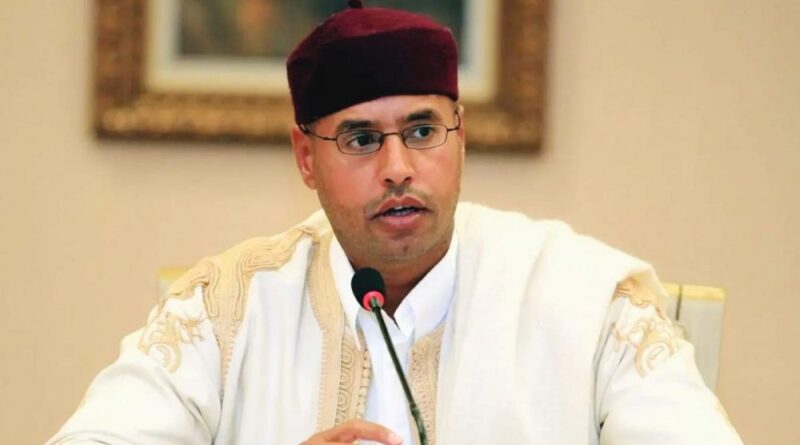
The Gaddafi name shot to international attention again this month with the assassination at his home of Saif al-Islam Qaddafi, once the most internationally well-known son and presumed heir of longtime dictator Muammar Qaddafi. Born during his father’s dictatorship, Saif al-Islam was long a key interlocutor with various foreign capitals and political trends, cultivating a reputation as a reformer. But his inability to break with the family during the 2011 war, where a regime crackdown provided an easy pretext for a multipronged foreign invasion supported by many of his former contacts, made him a special target of Libya’s most hardline revolutionaries in the ensuing government and a key, if often erratic, figure on the edges of the ensuing civil war.
The Dictator’s Son
Saif al-Islam’s quixotic father, Muammar, was one of the most recognizable figures of the twentieth century: a self-confident, aggressively assertive army officer more convinced than most dictators of his revolutionary genius and status as a man of destiny. Saif al-Islam was born in the early 1970s, after his father had ousted a conservative monarchy in September 1969, and grew up in a period where his father increasingly monopolized Libyan institutions even while claiming to revolutionize “people power”.
Muammar Qaddafi was perhaps the most bizarre of a number of regional dictators in a period where personalized dictatorships were the norm. He underwent many ideological transmutations, latching onto and often inventing ideological trends on a whim. Having taken over at the height of the Cold War, he claimed to chart a “Third Way” between capitalism and communism with what he vaguely described as an “Islamic socialism” that, however, owed little to Islam or socialism. He launched half a dozen Arab unionist attempts even as he increasingly lashed out at the mostly conservative Arab regimes around him. He later championed African unionism even as he supplied countless African rebel movements and portrayed his regime as a check on African immigration to Europe. He claimed to empower the masses by abolishing government elitism, but in reality presided over a system marked by government intrusion in all but name. He lambasted parochialism in favour of revolutionary social change, but ruled a system built on clan clientelism. He claimed to stand for Islam, funding numerous Muslim causes from the Philippines to Chad, while shunning Islamic orthodoxy and experimenting with everything from an entirely self-invented approach to Quranic exegesis to rigid but politically loyalist “Salafi” currents. He experimented with terrorists and mercenaries as well as freedom fighters, but castigated terrorism when and as it suited him. He criticized, and was a favoured bête noire of Western imperialism, but then abandoned Libya’s aspiring nuclear arsenal in a thaw with the West. The only consistent behaviour in Muammar Qaddafi’s long reign was an iron grip on Libyan politics and policy.
Keep supporting MuslimMatters for the sake of Allah
Alhamdulillah, we’re at over 850 supporters. Help us get to 900 supporters this month. All it takes is a small gift from a reader like you to keep us going, for just $2 / month.
The Prophet (SAW) has taught us the best of deeds are those that done consistently, even if they are small.
Click here to support MuslimMatters with a monthly donation of $2 per month. Set it and collect blessings from Allah (swt) for the khayr you’re supporting without thinking about it.
Saif al-Islam grew up in this bizarre atmosphere, and during his youth, his father was at loggerheads with any number of international and regional powers: the West, the Gulf states, and even neighbouring African dictators who did not share his particular approach to unionism. The 1980s saw intermittent, one-sided warfare between the United States, led by an unhinged Ronald Reagan who pursued a bizarre vendetta against Qaddafi as the “mad dog of the Middle East”, and France on one side, and Libya on the other: many of these were linked to Qaddafi’s adventures in Chad. By the early 1990s, Libya was blamed, rather unconvincingly, for a number of terrorist attacks and put under United Nations sanctions. Meanwhile, the regime brutally crushed an insurgency by the “Salafi Islamists” of the Muqatila, who viewed the dictator as both a tyrant and a heretic.
Muqatila had strong roots in eastern Libya, which long chafed under Qaddafi, and a presence in the Libyan diaspora in Western Europe – where, for a while at least, their activities were not unknown to intelligence agencies – as well as in North Africa, where insurgencies were brewing against Algiers and Cairo, and in Southern Asia. After their defeat in Libya, much of Muqatila moved to support the internationally isolated regimes of Afghanistan and Chechnya as worthy Muslim causes. These included mostly social links with the Qaeda group that by the late 1990s had become a key target of the United States. Qaddafi’s regime capitalized on the growing hostility toward Islamist militants and began a slow thaw with the West, brokered by Saudi prince Bandar bin Sultan and in particular by British prime minister Tony Blair.
Reform, its Conditions, and its Limitations
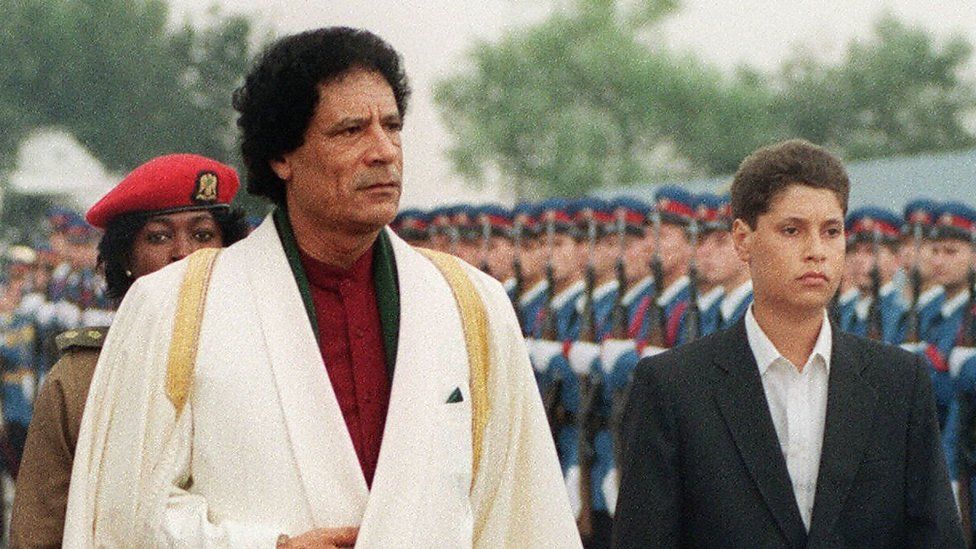
Muammar Gaddafi and his heir apparent son in 1989 [PC: BBC]
Saif al-Islam, who had spent this period studying at various European universities, was a key figure in this rapprochement as a “loyal critic” of his father’s regime that he insisted needed to reform from within. This, coupled with shared hostility to Islamist militants and the lure of Libyan oil, was an appetizing combination to Western ears in the 2000s. Among the Libyan reformists with whom Saif al-Islam surrounded himself were oil technocrat Shukri Ghanem, who was suggestively promoted to prime minister in 2003. Even though Muammar Qaddafi had angrily lambasted the American invasion of Iraq, and sent his daughter Aisha to serve as lawyer for its captured dictator Saddam Hussein, he was quite open to Blair’s diplomacy and by the end of 2003 had abandoned the nuclear programme – in the process throwing its foreign supporters, Abdul-Qadeer Khan of Pakistan and Friedrich Tinner of Switzerland, under the bus.
Over the next five years, Libya cooperated with the West on a number of fronts, with Saif al-Islam squarely in the centre of events. These included a privatization of the economy, from which Qaddhafi’s children benefited: indeed, Ghanem’s successor as prime minister, Baghdadi Mahmoudi, gloomily observed that his role was essentially to act as a babysitter for the dictator’s competing children, and even Saif al-Islam’s mother, Safia Ferkash, fretted about the potentially corrosive impact of economic liberalization. Even so, Saif al-Islam thrust himself into the business with gusto: economic free-trade zones were set up under the control of his siblings, personal friends such as Youssef Sawani lectured internationally on governance and economics, and he promoted a well-known technocrat, Mahmoud Gibril, to oversee privatization and general planning. With a reputation as a modernizing reformer, Saif al-Islam envisioned Libya as a potentially greater version of the Gulf states, rich in oil and prospering from privatization and closer links with the West.
Along with the lure of oil, the regime, led by the Qaddafis and foreign minister Abdelrahman Shalgam, also planned to take advantage of Libya’s geostrategic location in North Africa just across from Europe. Muammar Qaddafi furnished close links with unsavoury European leaders like Blair, Silvio Berlusconi, and particularly Nicolas Sarkozy, whose election campaign in 2007 he personally funded. Having played no small part in supporting Arab militias in Sudan, he set himself up as a mediator in the ensuing Darfur war, where these militias had massacred thousands of people. The Sudanese regime, with whom Qaddafi’s initially warm ties had long soured, credibly suspected the Libyan dictator of supporting its insurgency. European leaders were assured that Libya was a bulwark against unrestrained African immigration; at the same time, and with no apparent sense of irony, the Libyan dictator also called for African unity and styled himself the continent’s international champion.
Within this paradoxical policy toward Africa and the West came a darker side in Western security cooperation. Much of the thaw between Libya and the West had been built on a shared antipathy toward militant Islamists. Qaddafi’s spymaster Moussa Koussa, who had led a 1996 massacre of prisoners at Tripoli and was at the centre of the de-nuclearization programme, cooperated closely with his British and American counterparts: Muqatila leaders Abdelhakim “Sadiq” Belhaj and Sami Saidi were abducted from Malaysia and imprisoned in Libya. Saif al-Islam’s brother and rival Mutassem – a ruthless, arrogant man who was a credible foil to Saif al-Islam’s “good cop” – sought American weaponry as an alternative to the regime’s traditional suppliers.
There is no evidence that Saif al-Islam was personally involved in this side of regime policy; in fact, he seems to have extended an olive branch to the Islamists. He already had some diplomatic experience in his role as an envoy to Muslim militants in the Philippines, whom his father had supported in their struggle for a quarter-century, and now courted the support of Libyan diasporic Islamic thinkers such as Ali Sallabi to mediate. When many Muqatila members, hunted indiscriminately by the United States in Afghanistan and Pakistan, joined the explosive Qaeda, Saif al-Islam mediated on his father’s behalf with imprisoned Muqatila leaders, who rejected Qaeda and announced their loyalty to Qaddafi. In turn, the regime released a number of them, cultivated some loose ties with certain mostly Ikhwan-linked parties abroad and in the diaspora, and by 2009 was making occasional criticisms of a “war on terror” that it had originally supported and in which it hoped to continue to play a security role.
The House Comes Crashing Down
This was perhaps less alarming to the West than Muammar Qaddafi’s call for a unified African currency; though the Libyan dictator had long proposed such ambitious unionist policies with little success over a forty-year reign, it was certainly taken seriously by as senior a figure as American foreign minister Hillary Clinton. By the early 2010s, indeed, the Qaddafis’ honeymoon with the West had waned, and the “Arab Spring” uprisings, which Saif al-Islam had originally welcomed, brought the regime crashing down. Ironically, it was a mixture of the different networks that the regime had balanced – the “West” and the Gulf, neoliberals and Islamists – that now turned on the regime.
After a number of high-level defections, in February 2011, the Qaddafis cracked down on protests at Benghazi, only for many senior members to summarily defect and call for their ouster. Equally sudden was the insistence of Western leaders – Barack Obama, David Cameron, and in particular Qaddafi’s former beneficiary Sarkozy – that the Libyan dictator must go. So too did Qatar, hitherto the Gulf regime closest to Libya, and soon enough, their rivals, the United Arab Emirates. Under Gulf influence, the Arab League, which had originally called for regime restraint, found itself tugged along in a war policy.
Given that this occurred at the height of the “War on Terror” and that the original protests surrounded victims of an anti-Islamist massacre from the 1990s, the regime initially resorted to the “anti-Islamist” card, branding its opponents as terrorists. Though the rabidly anti-Islamist Blair and the American military and security, which had cooperated with Qaddafi for several years, were inclined to agree, political leaders such as Clinton, Cameron, and Sarkozy tilted the balance in favour of war.
At the protests’ outset, Saif al-Islam had rushed to mediate; both liberal friends such as Sawani and Islamists such as Sallabi, urged him to redress the protesters’ grievances. But matters had rapidly spiralled beyond his control with major military defections and a war already afoot, and ultimately – to the disappointment of those who had seen him as a genuine reformer – he sided with his family. To the disappointment of some former supporters, Saif al-Islam came out swinging, defiantly echoing his combative father’s rhetoric and arming regime militias that killed opposition in Tripoli. The networks that Saif al-Islam had cultivated and with whom he had mediated – both Islamists such as Sallabi, whose son Ismail emerged as a commander, and Sadiq, as well as neoliberals such as Gibril and Shalgam – went into revolt.
This rebel coalition relied heavily on the North Atlantic Treaty Organization (NATO) as well as weapons shipments from Europe and the United States, as well as Muslim countries like Qatar, Turkiye, Sudan, and the United Arab Emirates. British intelligence managed to smuggle out their longstanding collaborators like Koussa, but Saif al-Islam’s public siding with his father spelt the end of his “reforming” reputation. His father and Mutassem were lynched outside Sirt, but Saif al-Islam managed to avail of tribal connections – the same connections he had once disdained – to seek refuge in Bani-Walid.
A Third Way or Illusions of Relevance?
One paradox of the 2011 war, on which the Qaddafis had unsuccessfully tried to play, was that a West then at the peak of its anti-Islamist “War on Terror” nonetheless fought on the same side as Islamists of various stripes. This cooperation didn’t last, especially after the Islamist Ikhwan party won the election in neighbouring Cairo. In Libya, the Islamists tended to side with the most hardline of the revolutionaries, shunning any rapprochement with former regime officials, including Gibril. Their paranoia was not baseless: in fact, the United Arab Emirates was pushing a return to the anti-Islamist tilt in Washington, notably when the Ikhwan were ousted, with the support of the Qaddhafis’ old Saudi interlocutor prince Bandar, in a 2013 coup at Cairo and then bloodily persecuted by the ensuing military dictatorship.
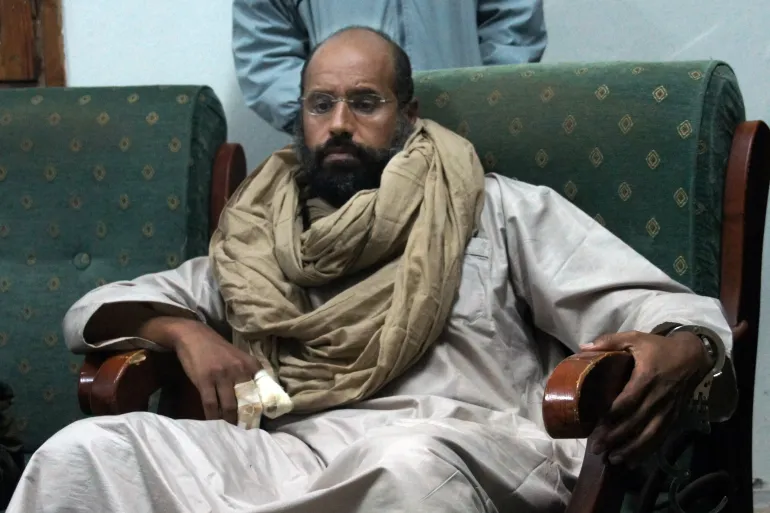
In this Saturday, Nov 19, 2011 file photo, Saif al-Islam is seen after his capture in the custody of revolutionary fighters in Zintan, Libya [AP Photo/Ammar El-Darwish, File]
However, Islamists had done quite well out of the 2011 Libyan revolt, and their uncompromising attitude and revolutionary maximalism tended to make unnecessary enemies. One case in point concerned Saif al-Islam’s refuge in Bani-Walid. Though he was effectively under a comfortable house arrest there, “revolutionary” militias insisted on his handover, but the town’s militias refused. After some of their fighters were killed, the “revolutionary” camp stormed the town in October 2012.
A year of polarization followed when both the revolutionary-cum-Islamist camps and their rivals armed and organized. This presented an opportunity for Khalifa Haftar, an unsavoury and nakedly ambitious general under Qaddafi who had been captured in a 1980s battle in Chad and then coopted by American intelligence to defect. Immediately upon returning to Libya in 2011, Haftar angled for power, and he now collected the Islamists’ rivals and, with considerable support from the new anti-Islamist government in Cairo and their backers in Abu Dhabi, launched a campaign for power. The “revolutionary-Islamist” camp hit back and seized Tripoli as, by 2014, Libya was in full-scale civil war between two rival coalitions: the government coalition, largely comprising revolutionaries in the west and Islamists, in Tripoli and their rivals in the east, backed by Haftar, in Tobruk. Even after a new government, led by Fayiz Sarraj that included members of both camps, was agreed upon in 2016.
Still imprisoned at Bani-Walid, Saif al-Islam began to push himself as an alternative to both camps in the war. He was in the custody of militias from the mountain town of Zintan that, more for factional than ideological reasons, had first sided with Haftar in opposing the Islamists but, after Sarraj’s coalition government took over, increasingly turned against Haftar. Though many bystanders described Saif al-Islam as deluded, he made an undoubted impression among others, particularly among western Libyans in such towns as Zintan and Bani-Walid that were both wary of the “revolutionary-cum-Islamist” camp’s triumphalism and the eastern rebels’ brutality. In a remarkable twist, his own jailer, a commander called Ajami Atiri, soon became one of Saif al-Islam’s most fervent supporters. Haftar certainly saw him as a rival and tried to have him killed; he offered a bounty to a Zintani commander, Ibrahim Madani, who refused.
Firmly backed by Cairo and Abu Dhabi, in 2019, Haftar reneged on his negotiations with Sarraj and made a full-scale assault on Tripoli. He was originally encouraged by the neoconservative American security advisor John Bolton, who urged him to make it quick; however, when the assault dragged on, the Americans withdrew their support. More support came instead from several thousand Russian mercenaries. Russia’s leader, Vladimir Putin, had bitterly opposed the 2011 ouster of the Qaddafis, and – in order to oust its beneficiaries – approved a campaign to attack Tripoli. However, unlike the Haftar-friendly mercenaries, his preference was for Saif al-Islam, son of his old friend Muammar. To Putin’s surprise, however, Saif al-Islam resolutely refused to support the attack. Whether this was out of principle or his rivalry with Haftar, the last remaining Qaddafi scion thus refused the second major foreign regime-change attempt in 2010s Libya.
In this instance, for once, Saif al-Islam’s instincts proved correct; Haftar’s assault on Tripoli failed, partly after a major Turkish campaign rushed to Sarraj’s support in 2020. Frantic negotiations ensued: Sarraj, who had never exerted much power, agreed to step down, and an election was arranged. This was what Saif al-Islam had awaited, and, convinced that he would command strong support as a “third way” to the warring parties, he tried to run. He was originally barred from participation, but this was overturned. However, what emerged was simply a reconfiguring of political elites that satisfied nobody. During the years of muted squabbling and occasional crossfire since, the shadow of the last politically relevant Qaddafi continued to loom large as a potential partner or threat to any of the factions. That shadow was snuffed out suddenly with his assassination at his Zintan home in February 2026.
Conclusion
Saif al-Islam will likely remain a polarizing figure. What many saw as a reformist instinct during his father’s dictatorship will be remembered by others as an overconfident naivete on which the Qaddafis’ enemies pounced: notably, none of the Libyan rivals with whom he had dealt, whether neoliberals or Islamists or others, hesitated to turn on the regime when the opportunity came. Nor did Western and Gulf countries to whom he had opened relations hesitate to topple his father’s regime. Some might see Saif al-Islam’s negotiations with political opposition as evidence of his sincerity; others might see it as a cynical cover for a family autocracy that he abandoned as soon as his father decided to crack down in February 2011. Others might argue that the political “reform” was a bad idea on its own, especially as it involved hobnobbing with such wretches as Blair, the abandonment of a potentially useful nuclear deterrent, and an at least basically functional, if autocratic, socioeconomic setup in favour of courting international oil companies.
What can be safely surmised is that Saif al-Islam, born to privilege and power in a family-based autocracy, was far from the most destructive of Libya’s political actors. He lacked the ruthlessness of other major Qaddafi lieutenants, such as his brother Mutassem and spymaster Koussa; equally, his rejection of the 2019 invasion shows some semblance of principle that the bloodthirsty, inept Haftar, who jumped from American to Russian to Emirati fealty, ignored. More than one Libyan potentate, not simply Haftar, will breathe a sigh of relief at his elimination from the scene.
[Disclaimer: this article reflects the views of the author, and not necessarily those of MuslimMatters; a non-profit organization that welcomes editorials with diverse political perspectives.]
Related:
– Fort Down In A Fortnight: Syrian Insurgents Oust Assad Regime
– The Downfall Of A Tyrant: Bangladesh’s Sheikh Hasina Forced Into Flight After 15-Year Reign